
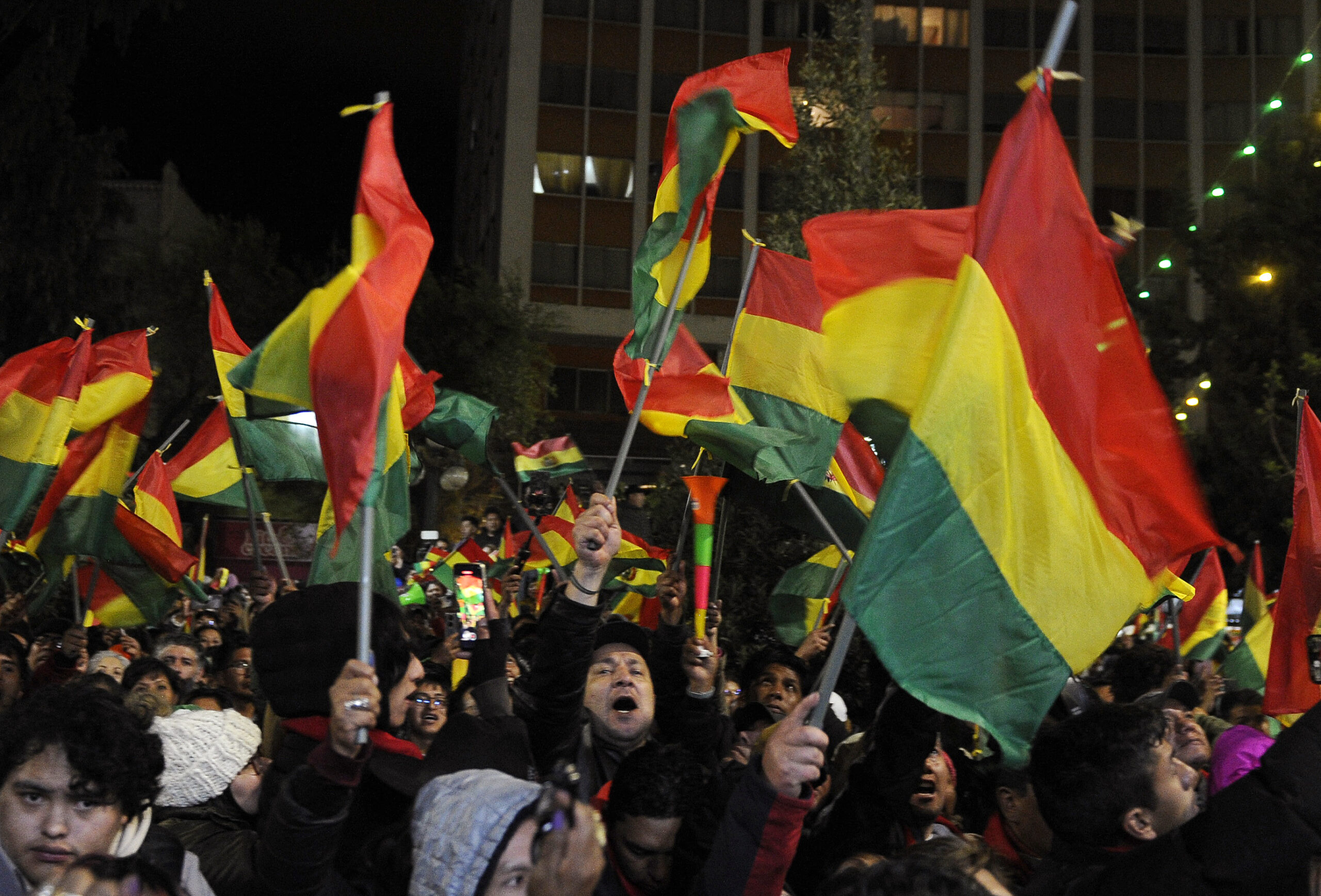
In the lead up to elections, the country’s polarization deepened. But Bolivians showed how a massive civil society movement can organize to restore democracy. It’s a blueprint for nonviolent activists everywhere.
April 2026
There are moments in a country’s history, especially in authoritarian countries, when institutions feel like scenery: visible, formal, but hollow. It is hard to trust them, and it’s even harder to think that they will uphold their duties, that they will do what they ought to do.
Bolivia’s 2025 presidential election was one of those moments.
By the time my country reached 2025, the crises we were facing were layered on top of one another. Inflation hovered around 23 percent. Meat and basic foods became scarce. Fuel shortages were so severe that many of us walked or biked to work. But the crisis was not only economic; it was institutional and democratic. For more than twenty years, the ruling Movimiento al Socialismo (MAS) party had been dominant. By 2025, state institutions had been eroded and politicized, and then further weakened by internal fractures within the ruling party itself. Volatility could be felt everywhere, and holding elections in such a moment didn’t only seem difficult, it felt dangerous.
In the lead up to the vote, the country’s polarization deepened, but what was more alarming was that several authorities aligned with MAS, including former president Evo Morales, openly threatened unrest to halt the elections. This is why more than two-hundred civil society organizations united to create Cuidemos el Voto (Let’s Protect the Vote), an independent, youth-led electoral-mobilization effort that aimed to hold a parallel vote count after recruiting more than sixty-thousand volunteers across the country. Our goal in holding a parallel vote count was to have an independent tally conducted by civil society that would allow results to be verified in real time against official numbers. But, as expected, the ruling party accused monitoring initiatives like ours, that were simply seeking transparency, of plotting fraud. One of our allied monitoring rooms in La Paz, where we received and processed voting-center results, was targeted by leaders of the ruling party the night before the election. These party leaders seized the building, entered the rooms where our teams were working, and demanded the arrest of those involved with our project. The risk that the election might be disrupted, or even suspended, was real.
And yet, the elections were held. The results were independently verified. And Bolivia did not descend into chaos.
What made the difference was not institutional strength. It was organized, nonviolent action.
The Collapse of a Vertical System
To understand the election, one must understand the exhaustion of the MAS’s vertical model of power. Evo Morales’s authoritarianism became the central force that not only eroded democracy in Bolivia but also fractured his own party. After two decades in power, Morales refused to step aside. Legally, he could not have been a candidate in 2019, and after the fraud that same year, he also could not run again. But politically, he refused to relinquish control. Corruption scandals, cases of political abuse, and the documented 2019 electoral fraud did not move him. The party structure he built around personal loyalty remained focused on his political survival, not collective governance. Even within MAS, this dynamic generated growing discomfort: Leaders and former allies publicly questioned his insistence on returning to power, warning that it deepened internal divisions and weakened the party’s ability to govern. What had once been a broad-based political movement increasingly revolved around a single figure.
Several MAS members have told the press that Luis Arce, who served as president from 2020 to 2025, and his vice-president, David Choquehuanca, were handpicked to replace Morales on the 2020 ballot without consulting the party’s grassroots. When Arce took office, he inherited a structure designed not to govern but to extract, as is common in closed, authoritarian systems. Then came the generational fault line: Andrónico Rodríguez’s rise. Initially hailed as Evo’s natural successor, Rodríguez eventually became another casualty of the same authoritarian logic that had dominated the party for years, pushing factions into deeper conflict. While he was popular among younger MAS voters, Morales never allowed Rodríguez’s leadership to emerge separately from his own. As a close ally and mentee, Rodríguez remained a supporter of Morales’s candidacy instead of pursuing his own.
Authoritarian systems often present centralization as efficiency. In truth, centralization without accountability breeds fragility. When everything depends on loyalty, decisionmaking becomes narrow and brittle. When institutions are hollowed out, they cannot absorb shocks. By 2025, Bolivia was a country with elections but without widespread trust. Suspicion filled the vacuum.
But suspicion alone, without proof, is dangerous, especially in such a polarized society. It can destabilize as much as fraud itself.
That is why we decided to build our own parallel system, so that we common citizens could have our own peace of mind by having our own data and our own results.
The Rise of Rodrigo Paz and the Return to the Center
What made this moment even more significant was the outcome itself. Contrary to the polls ahead of the election, Rodrigo Paz won the first round of voting, ahead of the MAS party candidates and traditional opposition leaders. Paz, the son of former Bolivian president and leader of the Movement of Revolutionary Left party Jaime Paz Zamora, was a moderate candidate whose campaign was small and grassroots-based. But Paz’s rise was not accidental. For years, besides winning the municipality elections in the southern region of Tarija, he had quietly built a national territorial presence in rural areas long dominated by MAS. While much of the political class was trapped in personal attacks and mutually assured destruction during the presidential campaign, Paz focused on proximity. He showed up in places others had abandoned. He spoke in a centrist tone that rejected both authoritarian nostalgia and reactionary extremism. In a moment marked by extreme political polarization, he positioned himself outside the shouting match.
I believe that Bolivia is not, at its core, an ideologically extreme country. Historically, after moments of rupture, we return to the center. Paz’s victory reflected that instinct. It was not a triumph of ideological purity, but of exhaustion with confrontation. That a moderate candidate won matters because hybrid regimes often collapse into two poles: authoritarian entrenchment or radical opposition. A centrist victory signaled something different: Citizens were seeking institutional recalibration and stability, not bloody revenge.
This is an important lesson for other democratic oppositions seeking to defend democracy in hybrid or democratically backsliding countries. In fragile systems, moderation is not weakness, it is stabilization. Bolivia’s election did not simply produce a winner, it interrupted a cycle of escalating extremes. And because the result was independently verified, it carried legitimacy beyond party lines.
Building a Movement
Cuidemos el Voto became the largest electoral-monitoring initiative in Bolivia’s history. Volunteers were active in more than 70 percent of electoral precincts. With thousands of volunteers recruited during an economic and fuel crisis, this effort became something beyond what anyone imagined. No single component organization could claim ownership. Cuidemos el Voto was built through alliances: youth activists, environmental groups, the business sector, indigenous leaders, long-standing NGOs, and ordinary citizens who refused to let another election be held in the shadows.
I participated as part of Ríos de Pie (Standing Rivers), an environmental and human-rights movement. Our team held onto three core principles of nonviolence: unity, organization, and discipline. Those principles anchored us when everything else felt overwhelming. They helped us mediate tensions between competing actors, adapt communication under pressure, and stay focused when authoritarian pushback intensified.
We planned for two years, but the institutional and economic crises made everything harder. The electoral body delayed releasing basic data, including precinct-level information, voter records, and voting ballot design, not out of malice, but because they were working with extremely limited resources. However, we needed access to voter rolls or images of voting records to train AI models for the parallel vote-tabulation process, but they were not available. We executed the project with constant delays, yet somehow, we always made things work.
We built a parallel quick count using mobile reporting and AI-assisted comparison of results. Volunteers photographed tally sheets and uploaded them through our app to a centralized system. We recorded more than three-hundred irregularities across both rounds of the election, including discrepancies in tally-sheet data, delays in opening or closing polling stations, restrictions on observer access, and incidents of intimidation. We shared these reports with international observers, and we followed up with domestic bodies to ensure accountability. More importantly, when the electoral branch published its numbers, we could compare table-by-table results and confirm the accuracy. I wouldn’t have believed the results of the first round myself without our independent effort. Having our own data made us an independent counterweight to an institution few trusted, and the voice of calm when misinformation that was circulating contradicted the outcome. Within hours of polls closing, we had independent results. If there had been fraud, we would have known, and we were prepared to prove it.
In a polarized society with a history of electoral manipulation, misinformation spreads quickly. Without independent verification, even accurate results can be contested. Having our own data allowed our civil society alliance to act as a stabilizing force. We did not trust the authorities, but we were capable of verifying them, and in doing so, we lowered the country’s political temperature.
The lesson here is critical: In hybrid regimes, democracy is defended not only by formal institutions, but by parallel civic capacity. When citizens build their own mechanisms of verification (independent counts, documentation systems, oversight networks), they reduce the regime’s monopoly over truth. Gene Sharp, a leading nonviolence theorist and thinker, anticipated this decades ago when he described the construction of “parallel institutions” as one of the most advanced forms of nonviolent intervention. These are not symbolic protests; they are functional replacements for the state. When official structures cannot be trusted, citizens build their own.
Bolivia’s experience also exposes a broader myth: that centralized, authoritarian systems are more efficient and therefore more capable in moments of crisis. Over the years, we have seen the opposite. Authoritarian governance prioritizes allegiance over competence. It suppresses criticism rather than incorporating it. It removes feedback loops that allow institutions to adapt and improve. What appears decisive from afar is often masked chaos.
The same vertical structure that once allowed MAS to dominate the political landscape ultimately hollowed out the state’s capacity to manage economic and electoral crises. When institutions are designed to protect leaders rather than serve citizens, they eventually lose legitimacy. And legitimacy, once lost, cannot be commanded back into existence. It must be rebuilt.
Lessons for Democracy Defenders
Bolivia’s experience offers practical lessons for activists operating in competitive authoritarian contexts, and particularly those facing upcoming elections.
First, you must have your own count. Traditional observation and documentation of irregularities are not sufficient. Without independent data, you cannot calm fears or prove manipulation. Technology now makes parallel counts increasingly feasible even in countries with limited infrastructure, and ideally, local nonviolent movements should have the capacity to recruit enough members to conduct them.
Second, you must recruit at scale. Tens of thousands of volunteers participated in our effort. When ordinary citizens become part of the verification process, they feel ownership over the outcome. I highlight this because the usual “electoral monitoring” efforts are reserved for long-standing NGOs (often foreign ones) that employ electoral experts only. While this work has its value, it is also important to have an electoral control effort that is open to the country’s population. It is their democracy after all, and their participation transforms elections from elite contests into collective responsibilities.
Third, nonviolent discipline is non-negotiable. Our work rested on three principles drawn from nonviolent strategy: unity, organization, and discipline. We worked with actors across ideological lines, including political parties we had never collaborated with before. We protected volunteer data rigorously. We maintained independence even while coordinating with institutional actors such as political parties. Authoritarian systems thrive on provocation and chaos, but internal nonviolent discipline denies them that leverage.
Pluralism in Practice
One of the most important aspects of this effort was its pluralism. Cuidemos el Voto extended an open invitation to all participating parties to be part of this effort (including MAS, which didn’t respond). We made it clear that this project was for all Bolivians, regardless of whom they supported politically. We refused to stigmatize areas where the MAS vote was predominant; instead, as the spokesperson for Cuidemos el Voto, I made a conscious effort to invite them to participate in every interview and public statement I made. We highlighted that their vote mattered, and we needed as many people as possible to participate for this effort to be successful.
This approach was confusing to many, but we were focused on our goal. To protect electoral integrity, we had to cover as much territory as possible. That required collaborating with organizations whose political views we did not share, some even adversarial. The civil society groups leading this initiative had never worked with political parties before, yet we did so successfully because we respected each other’s roles. This project would never have been successful if we built it around a single party or ideology.
This is often overlooked. In polarized societies, civic actors may be tempted to work only within comfortable circles, or with those ideologically aligned with them. But authoritarian systems deliberately fragment society. Broad alliances are therefore not optional; they are strategic necessities. Pluralism expands coverage, it builds legitimacy, and it prevents civic oversight from being dismissed as partisan.
Authoritarian Fragility
Bolivia’s election was not inevitable. It was the product of preparation under pressure. It required thousands of people willing to dedicate time, resources, and courage during an economic crisis and amid political intimidation. For activists facing elections in their own constrained political systems, the message is not that success is guaranteed. It is that strategic, long-term preparation for nonviolent action is what changes outcomes.
Build your data before you need it. Recruit more people than you think possible. Train them not only technically, but strategically. Protect your independence fiercely. And cultivate alliances broader than ideology, age, or race.
Bolivia did not prove that authoritarianism disappears easily. It proved something more important: Authoritarian systems are more fragile than they appear, and organized citizens can bend moments of instability toward democratic accountability. When citizens stand together in truth and nonviolence, even the most entrenched regimes must yield.
Jhanisse Vaca Daza is an activism outreach specialist and director of the Freedom Fellowship program at the Human Rights Foundation and cofounder of the Bolivian nonviolent citizen movement Ríos de Pie (Spanish for Standing Rivers).
Copyright © 2026 National Endowment for Democracy
Image credit: JORGE BERNAL/AFP via Getty Images
|
FURTHER READING |
||
Bolivia’s Silent Destruction |
When Does Competitive Authoritarianism Take Root?V. Ximena Velasco Guachalla, Calla Hummel, Sam Handlin, and Amy Erica Smith It is not easy to build a stable hybrid regime. Elected autocrats may try, but comparing Bolivia, Brazil, and Venezuela shows how difficult it is to succeed. |
Bolivia’s Citizen RevoltEvo Morales lost the presidency in November 2019 due not to a coup, but to a citizen revolt. After his controversial bid for a fourth consecutive term, the opposition mobilized against him and his regime disintegrated. |