
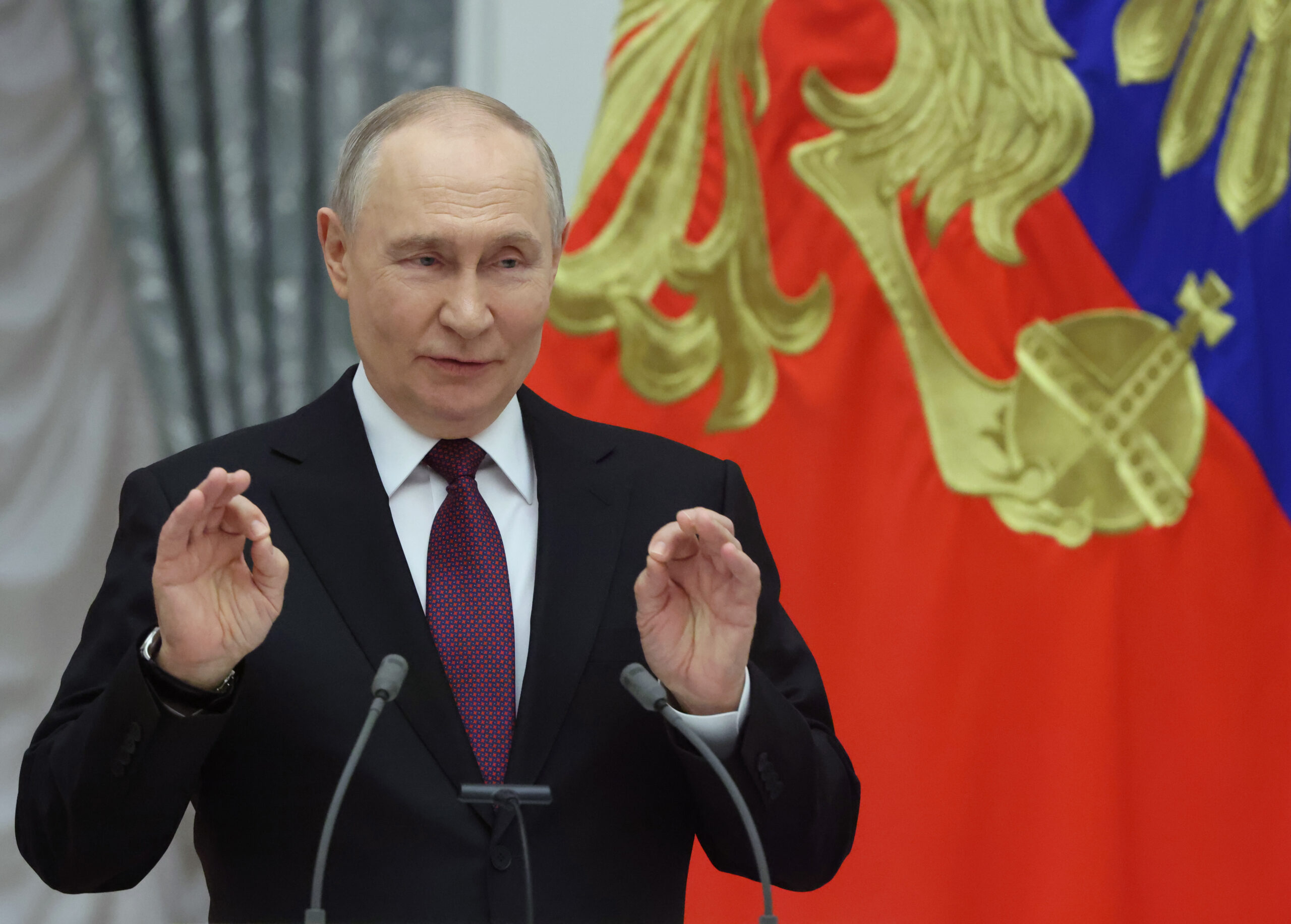
Who does Putin trust? Russia is governed by an array of “ruling dynasties,” where kinship and personal ties matter over all else. Where corruption goes unchecked, nepotism rules.
March 2026
Do Russians trust President Vladimir Putin and his inner circle—and, conversely, do Putin and his top officials trust the ordinary citizens of their country? This double question has long haunted students of Russia. Today, as the Russian state wages a war of aggression against Ukraine, it not only remains puzzling but is also more painful than ever. Do most Russians trust what Putin says to the point where they are willing to kill and die for him? We cannot give a confident answer: All election results from Russia are subject to doubt, while standard social-survey research is irrelevant for many reasons. I would like to propose a different way of approaching the question.
By what principle does a boss select subordinates, and how do those subordinates, in turn, choose their own teams? Trust. “Trusted persons” is a legal term describing those whom a leader—say, a president—can rely on. Accordingly, by studying the composition of the Russian state establishment (the government, governors, leadership of the security agencies and courts, members of both chambers of parliament, and other classes of officials), one can gain an idea of whom President Putin trusts. This hypothesis formed the basis of an investigation, lasting nearly two years, that the independent investigative reporters of Proekt conducted under my editorship.
For this investigation, we thoroughly studied the biographies and family ties of 1,329 top-level Russian officials—from the president and deputies representing all 89 regions of the country in the State Duma to directors of the largest state museums, such as the Hermitage in Saint Petersburg. (The detailed methodology of our research can be found here.) We sought to understand the likely grounds on which an official had obtained his or her post: Was it for any reason beyond 100 percent loyalty to the supreme ruler? For example, did a family tie to some high-ranking person advance someone’s career? Was there an affiliation with one or more of the military or security services? We also closely examined what officials’ relatives do: Do they work in public administration or in businesses connected to the state?
Such research sounds simple but is not always easy to accomplish. In Russia, data on officials—even the most senior and visible ones—is often classified. This is not limited to the security services. The Presidential Administration, a purely civilian body, refuses to disclose the identities of most of its managers except for a few top figures. To identify these people, we conducted a full-scale journalistic investigation, studying, for instance, internal Kremlin phone directories. Identifying family ties was even more difficult—the state does everything it can to conceal personal information about “civil servants.” Can you find official information about three members of President Putin’s family working in the Russian government? Of course not. But you will find this important fact if you read this essay to the end.
As often happens, when things are deliberately hidden, the risk of leaks increases. This is true of Putin’s Russia, and this is precisely what ensured the success of our investigation. Over the years, Proekt has assembled a unique collection of hundreds of data leaks from Russian official sources. Leaked information includes the client list of Aeroflot, the state airline; a database that the Federal Security Service (FSB) keeps of people who have crossed Russia’s borders; the names of citizens who ordered covid-19 test results delivered to their homes; and more. We meticulously archived, aggregated, cross-checked, and supplemented all these datasets, ultimately creating a kind of “super leak”—a database that made possible our original “Fathers and Grandfathers” study (first published by Proekt on 10–15 November 2025).
This “super-leak” helped us to identify officials’ relatives. If two people regularly fly together to resort destinations, order food delivered to the same address, and park each other’s cars using a Moscow parking app, we assume they are a couple. Two people, not necessarily sharing the same last name, were registered at the same address many years ago—this is sufficient grounds to assume they are siblings.
From Open Recruitment to Dynastic Rule
High-quality studies of Putin’s nomenklatura have been rare, to put it mildly. In 2003, a research group led by Olga Kryshtanovskaya from the Russian Academy of Sciences studied the biographies of about 3,500 top state officials of what could be called the “first Putin cohort.” Naturally, that study could not use the methods available to investigative journalists today. In particular, Kryshtanovskaya and her colleagues did not examine family ties among nomenklatura members.
Even so, the 2003 study caused a great deal of controversy. Among other things, Kryshtanovskaya identified a key trend that would still be relevant years later: Putin was flooding the top ranks of state management with former members of the security services. In the elite of 2003, at least 25.1 percent had experience working in law enforcement or security agencies. A similarly large share of officials (21.3 percent) advanced thanks to having been Putin’s colleagues in work, service, or life in Leningrad (and later, after the city had changed back to its old name, Saint Petersburg). To a significant extent, these two groups overlapped: Many of Putin’s fellows had served in the security services just as had the former KGB lieutenant-colonel.
Considering these figures from another angle, we can say that around half of those studied had no personal connection to Putin, either as onetime professional colleagues or people who shared hometown connections with him. Who were these people without ties to Putin? Kryshtanovskaya’s study provides no definitive answer, but does note certain details. Eleven percent of top officials were appointees from big businesses whom Putin inherited as holdovers from the 1990s. Another significant share consisted of regional politicians, also not personally connected to Putin. Finally, a third large group comprised new appointees promoted from below. The best-known sources of these last officials were a pair of youth organizations, Nashi and Walking Together, which grew under state patronage during Putin’s first two presidential terms.
Grotesque as they were—their first requirement was unswerving devotion to Putin—these organizations brought large numbers of “people from the masses” into the Russian leadership. You had to show love for Putin to rise through Nashi’s ranks, but it remains true that many who did rise made major careers without having family money or connections to back them. Former Nashi leader and State Duma deputy Robert Schlegel comes from a single-parent family of ethnic Germans; he was born in Turkmenistan and later moved with his mother to a small town near Moscow. He described the beginning of his career in the mid-2000s as follows:
Putin needed active, young, and loyal people to change the system. And I liked that idea. You have to understand the environment I came from: a migrant from a village. Yes, at that time I sympathized with Putin.
According to our calculations, by the late 2000s at least thirteen former Nashi members had embarked on major managerial careers. Among them were cabinet ministers, State Duma deputies, and other first-rank state officials. Of course, almost all of them turned out to be corrupt hypocrites. (Schlegel, who left government in 2016, moved to Germany, and became a Kremlin critic, is an exception.) Yet it remains the case that the early Putin regime did allow ordinary, random people into its ranks. The only condition was trust in Putin. If you trusted Putin, he trusted you.
Since then, however, something has changed and it is very important.
As of 1 January 2025, slightly more than three-quarters of top Russian officials had at least one relative also who worked in public administration or for a business that drew money from the state budget. In other words, three of every four top officials—cabinet ministers, Kremlin bigwigs, FSB officers, Defense Ministry or other security-agency heavyweights, judges, State Duma deputies, and members of the Federation Council had either placed their relatives in the state apparatus or had themselves been placed there by high-ranking kin. This is an astonishing figure for which, unfortunately, there is no point of comparison. No previous studies have examined this side of Russian official life.
In some state bodies, the “Nepotism Index,” as we called it, was almost off the charts. It turned out that 86 percent of Federation Council members (the most “nepotistic” body in Russia) had relatives in the state apparatus. So did:
– 84 percent of State Duma deputies;
– 74 percent of Presidential Administration employees;
– 74 percent of security officers and judges;
– 69 percent of regional governors;
– 61 percent of those holding ministerial rank.
In the vast bulk of cases, each top official has not just one relative holding a government position. The average number of relatives in our sample per official is four. Typically, these are parents, siblings, and children; not infrequently—nieces, nephews, uncles, aunts, and even more distant relatives.
The explanation for this is, in a sense, quite “reasonable.” Until 2023, Russia had a very weak—but still formally existing—legal requirement for officials to publicly declare their income and property; this requirement also applied to their immediate family members. Therefore, when wishing to conceal assets, officials often resorted to more distant relatives—for example, registering companies that received state contracts in the names of an uncle, a nephew, or even a former spouse. (There are hundreds of such examples; I will mention just one here: Pyotr Biryukov, Moscow’s deputy mayor and a behemoth of Russian corruption, registered companies receiving multimillion-ruble city contracts in the names of distant relatives and their acquaintances.)
Distant relatives with last names that differ from the relevant official’s surname are harder to link to that official. For example, there is Arsen Kanokov, the longtime head of Kabardino-Balkaria (a republic in the North Caucasus with close to a million residents) and now a member of the Federation Council. He is a billionaire. He worked closely for years with his relative Vladimir Zhamborov, but both hid the family tie to avoid conflict-of-interest accusations. Even more telling is the example of Vladimir Putin himself: At this very moment, one of his nieces and two of his sons-in-law work under his authority, yet none has ever acknowledged the family relationship.
Given the all-pervasive nature of nepotism in Putin’s Russia, it is hardly surprising that the country is now replete with literal “ruling dynasties”—state officials’ families in which at least ten relatives are simultaneously employed in “public service” or state-affiliated businesses.
Here is a list of Russia’s largest dynasties:
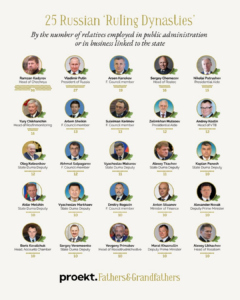
This list leads to several important observations.
First, it broadly corresponds to the list of the most influential names in Russian politics. Ramzan Kadyrov of Chechnya is the bloodiest and richest regional leader in Russia, as well as the one with the fullest ties to the security apparat. The number of his relatives in positions of power exceeds even Putin’s family.
Sergei Chemezov, an ex-KGB officer, is a longtime Putin friend who now runs the entire military-industrial complex. The Kovalchuk family, which controls a sizeable share of the financial and media sectors, is also closely associated with the president. And so it goes. Putin himself has more relatives on the public payroll than any Russian ruler since Czar Nicholas II.
Yuri Kovalchuk and Nikolai Patrushev have long been two of Putin’s closest advisors. The former counsels him on political and economic matters, the latter on security. What are their offspring doing? The answer is striking: They are kept at an equal distance from the throne, preventing any single “ruling family” from becoming more powerful than the other. It goes as far as a kind of “calendar balance.” Patrushev’s son Dmitry, age 48, works as a deputy prime minister and is named by some experts as a possible “Putin successor.” But another 48-year-old, Kovalchuk’s son Boris, was fast-tracked into an equivalent position—he became head of the Accounts Chamber, meaning that he has the authority to audit the government in which the younger Patrushev serves. Is this another “contest between possible successors” like the one that occurred during Putin’s second presidential term between deputy premiers Sergei Ivanov and Dmitry Medvedev? Or does this situation exist simply because the Putin system—in which kinship and personal ties matter more than any professional competence—cannot and will not function any other way?
The problem of nepotism has clearly spread far beyond the Caucasus, where “advancement through kinship or friendship” has long been the rule. Among the ruling families listed, only five people have made or are currently making political careers in the Caucasus. In this sense, Putin’s Russia has become Kadyrov’s Chechnya.
I want to warn readers against an incorrect comparison. The “ruling family” in Putin’s Russia is not the same as, say, the Kennedy or Bush clans in the United States, or any similar family in countries with traditions of political dynasties. There are three crucial differences. First, most denizens of Russia’s “nepo officialdom” received their high state posts without building any public political career. They were hired, most likely thanks solely to patronage from above. Second, in the great majority of cases, Putin’s relatives and those of the broader nomenklatura hide their kinship, which speaks volumes. Finally, in a very large number of cases, family ties are accompanied by proven corruption or other criminal connections—journalists or law-enforcement agencies have exposed crimes involving the relatives of Putin, Chemezov, Kadyrov, and others, but all authorities in any position to do something about such findings have resolutely ignored them. The exposures have had zero impact on the standing of these families.
Why Family Matters
Why have Putin and his lieutenants created large political clans? Has it been for reasons of money and ambition? Surely those are factors, but the main reason may be that they see this as a genuine method of governing a country whose democratic institutions (above all elections and free media) they long ago put out of operation.
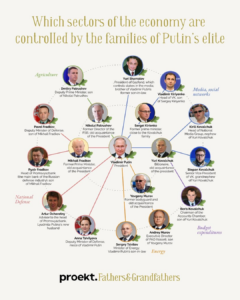
Here we approach the answer to the main question posed at the beginning of this essay —about trust. Speaking with a person from Ramzan Kadyrov’s inner circle, we asked why Kadyrov had appointed as many as ninety-six of his relatives to various state jobs. The answer was simple. “I have a small firm,” our interlocutor told us. “I appointed my wife as chief accountant because I do not want financial matters, taxes, and the like to become known to anyone outside the family. And for Ramzan, this is even more so.”
This answer applies to the entire country. Kadyrov name relatives to all positions because, he believes, only they can be trusted with his secrets, his life, his tomorrow. Putin does the same because he suspects (probably rightly) that a person not bound to him by kinship—even a supporter—will, in an extreme situation, turn away, stop supporting him, perhaps even actively betray him. Of course, “people from the masses” remain within the system, technocrats who rise thanks to talent or sycophancy. Yet in recent years, the situation has changed. There are fewer technocrats, and they cannot compete with rodnya (relatives).
To return to Putin’s family, it has (or had, as of the end of 2025) three members holding high-ranking government posts without any acknowledgement—from them or the president—of any relationship.
– Anna Tsivilyova (née Putina), age 53, is deputy minister of defense and state secretary of the ministry. She is responsible for providing the military with social support, salaries, war-related payments, veteran-rehabilitation programs, and so on. These are all vital tasks in a country at war. She is Putin’s second cousin, the daughter of the president’s older cousin Yevgeny Putin (1933–2024) from the city of Ivanovo a few hours northeast of Moscow.
– Sergei Tsivilyov, age 64, is Anna Tsivilyova’s husband and thus Vladimir Putin’s in-law. As energy minister, Tsivilyov oversees the Russian economy’s single most crucial sector, whose revenues depend on the extraction and export of natural resources.
– Viktor Fisenko, age 47, first deputy minister of health, is married to another Putin cousin, also from Ivanovo. Her name is Elena Zhidkova, and her status in the state is comparable to that of a minister. Elena oversees medical services within one of the largest state corporations, Russian Railways.
Other relatives of the president—twenty-seven people altogether, by our count—do not work in the government but occupy positions fully comparable to ministerial ones. They include, to cite a few, a deputy head of Gazprom who is Putin’s nephew, the head of the largest energy company RusHydro (also a nephew), and a co-owner of the country’s largest insurance company (again, a nephew).
Why did Putin appoint all these people to high government posts?
Certainly not to provide them with money. All the individuals mentioned were endowed with wealth much earlier (for example, the Tsivilyov family received, essentially as a gift many years ago, one of the country’s largest coal companies, Kolmar). The answer seems obvious to me: Putin promotes relatives because he does not trust others aside from, perhaps, a few bodyguards and certain FSB appointees. The number of such people has grown since the 2003 study. People whose job comes with a uniform (whether military, intelligence, or law enforcement) make up at least 29 percent of the Russian establishment—almost every third official. And every one of them has relatives of their own.
Roman Badanin is founder and editor-in-chief of Proekt. a Russian-language media outlet specializing in investigative journalism. He has worked as an editor for Forbes Russia, TV Rain, and the RBK news agency.
Proekt’s original investigation was co-authored by Katya Arenina, Boris Dubakh, Alexey Korostelev, Roman Kovalenko, Mikhail Maglov, Nadezhda Makeeva, Leonid Pimenov, Ekaterina Reznikova, Roman Romanovsky, Mikhail Rubin, Alexander Savelyev, Vitaly Soldatskikh, Alexander Ternavsky, Elizaveta Tsybulina, and Andrey Zatirko.
Copyright © 2026 National Endowment for Democracy
Image credit: Contributor/Getty Images
|
FURTHER READING |
||
Two Summits, Two Wests |
Why Russia’s Youth Don’t Support Putin’s WarThe Kremlin works hard to indoctrinate Russia’s youth to support Putin’s war in Ukraine. But a strong percentage support an immediate ceasefire and don’t think it’s a cause worth dying for. |
David vs. Goliath: Defeating Russian AutocracyUkraine versus Russia is a modern David versus Goliath conflict that matters not only for the future of Ukraine, but for that of democracy itself. |