
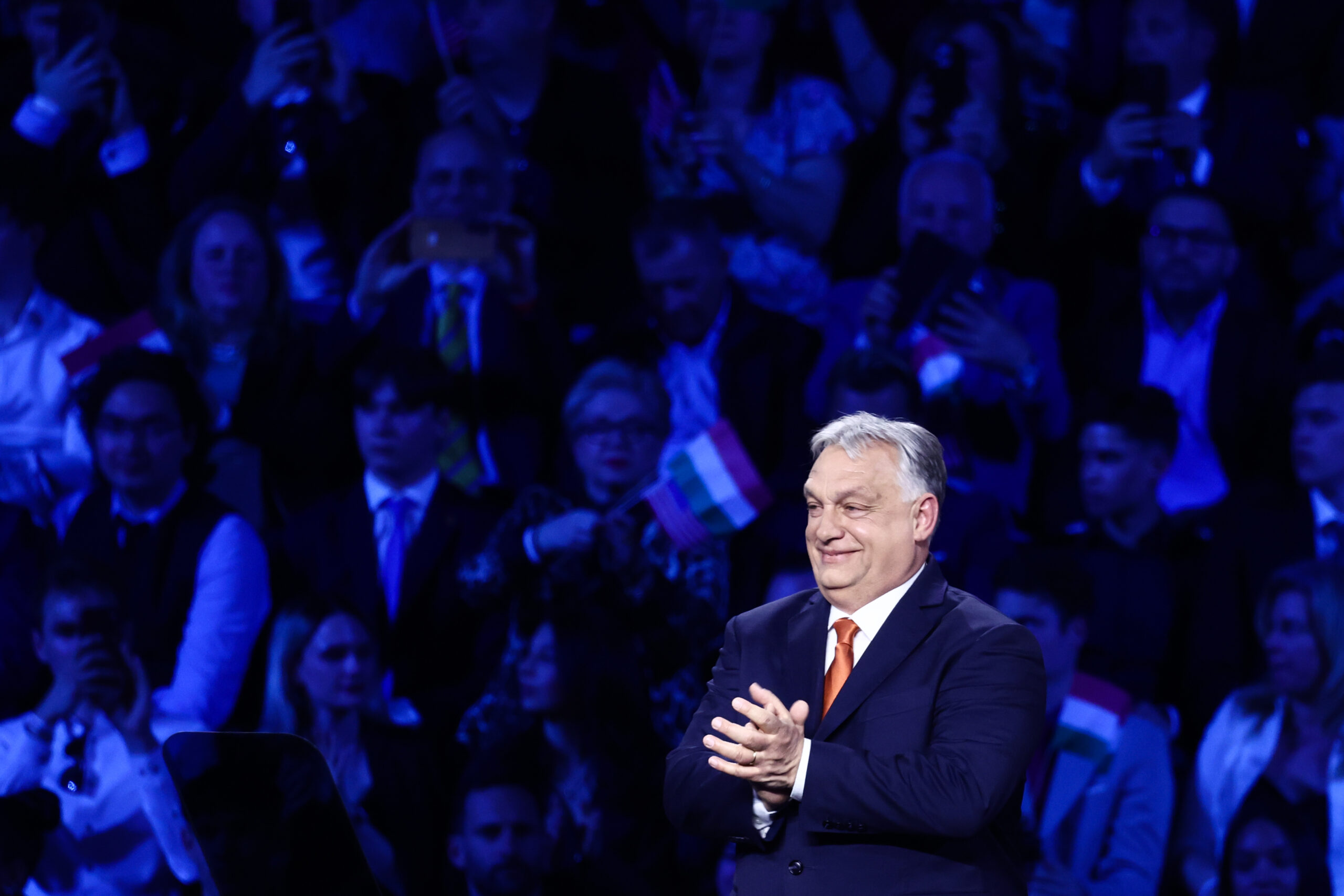
As Hungary approaches a crucial election, Viktor Orbán finds himself vulnerable. These are the three most likely post-election scenarios and how civil society must respond.
By Stefania Kapronczay and Breza Race Maksimovic
April 2026
Viktor Orbán’s fourth consecutive term as Hungary’s prime minister is nearing its end. The country will hold a general election on April 12, and Orbán is facing the biggest challenge of his sixteen-year tenure. Under his leadership, Hungary has become, in the eyes of many, a leading example of modern authoritarianism. His government’s ability to concentrate and maintain power has become a reference point for similarly inclined politicians around the world.
Orbán’s party, Fidesz, has transformed the country’s institutions and established control over nearly all spheres of life. Through a combination of legal instruments and narrative control, the party has also extended its influence over the minds and imaginations of the people. This system is adaptive. Its resilience lies not only in formal institutional capture but in its ability to shape incentives, expectations, and behavior across society, blurring the boundary between compliance and consent.
The current election campaign illustrates this system perfectly: The electoral rules favor Fidesz to such an extent that the main opposition party, Tisza, needs to win by a 4–5 percent margin to secure a parliamentary majority. Moreover, the National Election Commission, State Audit Office, and Media Council — which together form the backbone of electoral manipulation in Hungary — routinely rule in favor of Fidesz, enforce election rules unevenly, and fail to investigate reported abuses.
Fidesz has long blurred the line between party and state, including the use of public resources to amplify its campaign messages. But this year, the party has gone even further, using state-linked networks to finance large-scale campaign events and deploy coordinated digital strategies similar to Russian-style influence operations, including creating fake social-media profiles to spread false information and circumvent the ban on political ads appearing on social media. Flat-out lies are now part of Fidesz’s campaign playbook: Progovernment media circulated a fully fabricated, AI-generated document, claiming it was Tisza’s official program despite the party’s clear denial. The fake document included unpopular proposals such as tax hikes and a tax on pensions. In Hungary’s highly centralized and constrained media environment, AI is particularly problematic, as it enables the rapid production and dissemination of disinformation while severely limiting any possibility of effective correction.
These dynamics highlight an often-missed but critical point: Elections in such systems are contests over not just votes but reality itself — over what citizens believe is true, possible, and worth risking engagement for.
Is Hungary at a Turning Point?
For all Fidesz’s power, resources, and electoral machinations, Hungary may soon be regarded as a leading example of how a modern authoritarian regime crumbles. Corruption scandals, a struggling economy, and government mismanagement have put the party on its heels for the first time in years. Notably, it was a devastating 2024 scandal — the presidential pardon of a person implicated in a child sex-abuse case — that gave rise to a new political party: Tisza, led by Fidesz dissident Péter Magyar. Since that autumn, Tisza’s popularity ratings have consistently surpassed those of Fidesz, according to independent polling. Tisza has been calling out the failures of the Hungarian state and exposing abuses of power as the underlying cause.
In recent months, a series of scandals has exposed growing cracks in Fidesz’s hold on power. These include failures of the child-protection system, prioritizing battery-plant investments over citizens’ health, and, most recently, the alleged use of state secret services to compromise Tisza. Growing numbers of citizens as well as current and former state employees, including police officers and soldiers, are beginning to call for political change. Many are participating in Tisza events and even campaigning for the opposition, and investigative journalists report that sources are becoming more open to disclosing information. This is the texture of a system under strain — not collapsing, but coming apart at the seams.
This suggests that the government’s narrative dominance and its capacity to deter dissent are weakening. Even prominent public institutions dependent on the state have begun to speak out — for example, when the police publicly contradicted Fidesz MP János Lázár’s assertion that his critics had criminal records, and when a court openly challenged a government decree on the “solidarity tax.” These are not isolated incidents but early signals of shifting loyalties within the pillars of support that sustain the regime. Such shifts rarely occur because of elections alone. They are the cumulative result of pressure, exposure, and changing perceptions of risk.
After the Election: Three Likely Scenarios
1) A Tisza victory without a constitutional majority. If Tisza secures a conclusive mandate, the party will face a constitutional system built by Fidesz with Fidesz loyalists holding crucial state appointments, along with numerous smaller “landmines” designed to prevent a Tisza government from succeeding. At the same time, a gradual realignment within the state apparatus may begin, as civil servants, judges, and prosecutors act with greater autonomy, potentially making decisions more consistently in the public interest.
Tisza’s lack of governing experience and the inertia of the administrative system will likely pose significant challenges, including obstruction by Fidesz MPs, holdover appointees, and civil servants as well as slow institutional adaptation. The emergence of capable leaders beyond Péter Magyar will be critical. Fidesz’s internal discipline may weaken after defeat, creating space for more fluid parliamentary dynamics and occasional cross-party cooperation. But the party will no doubt continue its polarizing tactics to regain power.
Governance will likely focus on tangible issues affecting everyday life: raising wages in public services, passing anticorruption measures, and curbing state propaganda. Broader institutional change, however, will remain constrained because of the lack of a constitutional majority. For citizens, this scenario is mixed. While many may experience a renewed sense of agency, high expectations also carry a significant risk of disappointment if change proves too slow or too small.
2) Fidesz retains power without a supermajority. If Fidesz wins but loses its two-thirds majority, its grip on power will weaken. The party will no longer be able to rely on permanent emergency rule and decree-based governance. Moreover, alternative centers of power could emerge and undermine Orbán’s ability to shape public opinion and direct political action.
Tisza will likely adopt a more confrontational and publicly engaged opposition role, combining parliamentary tools with grassroots mobilization. Limited institutional openings may emerge, even as pressures persist. For citizens, however, the picture remains bleak, with disillusionment, withdrawal, and emigration as likely outcomes.
This scenario presents a strategic dilemma. With democratic space remaining constrained but not closed, prodemocracy movements risk not just repression but also demobilization — the gradual erosion of belief that engagement matters. In such conditions, movements must shift from reactive protest to strategic persistence: building local bases, sustaining networks, and identifying small but meaningful wins that rebuild a sense of agency among citizens who have been told for years that nothing can change.
3) A contested or unclear outcome. In the case of a narrow and contested outcome, instability and polarization are likely to intensify. Both sides may dispute the results, mobilize supporters, and sustain prolonged protest activity, potentially accompanied by sporadic violence. Trust in institutions will continue to erode as legal uncertainty about the real winners and political conflict delay consolidation of power.
This is the most volatile scenario, and the one where discipline matters most. Without strategic clarity and nonviolent discipline, civic mobilization risks being coopted, discredited, or escalated into cycles that ultimately benefit hardliners.
What Civil Society Must Do
Our hope is that Hungary becomes a leading example of how civil society contributes not only to dismantling authoritarian power but to building a democratic system that citizens can genuinely trust and embrace. That will require the systemic change, encompassing both democracy and equality, that earlier political transitions failed to realize. For this, civil society must prepare — not for election day, but for the day after.
A key lesson from the past sixteen years is that disengagement from politics, whether forced or voluntary, comes at a cost. Rebuilding democratic life requires reentering the political space deliberately and strategically. Fidesz’s dominance narrowed advocacy channels and discouraged engagement with politicians and parties. This distance of civil society from partisan politics meant withdrawing, to a certain extent voluntarily, from the work of representing citizens’ voices. But meaningful change will not occur without civil society’s active engagement.
Reengagement does not mean aligning with parties, but reclaiming influence. Civil society must act as a bridge between citizens and institutions, between demands and policy, between pressure and accountability. The task ahead has three parts: imagining change and formulating concrete proposals; relearning the tools of advocacy; and developing strategies suited to the new openings that may emerge. Crucially, these are not technical tasks, they are political ones. They require organization, coordination, and a willingness to operate in contested space.
The most important lesson we have learned from the last sixteen years — as well as through our own activism and from democratic movements around the world — is that real change does not happen without the meaningful involvement of citizens. Even modern autocrats care about public opinion and citizen mobilization. Yet this is where many transitions fail: Participation drops after elections, just when it is needed most. Without continued engagement, accountability weakens and old patterns reassert themselves. Civil society must sustain civic activity across all scenarios.
Another key lesson from the Orbán era is the importance of alliances. While building and maintaining them can be difficult and requires compromise, they strengthen not only defense against repression but also the effectiveness of advocacy. Fragmentation is a deliberate strategy of repressive governments. Isolated organizations are easier to defund, delegitimize, and dismantle. Connected ones are not. Building alliances is not just defensive — it is foundational. Durable change requires coalitions that extend beyond traditional civil society actors to include professionals, local communities, and even segments of the state.
What the International Community Should Do
The international response to Hungary’s elections will matter, but not in the way it is often assumed. Outside organizations and foreign governments tend to focus on election observation, statements of concern, or engagement with political elites. While important, these are insufficient in systems where formal processes are only part of the picture.
The priority should shift toward supporting the long-term capacity of civil society and independent actors, including independent media outlets and educational institutions. This means providing sustained, flexible funding rather than short-term project cycles, protecting and amplifying independent media, and investing in civic infrastructure and grassroots organizing.
International organizations, nongovernmental organizations, and foreign governments must also resist the temptation to “pick winners.” Overpersonalization of support weakens broader democratic ecosystems and creates dependencies that are easily exploited. Most important, external engagement should align with local strategies, not substitute for them. Change is driven internally. International support is effective only when it reinforces rather than directs that process.
Hungary stands at a familiar but fragile moment, one that many societies have faced before, and that many have struggled to navigate well. The history of democratic transitions is full of openings that were not seized. Elections may open doors, but they do not walk societies through them. What happens the day after will depend less on who wins, and more on whether citizens, civil society, and institutions are prepared to act. The real test is not electoral change, but whether Hungarian society can sustain the pressure, participation, and imagination required to turn political openings into democratic transformation.
Stefania Kapronczay is a human-rights expert and strategist. Breza Race Maksimovic is CANVAS program director.
Copyright © 2026 National Endowment for Democracy
Image credit: Jakub Porzycki/NurPhoto via Getty Images
|
FURTHER READING |
||

Why Viktor Orbán Is in Trouble
|

The Viktor Orbán Show |
How Viktor Orbán WinsThe case of Hungary shows how autocrats can rig elections legally, using legislative majorities to change the law and neutralize the opposition at every turn, no matter what strategy they adopt. |