
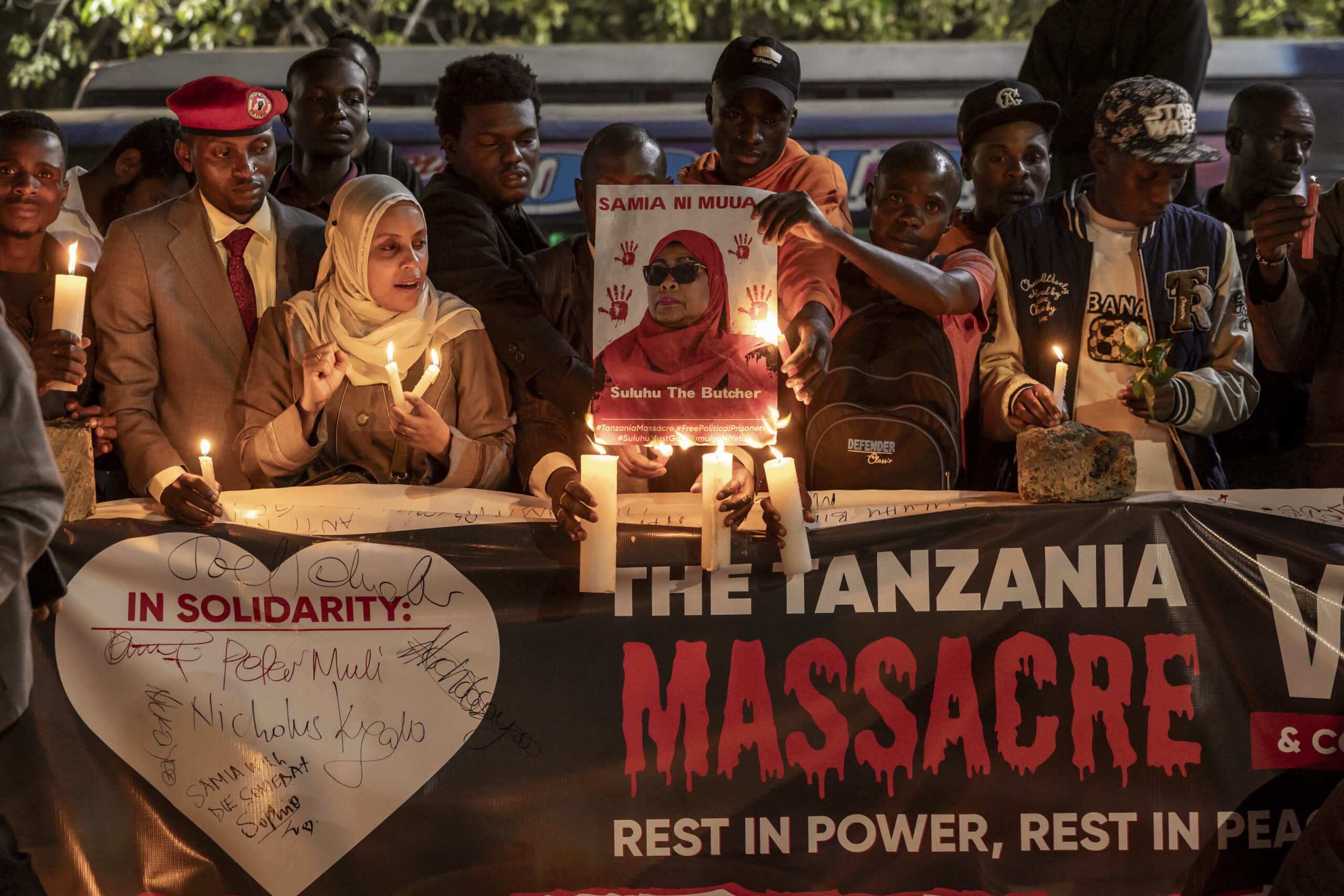
Tanzania’s October election was a sham. When people rose up in protest, the regime responded with a brutal crackdown. That reign of terror marks a turning point for the country, and there is no going back.
By Dan Paget
December 2025
Tanzanians went to the polls on 29 October 2025 to cast ballots in a lopsided contest with only one possible outcome — the reelection of President Samia Suluhu Hassan. In the immediate wake of the sham vote came unprecedented protests and an equally unprecedented and violent six-day crackdown, with an internet blackout ensuring that only scraps of reporting and footage could trickle out. Weeks later, many of the details remained unknown, but the overall picture was clear: The brief reign of terror perpetrated by security services and overseen by President Hassan resulted in hundreds, perhaps thousands, of people dying, their bodies presumably incinerated or dumped in mass graves; hundreds of activists charged with treason; and still more detained by the police. Not since the days of German colonialism had mainland Tanzania experienced brutality on this scale. When another wave of protests was planned for Independence Day, December 9, the regime launched a sweeping security operation to stymy them in advance. These events, and their aftermath, have fundamentally changed the dynamics of political struggle in Tanzania almost overnight.
Before this election, two things had long been true of Tanzanian national politics: First, Chama Cha Mapinduzi (CCM), in power in one form or another since national independence in 1961, could sustain the claim that it ruled with popular legitimacy. Whether fact or fiction, CCM had developed the means to perform its popularity — by having a presence in every neighborhood, holding mammoth rallies, integrating party and state, and leveraging its legacy as the party of liberation — while practicing autocracy, even as opposition was growing. Second, there was no sustained protest movement in the country. An antiauthoritarian movement of opposition parties, activists, and their numerous allies had been in formation for years, but it never succeeded in mobilizing mass protests. Whether for fear of the regime’s response, respect for the norms of peace and civility, or the absence of a culture of popular demonstration, citizens stayed at home, and protest in Tanzania remained the purview of a hyperpartisan few.
Thus the regime was able to assert its popular legitimacy even as it deployed autocratic measures to stifle opposition and dissent, secure in the belief that its opponents could not muster regime-challenging protests. But in the wake of the protests and the crackdown, CCM can no longer mask its authoritarian rule with the cloak of popular participation, order, and civility. Not only is the regime’s façade of popularity and benevolence crumbling, but so is another key element of its rule — the stable, low-protest status quo. Amid the postelection demonstrations, the antiauthoritarian movement began to take on a new, protest-oriented form. The carnage of the crackdown was meant to strangle it at birth. But its potential to reassemble will loom over Tanzanian politics.
This bodes ill for CCM and its leader, President Hassan, as well as the CCM-packed National Assembly. The president, who had come to power in 2021 upon the death of President John Pombe Magufuli and was now running for her first full term, claims to have won reelection with almost 98 percent of the vote in a contest that the regime contends had record-breaking turnout. In the short-term, Tanzanian citizens have reason to fear that the regime will employ increasingly destructive means to prolong its 64-year tenure. At the same time, however, this is a moment of revival for Tanzania’s people-power movement despite everything that CCM has thrown at it. Moreover, this is a true shift from just weeks earlier, when Hassan appeared to be on track to reconsolidate CCM’s status as a legitimized, if autocratic, hegemon. These events, and their aftermath, bring into view a different set of possible futures for this once-peaceful, if long-autocratic, nation. Today it appears that the regime’s crackdown had at least one unintended casualty: the social foundations of its rule.
The Terror
CCM has a long history of using authoritarian means to tilt the electoral playing field in its favor, from suspending regime-critical newspapers to banning opposition rallies. Yet in 2025, under Hassan, the CCM government crossed autocratic thresholds it had not transgressed in decades. Perhaps most troubling, it kept both of Hassan’s principal opponents off the presidential ballot. Tundu Lissu, the leader of the opposition party Chadema, spent the election campaign in court being tried for treason, while Luhagha Mpina, candidate of ACT-Wazalendo, was disqualified on technicalities. These brazen acts of electoral manipulation were part of a wider program of repression that had been gathering steam for some time, including an escalation in political abductions and killings that intensified in 2024 as well as the banning of the social-media platform X in June 2025 and the Tanzanian platform Jamii Forums for the duration of the election campaign. With undemocratic and sometimes criminal moves in the run-up to the 2025 election, CCM completed an authoritarian turn that had begun just over a decade ago, becoming a hegemonic electoral autocracy.
Triggered by the regime’s electoral manipulation, protests broke out on October 29 in several neighborhoods of Dar es Salaam, Tanzania’s commercial capital, as voting got underway. They spread across the cities of Mwanza, Mbeya, Arusha, Geita, Dodoma, and a number of other towns. To what extent the initial protests were pre-orchestrated remains unclear, but the scenes on display indicate that they were, at most, minimally organized. These protesters were armed with cellphones and guts — not the banners, placards, and route maps we see with centrally organized demonstrations. As is often the case, the protesters comprised myriad identities; they included both men and women, Muslims and Christians. Insofar as there was a typical protester, it appeared to be someone young and poor, like Tanzania’s population itself.
Participants may have been animated by any number of material grievances, but they channeled those into demands that were resoundingly political. Video footage shows protesters chanting “We do not want CCM!” and telling journalists repeatedly that they wanted clean elections and justice. Online, activists popularized a new nickname for Hassan: “Idi Amin Mama,” in reference to the notorious Ugandan dictator Idi Amin Dada. Online footage, little of which has been verified to date, showed angry but high-spirited protesters in demonstrations that took on a decidedly emancipatory mood. Protesters even seemed exhilarated at times. At least fleetingly, they controlled the streets — challenging, and briefly throwing off, the authority of the regime.
Some protesters were violent, tearing down posters of Hassan, ransacking polling stations, and torching vehicles and buildings — especially those belonging to ruling-party politicians, the police, and the government. At the same time, there was brief but widespread online speculation — reinforced perhaps by video footage showing protesters greeting army-personnel carriers — that Tanzania’s armed forces would turn out to shield the protesters from police. This would, of course, have set the stage for a political revolution. For a moment at least, it seemed as though the regime’s authority was ebbing.
Many details of the protests, and the regime’s response, remain difficult to ascertain. Not only did the digital shutdown shroud Tanzania in secrecy, but professional reporting was impeded both by the danger it involved and by state restrictions. Nevertheless, once the shutdown was lifted, the trickle of amateur footage making its way out of Tanzania became a flood. These videos, some of them verified, along with countless eyewitness testimonies and increasingly extensive independent reporting, paint a shocking picture.
It was a massacre. Beginning on election day, and gathering speed over the following three days, state-security forces killed protesters at scale. Police officers, supported by army soldiers, alongside heavily armed unidentified men in plain clothes, fired directly into the crowds, liberally and indiscriminately. They shot at protesters facing off with them, and they shot at protesters who were fleeing. They even shot bystanders. In the days that followed, these regime thugs snaked into residential neighborhoods, perhaps searching for protest organizers — arresting some but lining up others and executing them on the spot. The exact identity of the perpetrators remains unclear. Some commentators suggested that they belonged to the Tanzanian Intelligence and Security Services. Others say that irregular paramilitary groups tied to the state apparatus of semi-autonomous Zanzibar — home to Hassan — were in the mix. Others, still, allege that troops from neighboring Uganda and elsewhere may have been deployed at Hassan’s request.
After three days, this brutal onslaught achieved its objective: quashing the protests. Reports indicate that by the fourth day the streets were largely quiet. Yet internet access was not restored for two more days. The regime, having visited terrible, wide-scale violence on its own citizens, then began to cover its tracks — removing bodies from the streets and taking them away from hospitals in trucks. Where they took the bodies remains a matter of debate, with some alleging they were disposed of in mass graves — a claim supported by satellite imagery — and others speculating that the bodies were incinerated. Regardless of whether one or both are true, it seems beyond dispute that the regime was trying to conceal whatever evidence it could. Because of this cover-up, verifying the number and identity of victims will likely require years of painstaking work.
It should be noted that the crackdown did not end on day six; it merely transitioned to another phase. The government moved to stop videos of the atrocities from circulating, and the state prosecution service swung into gear. Soon, hundreds of Tanzanians allegedly involved in the protests had been charged with treason and other offenses, even as Hassan was claiming that “those arrested were from other countries.” As follow-up protests approached, more potential activists were rounded up or assaulted.
Breaking the Foundations
The postelection brutality of 2025 marks a point of departure for the CCM regime. Not only did it become more authoritarian, but the constructed character of its rule changed. CCM’s legitimacy has long rested on its claim that it is popular, for which there is an evidential basis. In the 2024 Afrobarometer survey, for example, 56 percent of respondents reported “feeling close” to CCM. Even if some had perhaps tempered their answers, this result still indicates that the ruling party was liked by many. More significantly, CCM had worked to instill an image of its popularity in the minds of Tanzanians: It performed it at mass rallies with record-breaking attendance; it institutionalized it in its nationwide network of party branches; it materialized it in the party flags and party offices present in every neighborhood; and it embodied it in the hundreds of thousands of street- and village-government officeholders elected on CCM slates. The party touted its popularity constantly, presenting it as an enduring truth rather than a temporary phenomenon that could change with the whims of public opinion.
CCM has also claimed to rule in the people’s interests. Under Tanzania’s founding father, Julius Nyerere (r. 1961–85), this meant nationalization of industry and villagization. Under his immediate successors, it meant embracing a neoliberal focus on markets. And under Jakaya Kikwete (2005–15), it meant public-sector service delivery. While its claims may be contestable, CCM has certainly articulated and, by degrees, delivered on a developmental vision. In tandem, it has taken advantage of the fusion between party and state to embed this image of benevolent rule and public service in everyday life, presenting every state initiative and function — from public schooling to rural electrification — as a part of the party’s efforts to develop the nation. Since Magufuli’s presidency, the government has put renewed focus on building hydroelectric dams, electrified railways, better bus systems, and other grand infrastructure projects that literally cement its claims of delivering development.
Simultaneously, CCM has leaned into, and indeed cultivated, a national myth about its origins, reminding citizens that it was the party of Nyerere. In CCM’s self-conception, it is heir to his legacy and steward of his vision of national liberation. These claims were tied. CCM was popular because it ruled well. It ruled well, in its telling, because the mass party structure delivered channels of communication and accountability that kept its leaders aligned with the interests of the people. Nyerere was the leading architect of this mass party, and the chief philosopher of how the ruling party should relate to the people. In CCM’s telling, it is Nyerere’s example of benevolent rule in the people’s interests that has guided the party ever since.
CCM’s long-established autocratic practices, of course, contradicted those claims. If the party was so popular, why did it need to skew media coverage in its favor or arrest and harass opposition leaders? Yet, paradoxically, those very practices helped to sustain the claim of popularity. By degrading opposition capabilities, the party was able to suffocate criticism. And by controlling the state bureaucracy, it leveraged advantages such as preferential access to state resources to systematize its electoral advantage. Through these and other means, CCM won successive elections, apparently without mass rigging. When Kikwete won the presidency with 80 percent of the vote in 2005, it was hard to argue that the party was not popular, even if the popularity was ill-won.
This is not to say that its self-image had gone unchallenged. CCM’s critics have long argued that the regime is deeply unpopular and rules through manipulation. At times, these counternarratives broke through, or verged on doing so. Likewise, CCM’s actions sometimes militated against its own claims. By the end of Kikwete’s second term in 2015, a mounting set of grand-corruption scandals had given lie to the claim that CCM ruled for the people and not for itself. And by 2020, the brazenness of Magufuli’s tyranny had badly tarnished CCM’s benevolent reputation. Still, party defenders remained steadfast, contending that despite problems and missteps, CCM was nevertheless committed to serving Tanzanians. Even if the mechanisms of multiparty democracy — that is, elections — faltered, the channels of accountability built into CCM’s internal party structure would ensure that it corrected course.
These claims were at the foundation of the party’s rule. The rallies, the branch offices, the abundant images of Nyerere, and the association of party and state made CCM’s claims of popularity and benevolence part of everyday life. This enabled the party to sustain the image of a regime that was legitimate even in its worst moments. The late scholar and Chadema member Mwesiga Baregu summarized it well: By materializing these claims, CCM manufactured its legitimacy.
But after all that happened in 2025, it is far from clear that the regime can continue to credibly assert that it is either popular or benevolent. The protests undoubtedly undercut the regime’s claim of popularity. Although governments can, of course, be both popular and confronted by widespread dissent, antigovernment protests are generally interpreted as representative of popular sentiment. Tanzania’s 2025 election protests were no different. Activists insist that the protests were a national uprising demanding democracy and justice, not the machinations of a partisan minority.
The attempts by Hassan and her regime to portray protesters as a cadre of foreign subversives should be read as an attempt to rhetorically shrink the size of this movement. Regardless of whether or how much the protests dislodge the perception that CCM is popular, they undermine the party’s claims about how popular it is. They make Hassan’s official 98 percent vote share seem even more ridiculous.
Any damage to the regime’s legitimacy caused by the protests, however, is nothing compared to the reputational self-harm that the regime committed in its response to them. Why would a party committed to the people’s interests kill so many of its own citizens? Why would so popular a party need to resort to such methods? Ultimately, CCM showed a different face: a regime founded not on dialogue, party meetings, and mass rallies, but on bullets, militiamen, and midnight executions.
The regime may be able to suffocate this damning image in some parts of Tanzania, especially places far removed from protest sites. It can keep photographs and stories about the protests off domestic media and deflect blame. This could, in theory, allow the regime to minimize what happened and move on from the postelection atrocities — and it appears that the regime is trying to do just that. Hassan has pledged to launch a truth and reconciliation committee and fast-track long-promised constitutional reform, indicating that she will try to deflect and quickly move on. This should come as no surprise. Hassan has long assumed the persona of a reformer while acting as an autocrat. Although the Catholic Church has strongly condemned the regime’s actions, the Evangelical Church of Tanzania and Islamic Council of Tanzania have been more oblique, merely lamenting the violence and urging reconciliation without acknowledging the regime’s culpability.
In other parts of country, however, the scale and arbitrariness of the violence will be undeniable. In some communities, almost everyone will know someone — or know someone who knows someone — who was killed. From now on, as Tanzanians pass the CCM branch offices and party flags in their neighborhoods, their eyes will be on the bullet holes and empty chairs that serve as monuments to the deadly crackdown — living contradictions of CCM’s claims to popularity and benevolence.
CCM has never before had to contend with such a vivid disjunction of regime message and citizen experience. It may be, as Michaela Collord argues, that the party’s neoliberal settlement, intraparty power-sharing mechanisms, and ability to contain the opposition were atrophying before the election. Yet in the events since the election, CCM has not only, as Charles Onyango-Obbo put it, erased Tanzania’s reputation as an “island of peace.” CCM has transformed itself, in the eyes of many, into a regime that rules by terror rather than consent. In revealing its readiness to murder its own people in order to preserve power, the party has poured acid over the social foundations of its rule. The mask has slipped.
Suppressing a New Era of Protest
Tanzania has seen protests in the past: Citizens protested the construction of a natural-gas pipeline in Mtwara in 2013 and the terms of gold mining in Geita in 2015. In 2024, Maasai communities protested their forcible relocation. But these protests were localized, and demanded action on specific issues. They were neither nationwide nor partisan. They did not demand the ouster of a government, let alone a regime.
Tanzania’s antiauthoritarian movement has historically relied on methods other than protest. Street advocacy, online persuasion, hashtag activism, strategic litigation, international engagement, and, most of all, partisan opposition politics have been its modes of operation. Chadema, chief among the institutional leaders of this movement, had been trying to mobilize widespread, antigovernment protests since 2016 — but with little success, even after apparent widespread vote rigging in the 2020 elections.
By and large, Tanzanians observed longstanding social norms about peace and, outwardly at least, deferred to governmental authority. Security forces, meanwhile, ran highly effective campaigns of preventive repression, signaling with displays of force, such as large-scale police and military deployments, that protests were not authorized and would be put down without hesitation. From the regime’s perspective, this kept Tanzania locked in a well-established virtuous circle of protest prevention that granted CCM the best of both worlds: no protests, and no blood on its hands from protest repression. And without protests, it could realistically claim to enjoy popular approval with little contradiction in everyday life beyond the objections of an opposition it could stifle.
The regime’s extreme response to the 2025 protests should be interpreted in this context. There are many possible explanations for the severity of the bloodshed: a culture of police violence; miscommunication between central command and field operations; efforts by overzealous subordinates to please superiors; the competition between the police, the army, and other security forces; the different cultures and institutional orientations of each force; and, finally, the role and influence of certain government figures — most notably, perhaps, Hassan’s son and alleged shadow intelligence chief, Abdul Halim Hadifh Ameir, and the presidential advisor and CCM politician Haji Omar Kheir, who for years presided over “security forces and paramilitary groups that conducted torture, extrajudicial killings, and electoral violence” in Zanzibar. These possible factors must be read together; on their own, none can explain what happened.
Alongside these, however, is another plausible explanation that deserves consideration: The CCM regime was trying not merely to contain a set of protests but to prevent a new era of protest from emerging. Allowed to gain momentum, protests can become movements that might one day threaten the authority, or existence even, of a regime. And protests were gaining momentum in Tanzania. With them, Tanzania’s antiauthoritarian movement remade itself, in a process underway at least since Tundu Lissu became Chadema chairman in January 2025 and embraced the platform “No Reforms, No Elections.” The movement’s composition shifted away from opposition parties and institutional actors and toward a “leader-full” movement of street activists and their cheerleaders; its methods were reoriented around protest; and its posture became one of antisystemic struggle. Most of all, the movement’s vigor and popular support were revived.
CCM’s iron-fisted crackdown was a signal that it would, without hesitation, deploy unbridled force to quash antigovernment demonstrations — an attempt to force the genie back into the bottle. In this strategy was an implicit double message to protesters: Your actions are futile, and you are endangering only yourselves. CCM’s goal with its use of maximal force was threefold: to put down the protests, to prevent future protests, and in so doing to restore the previous low-protest order between the state and citizens. Perhaps archives will one day reveal a different logic to have guided the decision. For the time being, however, the regime does not deserve the benefit of the doubt.
The question now is whether, in the wake of the crackdown, the movement that had begun to reemerge after the election can coalesce and become a sustained force in Tanzanian politics. The risk of harsh repression could be severe enough to break any movement. The follow-up protests that did take place on December 9 appeared to be scattered and small, especially outside of Mwanza. This is an initial sign that, in the wake of the crackdown, the regime’s renewed attempts to deter protests in advance are working. But there are nevertheless reasons to believe that this movement will live on in some form.
Protest suppression exacts a heavy toll on everyday citizens and the economy. In the postelection fray, not only was the internet shut down for almost a week, but in some parts of Tanzania daily life came to a halt — household essentials ran low, streets became unsafe to walk, and freight transport came to a standstill. And in the days followed, the price of everyday goods spiked, share prices wobbled, and consumer confidence flagged. It will be costly for the regime to respond to future protests in the same way. Thus if protests persist, the regime may have little choice but to shift to a mode of suppression that is less disruptive to everyday economic life, and that will make demonstrations harder to contain.
Meanwhile, the fundamental issues that drove the protests remain. It is no coincidence that this reemergent movement in Tanzania has sister movements across East Africa, most notably in Kenya. Like its neighbors, Tanzania faces a cocktail of challenges — social, demographic, and economic — that make it ripe for protest: More than half of all citizens are under eighteen years old, and many of these young people are desperately poor. The overwhelming majority (72 percent) of Tanzanians work in informal jobs, and despite strong economic growth (averaging 5.5 percent over ten years), poverty has endured and perhaps increased since the covid-19 pandemic in 2020, and living standards have plateaued.
Not all of this is CCM’s fault. Also to blame are the lasting economic effects of the pandemic and the country’s dependence on rent-seeking and primary commodity exports such as gold, copper, coal, and refined petroleum. Yet over the decades, CCM has firmly associated itself with this economic model. In 2015, Magufuli broke with that consensus and renegotiated the terms of Tanzania’s engagement in the world economy. This was partly performance and partly substance. However, Hassan has since reversed course, preserving Magufuli’s emphasis on infrastructure megaprojects but prioritizing ease of doing business. She has suppressed the demands of informal workers and brokered disadvantageous deals smacking of corruption with the Dubai-based DP World and Emirates National Group to run key infrastructure systems. This has made it easy to paint a picture of Hassan and her government as deaf to, if not set against, the interests of Tanzania’s numerous poor.
In light of all this, CCM may well seek to placate protesters by taking action on living standards and finally implementing the long-promised constitutional reforms. Mwigulu Nchemba, in his address to Parliament after being named prime minister just weeks after the crackdown, promised to fight poverty and improve the lives of ordinary citizens. There are reasons to doubt that this will be enough to quiet potential protesters. The newly reconstituted people-power movement defines its cause in not only material but political terms. It demands democracy, envisioning democracy as the means to arrest grand corruption and improve material wellbeing. It sees the current government as a dictatorship and wants substantial constitutional reforms that would break CCM’s domination and install democratic rule. This movement is unlikely to be mollified by any other policy changes that CCM might offer, because it sees CCM itself as the problem.
The October 2025 protests and ensuing crackdown have shaken the foundations of CCM’s rule. How might the party weather this crisis? Some of its sister liberation movements have held power for decades in the face of animated protest movements, but mostly through naked repression. Zimbabwe, in particular, is a cautionary tale of the punishing costs of such an approach for both citizens and the regime. It is a destabilizing prospect.
There has been a steady stream of speculation about whether Hassan will be forced to resign, face a backroom intervention by the armed forces, or pushed finally to deliver constitutional reform. There are reasons to doubt each of these possibilities. Tanzanian presidents are notoriously powerful, and the armed forces are wedded to the ruling party, as they are in so many revolutionary regimes. Yet with this election and its bloody aftermath, the CCM has done ruinous harm to its citizens and its own image, making all these possibilities more likely than ever before. Tanzania will never be the same.
Dan Paget is assistant professor of politics at the University of Sussex. His essay “Tanzania’s Autocratic Reform-Washing” appeared in the July 2025 issue of the Journal of Democracy.
Copyright © 2025 National Endowment for Democracy
Image credit: SIMON MAINA/AFP via Getty Images
|
FURTHER READING |
||
Has Tanzania Reached Its Breaking Point? |
Tanzania’s Autocratic Reform-WashingDan Paget and Aikande Clement Kwayu President Samia Suluhu Hassan came into office promising democratic reforms. Four years later, it is clear she is more of a performer than a reformer. Far from delivering on her promises to unwind Tanzania’s authoritarian machinery, she is relying on the repressive tools we know so well. |
Tanzania: The Authoritarian LandslideWith brutal resolve, the ruling party sought not merely to win an election, but to annihilate the opposition. Now, with President John Magufuli gone, that strategic rationale will likely only grow stronger. |