
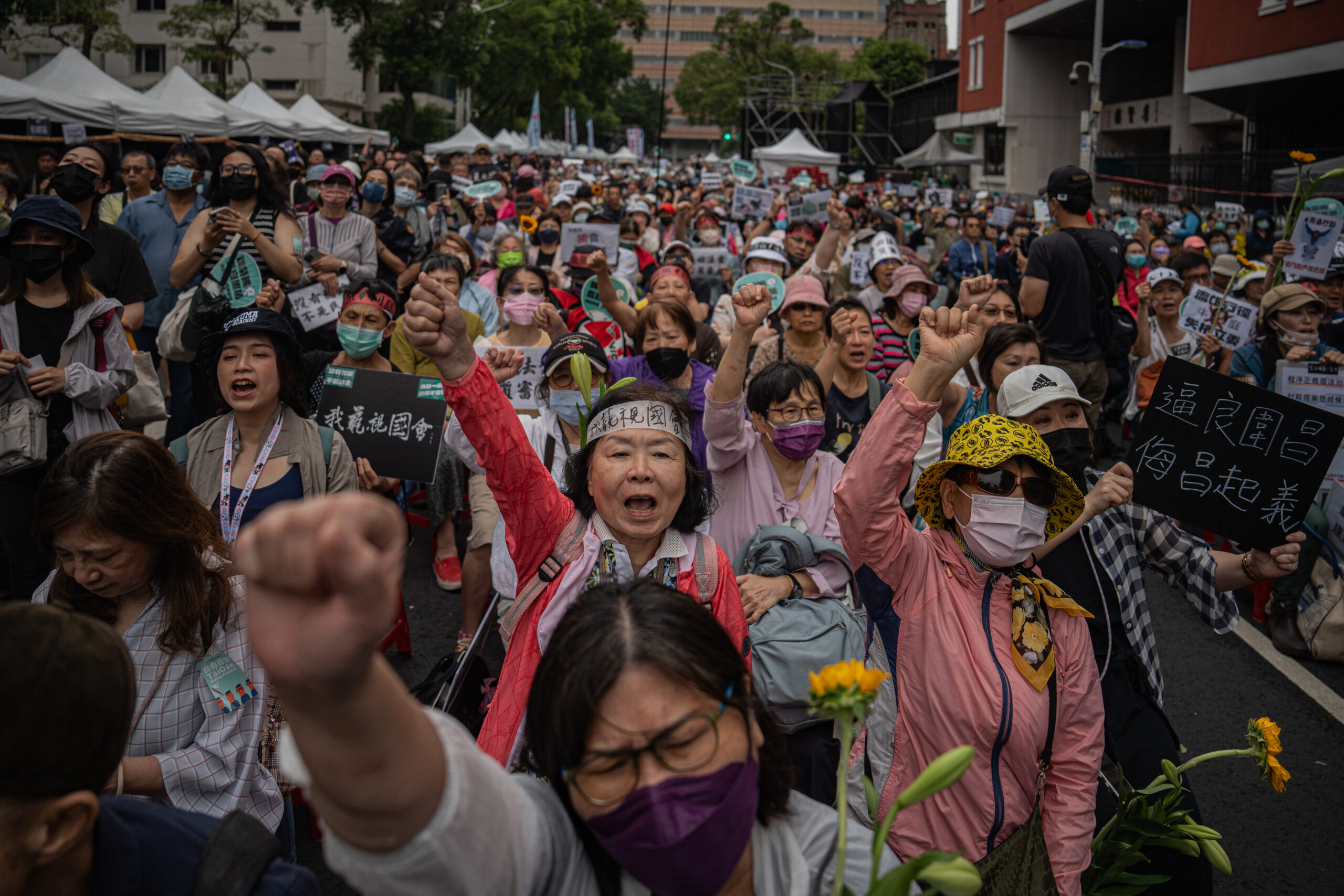
Taiwan held its first direct presidential election thirty years ago. Today it faces relentless threats from the Chinese Communist Party. Its best defense is self-deterrence.
March 2026
In March 1996, Taiwan held its first direct presidential election. The moment was historic: a society that had endured martial law, authoritarian rule, and decades of uncertainty finally stood before the world as a functioning democracy. Thirty years later, Taiwan’s democracy is not only intact but thriving. Its elections are competitive, its press is free, and its civil society is vibrant. Yet democracy alone does not guarantee survival. Taiwan’s challenge is stark: how to preserve its democratic way of life in the face of relentless threats from the Chinese Communist Party (CCP).
The answer lies in self-deterrence. Taiwan must cultivate the capacity to impose costs on aggression, to make any attempt at subjugation prohibitively expensive for Beijing. This is not about militarism or provocation. It is about survival — ensuring that Taiwan’s democracy endures not just as a moral beacon but as a political reality.
The Nature of the Threat
The CCP’s threats are not abstract. They manifest daily in military intimidation, cyberattacks, and disinformation campaigns. Chinese fighter jets cross the median line of the Taiwan Strait with increasing frequency, eroding the tacit boundaries that once stabilized the region. Cyber intrusions target government infrastructure, while coordinated disinformation seeks to undermine public trust in institutions.
Beijing’s strategy is clear: normalize intimidation, sap morale, and convince both Taiwanese citizens and the international community that Taiwan’s fate is predetermined. The CCP’s political narrative insists that Taiwan is a “domestic issue,” foreclosing international mediation and portraying any external support as interference. Against this backdrop, Taiwan cannot rely solely on sympathy or external guarantees. It must build its own deterrent posture.
Taiwan’s democratic success is remarkable, but democracy is not a shield. History is replete with examples of democracies that fell to external aggression when they lacked credible deterrence. The lesson is sobering: Legitimacy and vibrancy do not prevent conquest unless backed by the capacity to resist.
Ukraine offers a contemporary example. Its democratic aspirations did not deter Russia’s invasion in 2022. What did matter was Ukraine’s ability to resist — its asymmetric defense strategies, its mobilized citizenry, and its capacity to impose costs on the aggressor. Taiwan must learn from Ukraine’s example. Democracy provides moral authority, but deterrence provides survival.
Making Invasion Costly
Taiwan’s geography and society lend themselves to asymmetric defense. The island’s mountainous terrain, dense urban centers, and narrow straits complicate invasion. By investing in mobile missile systems, hardened infrastructure, and dispersed command structures, Taiwan can make any military operation prohibitively costly.
The principle is simple: Taiwan cannot match China’s military power symmetrically. But it can exploit asymmetry. Small, mobile, and resilient systems can survive initial strikes and continue to impose costs. Civil-defense training can prepare citizens to resist occupation, complicating Beijing’s calculus. The goal is not to defeat China outright but to make aggression a gamble too risky to attempt.
Embedding Taiwan in Global Supply Chains
Taiwan’s economic role is already strategic. Its semiconductor industry is the beating heart of global technology. By diversifying partnerships and embedding its industries deeper into allied economies, Taiwan can raise the stakes of any disruption.
If Beijing knows that aggression against Taiwan would trigger global economic shockwaves — crippling supply chains, disrupting markets, and alienating trading partners — it may hesitate. Economic deterrence is not about weaponizing trade but about demonstrating interdependence. It is about making Taiwan’s survival not only a moral imperative but an economic necessity for the world.
Resisting Disinformation
Deterrence is not only military and economic; it is psychological. Democracies are vulnerable to division, and the CCP exploits this through disinformation and influence operations. Taiwan must invest in civic education, media literacy, and transparent governance to inoculate its society against manipulation.
A democracy that believes in itself is far harder to destabilize. By cultivating resilience in the information domain, Taiwan can deny Beijing the ability to erode trust and sow division. This is self-deterrence at the societal level: a population that refuses to be manipulated, that stands united in the face of intimidation.
Self-deterrence does not mean isolation. Taiwan needs international support, but that support is most effective when Taiwan demonstrates its own capacity to resist. Allies are more likely to rally behind a democracy that shows determination.
Ukraine’s resistance galvanized international support; Taiwan must do the same. By investing in deterrence, Taiwan signals to the world that it is not a passive victim but an active defender of democracy. This strengthens the case for international solidarity and raises the costs of abandonment.
History offers sobering lessons. Democracies that failed to deter aggression often fell quickly. Czechoslovakia in 1938, despite its democratic institutions, was abandoned when it lacked credible deterrence. By contrast, Finland in 1939, though small, imposed significant costs on Soviet aggression through asymmetric defense, preserving its sovereignty.
Taiwan must heed these lessons. Democracy is precious, but survival requires deterrence. The CCP’s threats are real, and history shows that aggressors exploit weakness. Self-deterrence is not optional; it is existential.
Democracy Must Be Defended
Deterrence is often framed in cold strategic terms, but for Taiwan it carries a moral dimension. To deter aggression is to preserve democracy, dignity, and freedom. It is to ensure that thirty years of democratic progress are not erased by authoritarian conquest.
Taiwan’s struggle is not only about survival; it is about the universal values of self-determination and liberty. By cultivating self-deterrence, Taiwan affirms that democracy is worth defending — not only with ideals but with resilience.
The world admires Taiwan’s democracy. Thirty years of democracy have given Taiwan legitimacy, vibrancy, and moral authority. But survival demands more than ideals. Taiwan must now ensure it endures by making aggression against it a gamble too costly for Beijing to take. Self-deterrence is not about militarism; it is about survival. It is about ensuring that democracy, hard-won and deeply cherished, continues to thrive in the face of authoritarian intimidation.
Khedroob Thondup is the nephew of the Dalai Lama.
Copyright © 2026 National Endowment for Democracy
Image credit: Vuk Valcic/SOPA Images/LightRocket via Getty Images
Copyright © 2025 National Endowment for Democracy
Image credit: Man Hei Leung/Anadolu via Getty Images
|
FURTHER READING |
||

Why Taiwan’s Voters Defied Beijing — Again |
How Taiwan Should Combat China’s Information WarBeijing assaults Taiwan with a nonstop barrage of conspiracy theories and lies to undermine people’s faith in democracy — and China’s efforts are getting more sophisticated. Taiwan must do even more to fight back. |

Combating Beijing’s Sharp Power: Taiwan’s Democracy Under FireNo state on the planet is more heavily targeted by authoritarians’ information warfare than the Republic of China on Taiwan. And no other state and free society are better at resisting the daily onslaught. |