
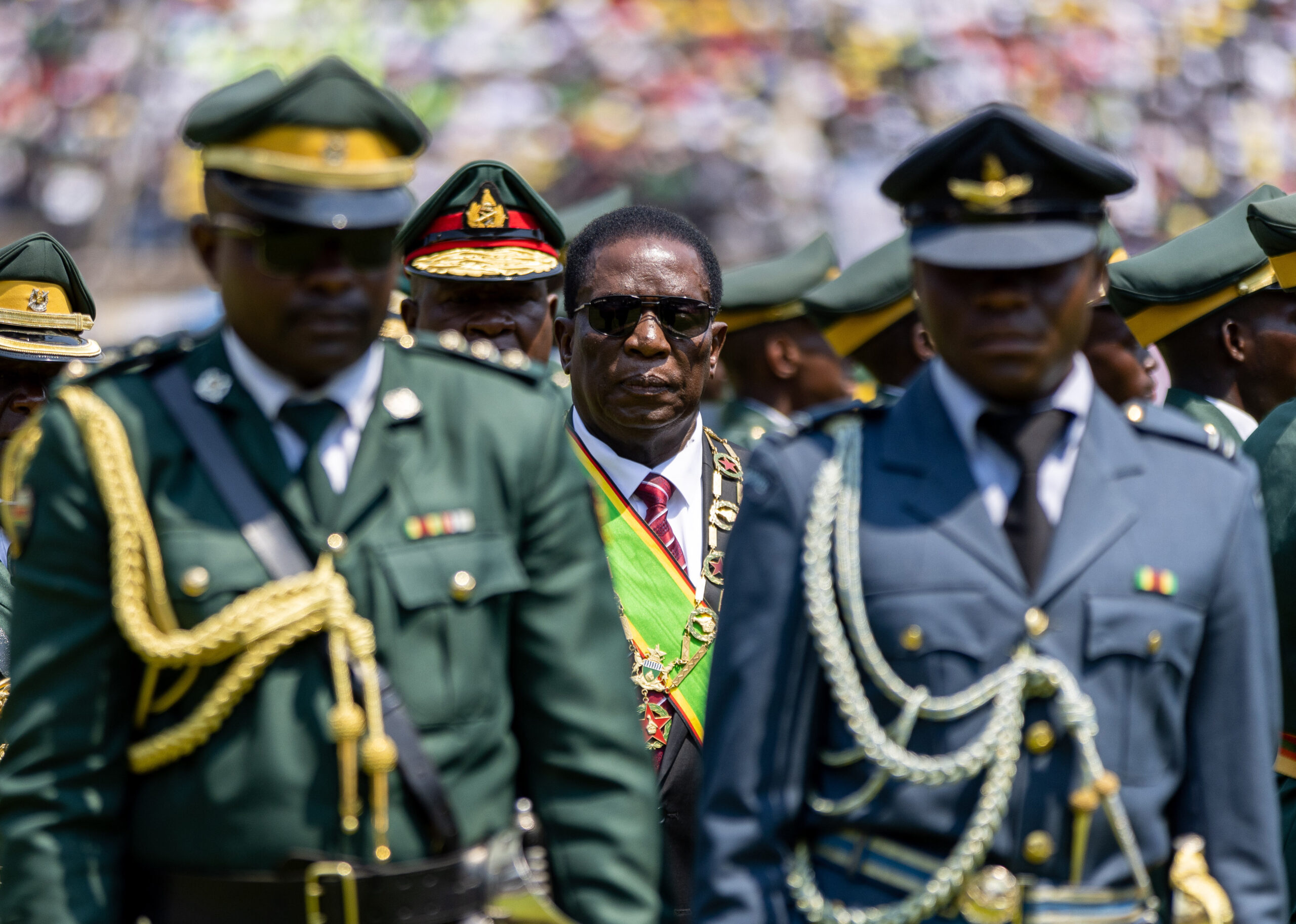
President Emmerson Mnangagwa wants to cling to power above all else, and he has launched a new effort to extend his reign. But, if they act fast, there is still time for Zimbabwe’s opposition and the international community to stop him.
July 2026
A dangerous power grab by Zimbabwe’s sitting president is underway. After a flawed and violent public consultation process, on June 24 Zimbabwe’s parliament passed a bill that would extend President Emmerson Mnangagwa’s term in office by at least two more years and completely abolish the current system of direct presidential elections. Mnangagwa is expected to sign the bill into law in July. The clock is now ticking on Zimbabwe’s democracy.
These proposed actions clearly violate the country’s 2013 Constitution, which established two five-year terms and, if enacted, would constrain Zimbabweans’ ability to select their president through the country’s long-standing post–liberation war tradition of “one man, one vote.” Zimbabwe’s opposition leaders have strongly condemned the changes, calling them a “coup” against the constitution. But it’s not too late to stop this latest attack on democracy in Zimbabwe.
The country has a long history of political violence, troubled civil-military relations, and authoritarian rule. Zimbabwe suffered for 37 years under the iron fist of former president Robert Mugabe until Mnangagwa ousted him via a military coup in November 2017. Since then, the ruling party has orchestrated two flawed elections, in 2018 and 2023, that kept Mnangagwa in power. Yet things have only gotten worse for Zimbabweans, with increased levels of repression, continuing economic crisis, and rampant corruption.
With Mnangagwa’s two-term limit approaching in 2028, he and his supporters are now launching a creative—albeit unconstitutional—attempt to cling to power. These actions unequivocally go against the existing limit of two five-year executive terms contained in the country’s constitution, which was hard won by the opposition during a rare and quickly disappearing moment of inclusive politics. It passed by referendum in March 2013 with more than 94 percent of Zimbabweans voting in favor.
Any changes to the constitution must go to a public referendum, a requirement that the ruling party is now refusing since it would likely lose.
This particularly innovative type of undemocratic maneuvering in Zimbabwe follows a worrying new chapter in the autocrat’s playbook. Last year, Togo’s ruling party successfully executed a nearly identical plan that got rid of direct elections to ensure President Faure Gnassingbé stayed in power beyond his legal mandate.
If allowed to succeed in Zimbabwe, this new type of power grab could gain traction more broadly, which would gravely harm the prospects for democracy in southern Africa and the continent writ large.
Yet another West African country, Senegal, may provide a template to forestall this outcome. In 2024, the president of Senegal, Macky Sall, attempted to stay in office beyond his legal term by delaying the country’s election. But citizens there took to the streets to protest, the country’s top court ruled that Sall’s power grab was unconstitutional, and strong regional and international pressure all helped to push Sall to reverse course, preserving Senegal’s democracy.
Zimbabwe’s democratic institutions are weaker than Senegal’s, which will make it more difficult to push the ruling party to back down. In contrast to Senegal, the military in Zimbabwe remains the ultimate arbiter of power.
But Zimbabwe does have a strong civil society, and powerful outside players remain interested in supporting democracy in the country and region. The combination of large-scale domestic protests, the support of the military (which is divided in its loyalties to the president and his vice-president), and coordinated external leverage could put just enough pressure on Mnangagwa to make a difference and at least force him into a referendum on the proposed changes.
African leaders, supported by the international community, should step up pressure on Mnangagwa to reverse course and respect the country’s constitutional term limits. As in Senegal, the role of the African Union would be critical, as would strong leadership from more democratic-leaning nations in the Southern African Development Community, like Botswana and Angola.
Because the United States under the Trump administration abruptly abandoned the decades-long, bipartisan consensus on global democracy promotion, Europe and the United Kingdom, in particular, will need to rally Western democracies and threaten the reimposition of the targeted sanctions that were lifted after Mugabe’s fall. Supporters of Zimbabwe’s democracy in the U.S. Congress must also apply pressure, tighten existing sanctions, and encourage allies to do the same.
Regional and international actors dropped the ball on their response to Zimbabwe’s 2017 military coup. After decades of Mugabe’s misrule and toxic outside relations, they nearly unanimously refused to call the coup a coup, and did not sanction the coupmakers or push for a transitional government.
The current power grab unfolding in Zimbabwe provides regional and international leaders with a unique opportunity to get it right this time. But time is running out.
Alexander Noyes is a fellow at the Brookings Institution and visiting scholar at the University of Pennsylvania’s Penn Washington. He is the author of Compromised Coalitions: The Paradox of Post-Conflict Power Sharing in Africa, forthcoming with the University of Pennsylvania Press.
Copyright © 2026 JoD Productions
Image credit: Tafadzwa Ufumeli/Getty Images
|
FURTHER READING |
||
African Popular Protest and Political Change |
Africa’s Leaders for LifeAlexander Noyes and John Reece The continent’s aspiring dictators are attacking term limits with a vengeance, finding new ways to avoid handing over power. But citizens are overwhelmingly against it — and can help keep their leaders in check. |
Zimbabwe: An Opportunity LostZimbabwe’s first elections since the November 2017 coup that ousted nonagenarian dictator Robert Mugabe were marred by the abuse of state resources, electoral irregularities, and a tragic bout of postelection violence that saw soldiers use deadly force against civilians. |