
If the war ends with the dismantling of the regime’s repressive apparatus, the Iranian people will have a rare, if fraught, opportunity. The totalitarian mindset often survives totalitarian regimes.
March 2026
With the smoke of war and a total internet shutdown having closed over Iranian society since 28 February 2026, debate on this conflict is missing the voices of a group of its main stakeholders: the people of Iran. Just prior to the Twelve-Day War of June 2025, when the United States and Israel bombed the Islamic Republic’s nuclear and missile facilities, I wrote in these pages about the four-decade-long war that the Iranian Shia theocracy had been waging against its own people.
I argued that this war is part of a larger fight that the regime has been conducting against liberal democracy, which in the worldview of the Islamic Republic’s founder, Ayatollah Ruhollah Khomeini (1900–89), was the principal evil to be eliminated. In that worldview, America was the “Great Satan” because it lured Iranian citizens with “nonsense” such as “democracy”; Israel was the “Little Satan” to be obliterated; and the Iranian people should be denied their political and social agency.
The February 28 military attack is a new development in a long and multifaceted unconventional war initiated by Tehran’s Islamist ideologues in 1979. This war is, in essence, ideological. It can only end with the regime’s ideological defeat, and only the Iranian people can bring that defeat about. That is why the spectacular military successes of the June 2025 operations were limited. The regime’s coercive capacities against society were left intact, and while the bombs targeted its military and nuclear arsenal, its security forces were out intimidating and arresting peaceful citizens.
As for democracy in Iran, its fate will be decided by the outcome of the war the regime is waging against its own people. This long struggle has been fought through many battles in which the state’s victories by means of violent physical repression have yielded for it only ideological defeats, transforming Iranian society into one of the most culturally secular in the Middle East. The latest battle in this internal war took place just a month before the outbreak of the ongoing one, and reached its bloody climax on 8 and 9 January 2026. We can only understand this battle against the backdrop of those that preceded it.
The protests began in Tehran around 27 December 2025, following a currency collapse and sharp price hikes. As in past rounds of protest, economic grievances quickly turned political and slogans denouncing the regime rang through the streets. The political turn that economic discontent so quickly took should be no surprise. The populace at large rightly sees the Islamic Republic’s very nature—its lawlessness, violence, and corruption—to be the main cause of economic and social hardships.
Over the last three days of 2025, protests spread to the main cities in this country of 95 million. People were chanting slogans such as “Until the mullahs are buried, this homeland will not be a homeland again!” As early as the second day, demonstrators in Tehran were heard shouting “This is the last battle—Pahlavi will return!” They meant Crown Prince Reza Pahlavi, a longtime U.S. resident who was eighteen years old when his father, Shah Mohammad Reza Pahlavi (1919–80), was deposed in 1979. As the protests reached a crescendo in both numbers and geographical spread slogans invoking Reza Pahlavi predominated.
On 2 January 2026, U.S. president Donald Trump publicly declared his support for the protests and warned the Islamic Republic’s rulers against violent repression. His remarks circulated widely inside Iran; in at least one instance, protesters even renamed a street after him. On January 8, the same day the regime cut off the internet, Reza Pahlavi publicly urged Iranians to take to the streets that evening and the following day. Popular satellite-television channels, including London-based Iran International, broadcast his appeal.
The evening of January 8 and the next day witnessed massive protests. The regime met them with a premeditated massacre. In the aftermath of January 9, while the world still had no idea of the scope of the killings, protests subsided as families began searching for disappeared loved ones amid waves of arrests and persecution.
How the Regime Wins Yet Loses
Iranians’ uprisings against the Islamic Republic have long been viewed as a string of failures, with savage repression ending each. During the 2009 Green Movement, millions demanded respect for their votes, still believing that the democratic reform of a totalitarian theocracy might be possible. The brutality of the ensuing crackdown marked the start of an irreversible rupture between state and society. Iranians began rejecting the rituals of Shia Islam. Over time, women’s refusal of mandatory veiling became a massive civil-disobedience movement. Since 2017, Iranian citizens have time and again made clear their rejection of the mullahs’ theocracy.
The 2022 Woman, Life, Freedom (WLF) movement—triggered by the regime’s murder of a young Iranian Kurdish woman, Mahsa Amini, for allegedly violating the Islamic dress code—was a direct ideological challenge. Protest slogans emphasized gender equality, freedom of expression (including the right not to wear the veil), religious liberty, the full range of civil and political rights, and people’s right to the pursuit of happiness.
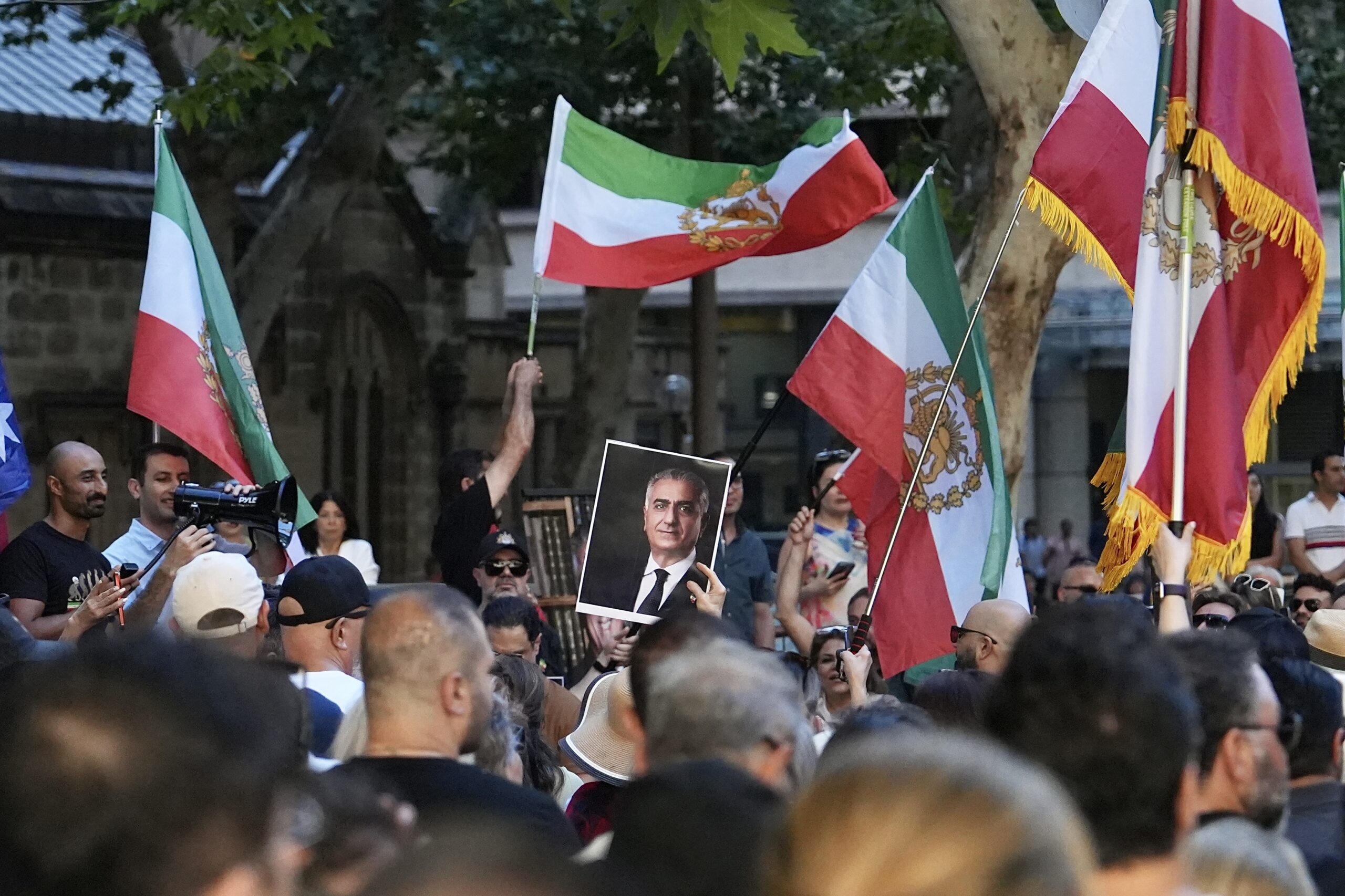
One of the distinctive features of the 2026 protests, which people are now calling the National Revolution, is that while previous surges of discontent lacked political leadership, this time the street rallies are invoking Reza Pahlavi. Since the WLF protests, the crown prince has declared himself “ready to lead,” at least during a transition.
With relentless repression blocking the emergence of leaders on the ground, Iranians have turned to the crown prince. Some support him out of monarchist conviction. Others back him as the best alternative available. He is aided, no doubt, by his having been very young during his father’s rule, which frees him from association with Pahlavi-era misdeeds. Earlier independent opinion polls consistently showed him with about a 30 percent favorable rating inside Iran, far ahead of any other individual. His approval may be much higher today, as recent anecdotal evidence suggests.
Ayatollah Khomeini bluntly condemned the idea of Iran as a nation-state. He equated nation-building with idolatry, and repudiated Iranians’ national identity. He replaced the flag and the anthem, renamed the National Consultative Assembly the Islamic Consultative Assembly, and told Iranians that they were not a nation but part of a global Islamic community. In short, Khomeini treated Iran as Islamism’s first conquest and a base for spreading it across the world.
In January 2026, we saw in Iran a populace reaffirming its Iranianness and reclaiming its status as the people of a nation-state. Iranians were shunning in no uncertain terms the Islamist globalism that Khomeini and his successors had sought to force upon them. Marchers waved the Lion and Sun flag, which was Iran’s official national banner from 1907 until 1979. They sang “O Iran,” a song pre-dating the Islamic Republic that many consider Iran’s de facto national anthem.
Iranians may not know Crown Prince Reza Pahlavi well, but they do know that his father and grandfather were the builders of Iran as a modern nation-state; they also know that he is not—and has never been—affiliated in any way with the criminal regime that has devastated their country and their lives. It is as if they are returning to 1978, eager to erase the noxious experiment of political Islam from their history and to start a new chapter.
This radical rejection of the 1979 revolution and its legacy is the reason why the violence against protesters reached the level of a total war. Even in the blood-drenched annals of the Islamic Republic, the events of 8 and 9 January 2026 marked a horrifying new low. Security forces ruthlessly carried out shoot-to-kill orders. In two days, more than thirty-thousand protesters were reportedly gunned down. Thousands were arrested. As the regime saw it, by reclaiming their national identity in defiance of the Islamic Republic, protesters had committed moharebeh—“war against God.” This made slaughtering them a religious duty.
A crucial difference between the National Revolution and those that went before it lies in the Islamic Republic’s weakened international position. Iran under Supreme Leader Ali Khamenei (1939–2026) had spent decades building an “axis of resistance” as a strategic pincer against Israel. After Hamas’s 7 October 2023 attack, Israeli forces decapitated and disorganized not only Hamas in Gaza but Hamas’s fellow Iranian affiliate Hezbollah in Lebanon. The December 2024 fall of Syria’s dictator Bashar al-Assad was another serious blow to Khamenei’s axis.
Even before the Twelve-Day War, these events had dramatically reduced the Islamic regime’s capacity to further its ideological and political agenda in the region. The June 2025 air strikes, which saw U.S. and Israeli warplanes dominate Iran’s skies without serious challenge, further discredited the Islamic Republic and psychologically empowered people already fed up with state violence and the regime’s catastrophic and corrupt mismanagement of public affairs.
President Trump’s January 2 message to the Iranian people, in which he promised to defend them against attacks by their own government, was also a crucial factor, as it showed for the first time that the Islamic regime was the common enemy of both the Iranian people and the United States. This message created a collective expectation regarding democracies’ responsibility to protect a population under assault by its own government.
Iranians are watching the unfolding war with trepidation and hope. Many saw the IAF’s deadly blow against Khamenei and other top officials in the war’s opening hours as a form of justice for the victims of state violence. Citizens are also watching U.S. and Israeli forces target the regime’s repressive apparatus—in the latest development, via Israeli drones that are making pinpoint strikes on street checkpoints manned by the regime’s Basij militia. The regime and its supporters, however, have so far maintained their cohesion.
“Take Over Your Government. It Will Be Yours to Take.”
If the current war results in the dismantling of the regime’s repressive apparatus—which appears to be one of its military objectives—the Iranian people will have the opportunity to see it through to a successful conclusion. It is amid these extraordinary circumstances that we must grapple with the transition to democracy as an urgent question for Iranians both inside and outside Iran. Crown Prince Reza Pahlavi has no organization on the ground but has come to the fore anyway, propelled by the sheer weight and flow of history. Iranians living in Iran have been calling his name, and his support within the diaspora is growing. The 65-year-old crown prince says that whether he becomes a permanent monarch must be left to the free decision of the Iranian people, and that in any case the new Iran which closes the book on the Islamic Republic should embrace life as a secular democracy protective of religious liberty, at peace with the world and neighbors (including Israel), and eager to safeguard citizens’ rights to choose their form of government and their key officials.
In April 2023, the crown prince paid a visit to Israel, whose president and prime minister received him like a head of state. This further enhanced his stature as a statesman in the eyes of many of his fellow citizens, some of whom recall that Iran and Israel enjoyed friendly relations during the time of his father.
Does this mean that there are no concerns related to the crown prince? It does not. His team has published a roadmap for a transitional government lasting two or three years that he would lead. Under this plan, he would during the transition interval designate and control the three branches of government, which would therefore be neither elective nor separate or independent. Such a concentration of power in the hands of a single person, however benevolent, must raise a red flag for prodemocracy activists. For the modalities of transition determine the nature of the political regime in gestation, and this transition program is not conducive to democracy.
In the past two months, diaspora activists who do not adhere to Reza Pahlavi’s transition plan and leadership, or who fear the illiberal tendencies of some among his followers, have tried to organize a forum in London that they dub the Iran Freedom Congress. The Congress, its organizers stress, is not a venue for leadership selection, leadership promotion, or coalition formation. Its purpose is to explore and model brokering mechanisms that will go with participatory transitional governance. Whether this latest initiative can draw a democratic roadmap and a viable structure for a pluralistic transition—and whether it can garner support inside Iran and within the diaspora—remains to be seen.
Even in the best-case scenario, if the Islamic Republic crumbles and Iranian citizens reclaim full agency, the road to democracy will be fraught with obstacles, not least because we are living in a time of global illiberalism’s revival. Moreover, the totalitarian mindset often survives loyalty to totalitarian regimes. We are already witnessing within the Iranian opposition defectors from the regime who, in their recent antiregime activism, reproduce its undemocratic modus operandi.
What role might the countries now battling the Islamic Republic play in a transition? We do not know. We also do not know how nearby Russia might seek to shape any transition. Iranians have long dealt with Russia—whether imperial, communist, or neoimperial—and its influence has never been friendly to self-government or democracy. The path to Iranian democracy, in short, is riddled with obstacles, but there is no other route to a future worth achieving.
Ladan Boroumand is honorary professor of history at the University of Parma and cofounder and board member of the Abdorrahman Boroumand Center for Human Rights in Iran. She has been working on a book tentatively titled The Islamic Republic’s War on Iranians, and How America Got Caught in It.
Copyright © 2026 National Endowment for Democracy
Image credit: Norvik Alaverdian/NurPhoto via Getty Images
|
FURTHER READING |
||
Why the Islamic Republic Still Stands |
Iran’s Massacres Will Haunt the Regime |
Why Iran Is Entering a Dangerous MomentMohammad Ayatollahi Tabaar Many fear that coups are making a comeback. While this is not true, one thing is alarming: Anti-coup norms are starting to erode. |