
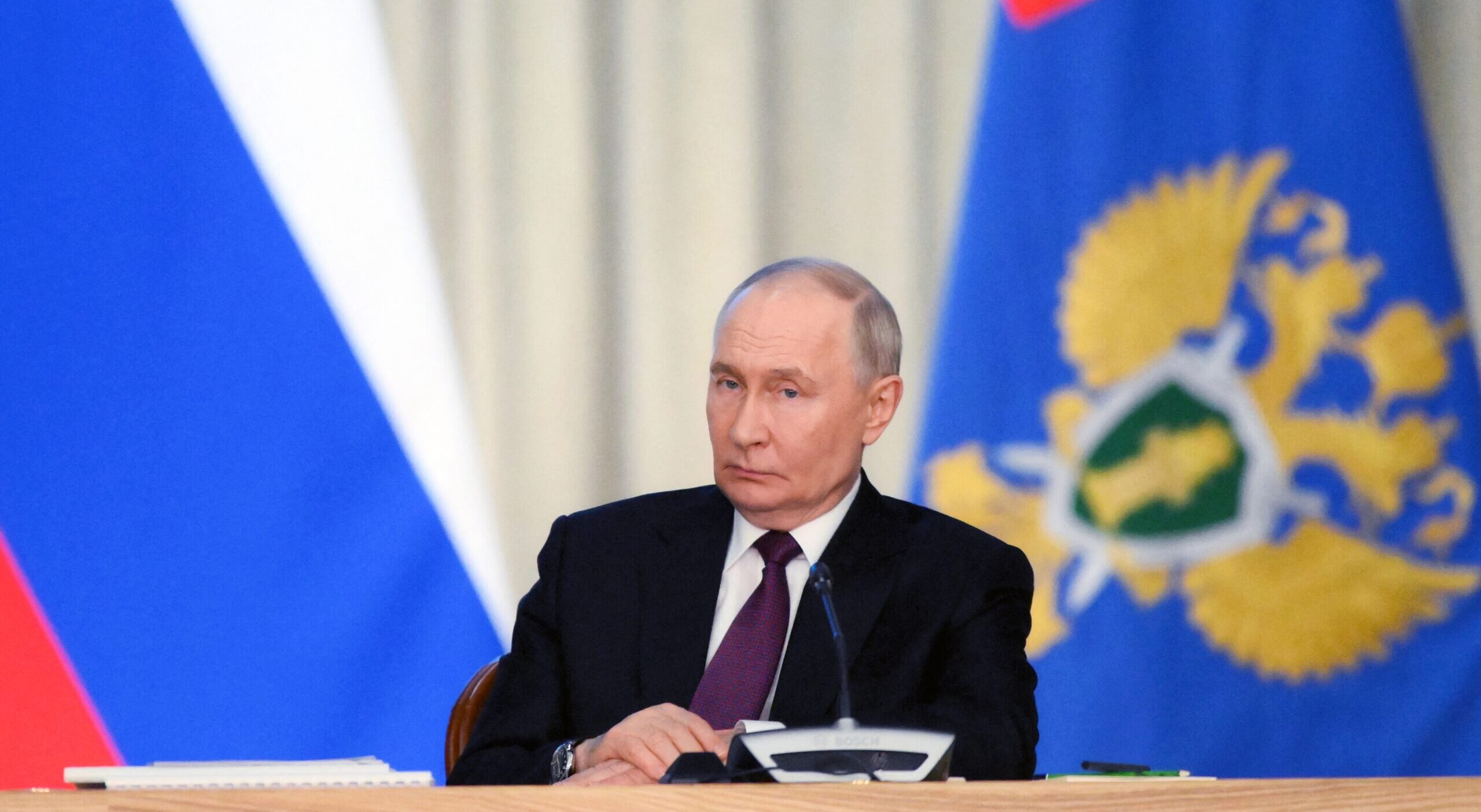
Russia’s influence operations are more concerned with reshaping voters’ fears and anxieties than convincing them of any specific falsehood. To survive, democratic values need to be defended and mobilized.
By Daria Azariev North and Vitaliy Shushkevich
March 2026
In Russia’s psychological war against Europe’s democracies, elections have become the decisive front. Fear, anger, and manufactured urgency have become the primary weapons of influence, with populist movements serving as their most effective political beneficiaries.
Today’s influence operations rarely aim to convince voters of specific falsehoods. Instead, these operations seek to reshape voters’ priorities. By elevating some anxieties and dimming others, disinformation reorders the hierarchy of public concern, transforming what feels existential. Fear of war and resentment of elites are magnified while dignity and opportunity are pushed to the margins. Once such emotional groundwork is laid, populist politicians flourish not because they offer solutions, but because they embody the urgency of these feelings.
Electoral outcomes increasingly hinge less on information than on which concerns nest closest to the heart: war or corruption, identity or dignity, economic decline or opportunity. This field of emotional-agenda setting has become the quiet terrain on which contemporary democracies fracture or endure. Whoever can define what feels consequential can define the political future.
Over time, disinformation also functions as a kind of social glue. Content circulating through Telegram channels or fringe social-media groups becomes a source of belonging, reinforcing trust through shared grievance rather than shared reality. When election season arrives, populist candidates tap directly into these networks, converting external interference into domestic momentum.
For this psychological manipulation to thrive, fertile ground is required. Over the past decade, much of Europe has become primed for such psychological targeting. Social fragmentation, mistrust of elites, widening economic inequality, and cultural polarization have created entrenched vulnerabilities, particularly in rural communities, small towns, and communities disconnected from traditional institutions. Disinformation does not create these fractures, but it exploits and widens them, making manipulation more effective and recovery more difficult.
These tactics operate across borders. The same narratives tested in Vienna or Bratislava often migrate westward, shaping elections and debates in Brussels, Berlin, and beyond. But in 2025, nowhere was this psychological war more visible than in Moldova. And nowhere was it more effectively resisted.
On 28 September 2025, Moldovans went to the polls to fill all 101 seats in their unicameral Parliament. The pro-European Party of Action and Solidarity (PAS), led by Prime Minister Dorin Recean and backed by President Maia Sandu, secured an outright majority despite months of sustained foreign interference and pressure.
International observers deemed the election competitive while warning that it had been marred by serious cases of “foreign interference, illicit financing, cyber-attacks and widespread disinformation.” Yet turnout reached its highest level in more than a decade, and voters decisively rejected Moscow’s preferred political proxies, including Igor Dodon’s Socialist Party and the Ilan Shor network, which continued operating from abroad.
The result showed that defeating psychological warfare requires more than fact-checking; it depends on rebuilding the connective tissue between truth, trust, and personal consequence. It restored a vital link between what people know and how it translates into daily life, proving that the Kremlin can be beaten not only at the border, but in the minds of voters.
Moldova’s success was the fruit of years of strategic efforts. Programs to “prebunk” (alert people to misinformation types and approaches ahead of their exposure to them) spread to schools and rural areas, along with training in media literacy. Journalists and civil society formed partnerships in service of information integrity, and pro-European Moldovans argued for a compelling national narrative that associated democracy with sovereignty, dignity, and economic opportunity. Kremlin-linked networks had deployed AI-generated content, cross-platform amplification on Telegram and TikTok garnering millions of views, cyber operations probing electoral infrastructure, and illicit financing channels. Moldovan authorities disrupted coordinated networks, dismantling tens of thousands accounts in the weeks before the vote.
The decisive factor, however, was not the policing of falsehoods. Rather, it was the re-anchoring of truth within the lived priorities of citizens and the denial of the emotional fuel that populist factions rely on to convert disinformation into political force. Prodemocracy actors avoided trying to refute every lie. Instead, they practiced urgency-shifting, reframing what truly mattered to voters. European integration became more than a distant geopolitical aspiration and instead a choice with tangible implications for economic stability. Corruption was no longer abstract but a daily burden to be confronted. Russian interference ceased to be a remote ideological issue and emerged as a direct affront to personal dignity and national sovereignty.
Moldovan leaders framed the vote as an act of collective democratic self-defense, linking personal agency to national sovereignty in a way that made the stakes unmistakably real for Moldova’s citizens.
Three Outcomes: Corrosion, Capture, Recovery
Moldova’s experience throws those found elsewhere in Europe into sharp relief. Across the continent, Russia’s psychological tactics have produced a recognizable pattern with three distinct outcomes: corrosion in Austria, capture in Slovakia, and crisis and recovery in Romania.
Austria’s 2024 election showed how democratic capacity can be corroded without collapsing. The far-right Freedom Party (FPÖ) surged by fusing grievance with spectacle. It stressed hardline antimigration and “remigration” rhetoric and warned of EU “dictatorship” while amplifying narratives seeded for over a decade by Kremlin-linked outlets and conspiracy networks. These claims were never crafted to be credible; they were crafted to be felt. They united anti-vaxxers, climate skeptics, religious conservatives, and disillusioned voters into an emotional coalition. Austria’s institutions held, but its political center of gravity shifted. The FPÖ leveraged these narratives to reframe the election into a referendum on fear around a manufactured sense of siege, converting emotional turbulence into formal political strength. The result was corrosion without collapse and a reordering of public priorities around these emotions.
Slovakia illustrated the next stage, where long-cultivated resentment can crystallize into political capture. Russian disinformation had conditioned the public with predictive anxieties for years: fears of imminent war, NATO provocations, and economic catastrophe. By the 2023 election, these fears had eclipsed all other concerns. The information ecosystem had already been reshaped: Telegram channels tied to Russian outlets determined the political weather; fringe broadcasters normalized conspiracy theories; influencers seeded a permanent sense of emergency.
Populist leaders acted as conduits for these narratives by campaigning on protection rather than policy, promising to shield Slovaks from the threats that Moscow had manufactured. That emotional contract transformed the resulting sense of urgency into electoral dominance. Once in power, the governing coalition moved quickly to weaken judicial oversight and reshape public media, completing a feedback loop in which captured narratives enabled institutional capture.
Romania showed that democratic recovery remains possible. For nearly a decade, Russia and its proxies had cultivated a disinformation ecosystem that blended Orthodox traditionalism, conspiracy networks, and TikTok-driven populism. By 2024, the country was primed. Călin Georgescu, an obscure candidate given to praising Russia’s President Vladimir Putin and promising “national rebirth,” vaulted from the political margins to first place (among six candidates) in the 24 November 2024 presidential election, setting up a runoff.
Most saliently, Georgescu had campaigned on a call to end the involvement of Romania, a NATO member since 2004, in helping its neighbor Ukraine to resist Putin’s invasion. The domestic-intelligence agency had found (but not yet published) information indicating that Georgescu’s campaign had relied on undeclared funding and a coordinated online-amplification effort that leveraged algorithmic promotion, paid influencers, and tens of thousands of TikTok accounts to rapidly expand his reach.
Georgescu’s surge triggered mass protests and a constitutional crisis. The nine-member Constitutional Court first ordered a recount, which caused the jurists to validate the results on December 2: Georgescu had finished with almost 23 percent of the vote, while his nearest rival had garnered slightly more than 19 percent. Four days later came the biggest shock in postcommunist Romanian history. The Court reversed itself with an unprecedented ruling — citing the now-declassified intelligence findings — that annulled the entire vote. Russia’s influence operations had undermined the integrity of a presidential election.
A fresh election was ordered for 4 May 2025. During the new campaign, civic actors and pro-European leaders took an approach different from the one that they had favored the year before. They reframed the hierarchy of what mattered. Their candidate, Bucharest mayor Nicușor Dan, did not try to debunk every falsehood. Instead, he redirected attention to the concerns that voters felt most acutely, toward everyday struggles and shared aspirations. Against fear of war, he emphasized economic fragility; against anger at elites, he elevated anger at corruption; and against narratives of lost sovereignty, he highlighted the tangible benefits that Romania gains from EU integration. Even the language of tradition was reclaimed, with campaigns celebrating Romanian artisans and Christmas markets as symbols of continuity rather than decline. In May 2025, Dan won the rerun not because Romanians stopped believing conspiracy theories, but because they believed something else mattered more.
This is no longer a war over facts, but over urgency. The Kremlin understands this. Psychological shaping functions as a form of deterrence, convincing societies that supporting Ukraine, deepening EU integration, or defending democratic norms is simply too exhausting, too chaotic, too costly. The vulnerability lies not in the sophistication of Russian tactics, but in the willingness of domestic actors to weaponize them. Populists remain Moscow’s most effective conduits.
The stakes of this struggle are already visible in the campaign for Hungary’s upcoming parliamentary elections, set for 12 April 2026. Prime Minister Viktor Orbán has once again leaned heavily on the politics of fear, warning that aligning with Europe in supporting Ukraine will drag Hungary into war, bankrupt the country, and jeopardize access to Russian energy. His potent messaging apparatus amplifies these claims across social media, state-aligned outlets, and mass campaign outreach. Hungary’s vote will test whether such fear-driven narratives can once again reshape the hierarchy of political concerns, or whether democratic forces can redefine what voters see as urgent.
To remain resilient, Europe must adopt the same long-term discipline as its adversaries: investing early in civic education; coordinating across sectors; supporting independent local media; and developing political narratives that evoke agency, belonging, and consequence. The lesson from Chișinău is that truth must feel urgent, not just accurate. Fact-checking and regulation remain necessary, but they are never going to suffice on their own. Democratic values must be mobilized with the same intensity that disinformation mobilizes fear.
Civic and informational resilience must be treated as pillars of Europe’s security architecture. At a moment of democratic backsliding and declining public trust, resilience requires rebuilding the emotional foundations of democracy, not merely its institutional shell.
Democracies fracture when commitment to truth and the shared values upon which they were erected begins to erode. Europe’s democratic future will depend on whether political leaders, civic actors, and institutions can restore that connection — so that what is true continues to shape what citizens believe truly matters.
Daria Azariev North is director of Democracy and Resilience Initiatives at the Free Russia Foundation. Vitaliy Shushkevich is a fellow at the Free Russia Foundation.
Copyright © 2026 National Endowment for Democracy
Image credit: Pelagia Tikhonova / POOL / AFP via Getty Images
|
FURTHER READING |
||
Two Summits, Two Wests |
Why Russia’s Youth Don’t Support Putin’s WarThe Kremlin works hard to indoctrinate Russia’s youth to support Putin’s war in Ukraine. But a strong percentage support an immediate ceasefire and don’t think it’s a cause worth dying for. |
David vs. Goliath: Defeating Russian AutocracyUkraine versus Russia is a modern David versus Goliath conflict that matters not only for the future of Ukraine, but for that of democracy itself. |