
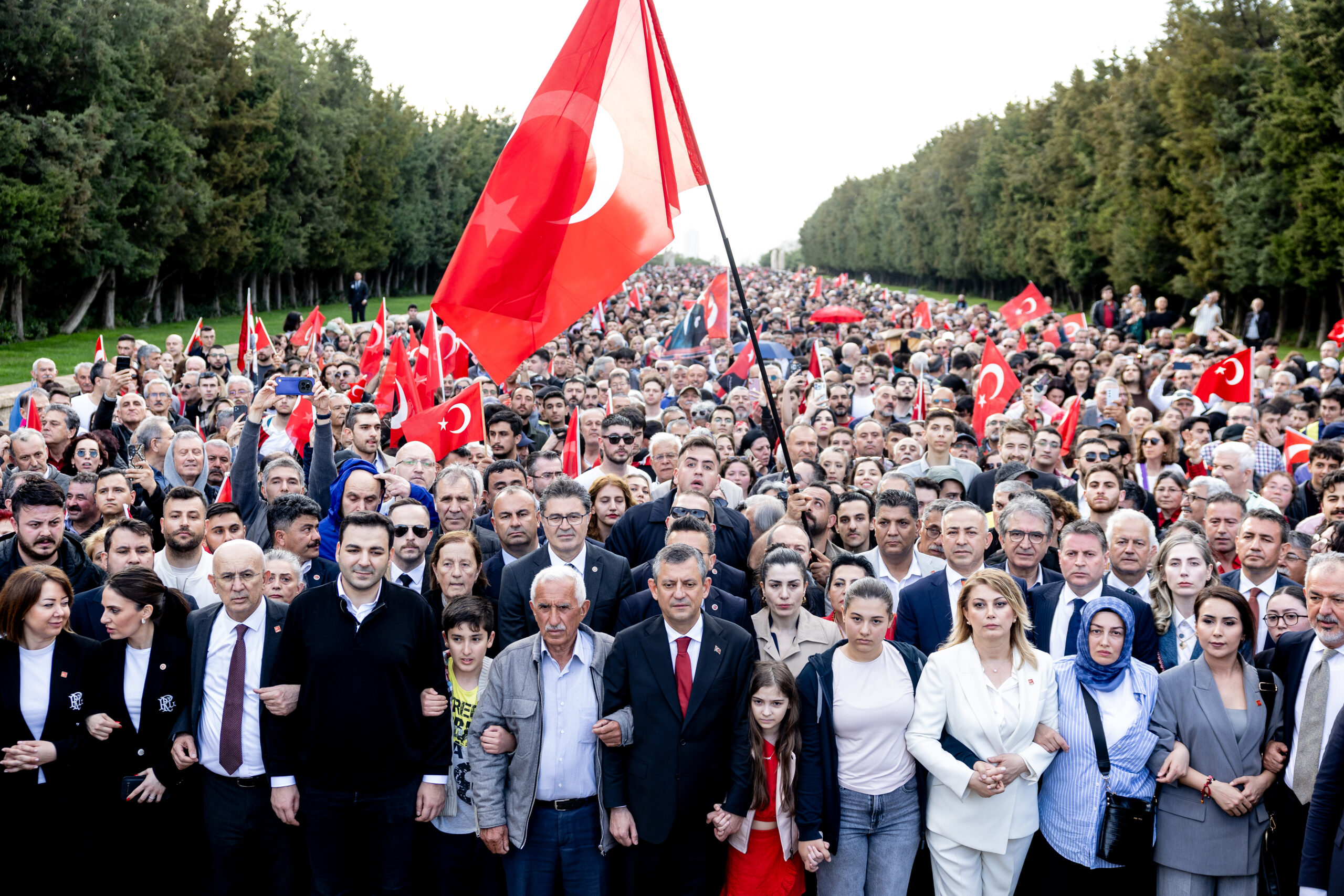
President Erdoğan’s rule has grown more repressive as he realizes he has no democratic path to power. But we are united in our resolve and determined to make Turkey a democratic republic worthy of its people.
By Özgür Özel
April 2026
Turkey is in the midst of a historic struggle for democracy and the rule of law. Since 2013, Turkey has undergone a sustained process of democratic backsliding. President Recep Tayyip Erdoğan, who first came to power with broad popular support and a pledge to reform the country’s economy and politics, has steadily dismantled democratic institutions, eroded the rule of law, muzzled the free press, built vast clientelist networks, and cultivated a loyal business elite. As the president’s popular support has waned, his rule has become more repressive because he no longer sees a democratic path to remaining in power.
The decisive victory of the opposition Republican People’s Party (CHP) in the 2024 municipal elections made it the country’s clearest champion for democratic hope and peaceful political change. Since March 2025, Erdoğan has escalated his attack on the opposition, especially the CHP, which I lead. Our presidential candidate, Ekrem İmamoğlu, the mayor of Istanbul and Erdoğan’s principal rival, was jailed that month along with many other mayors and municipal officials. They now face an array of charges, including corruption, aiding terrorism, and espionage, with prosecutors seeking sentences amounting to thousands of years in prison. Erdoğan has openly demanded that we accept the role of a loyal opposition, with no genuine ambition to govern, so that his rule may continue indefinitely.
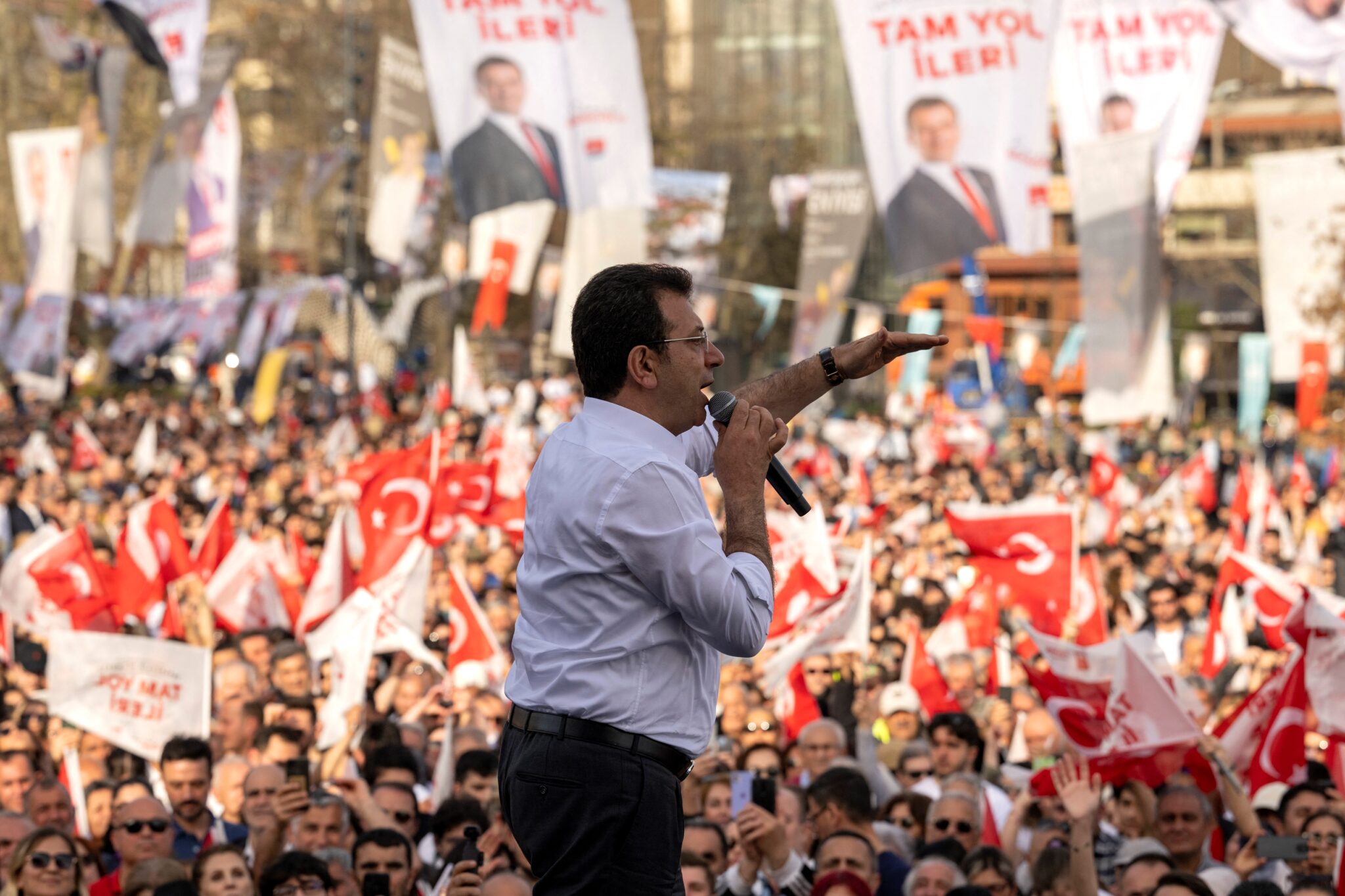
For more than a year now, millions of citizens have filled the streets and squares of Istanbul, Ankara, and cities across the country, protesting this assault on the opposition and defending free and fair elections. Turkey is now the site of one of the defining democratic struggles of the twenty-first century. Week after week, citizens who are determined to defend democracy and the rule of law continue to gather at mass rallies in Istanbul and in cities and towns across the country.
At the forefront stand Turkey’s “guardians of democracy” — young and old, women and men, farmers, blue- and white-collar workers, and democrats of every political persuasion and ethnic background — united in their extraordinary resolve. They are not a political fringe; they are the majority, as reliable recent polling makes clear. Their struggle will determine Turkey’s future, but its consequences will reach far beyond our borders. As Hungary’s experience has shown, elections under authoritarian rule are never simply about the transfer of power. They are moments that reveal whether authoritarianism is hardening into permanence or democratic renewal can still break through. The outcome in Turkey will thus matter globally. This is all the more true because of Turkey’s pivotal position between Europe and the Middle East, its proximity to Russia, and its significance as a Muslim-majority country with a long secular and democratic tradition.
Our Road to This Moment
Turkey is at a pivotal juncture, but this fight did not just begin. Since 2002, our country has been ruled by Erdoğan’s Justice and Development Party (AKP). Turkish voters initially extended a broad mandate to this new party, as the AKP had promised stability and appeared committed to continuing an economic-reform program already underway. For a time, Turkey was celebrated internationally as a “success story” — a country that seemed to reconcile democracy and a free-market economy with the values of a Muslim society.
Despite its promises, the AKP gradually abandoned its democratic promises, starting in 2008 as it began tightening its grip on the judiciary. In the years that followed, Erdoğan would forge new alliances with different groups or interests to remain in office, while deepening social and political polarization. Over the years, he accused the main opposition — my party, the CHP — of being the guardian of an old, elitist order, removed from the people. In the same breath, he presented his own political project as “national and native,” wrapped in religious symbolism.
A failed coup against Erdoğan’s government in 2016 — orchestrated by the Gulenist network, a religious cult that had long been Erdoğan’s ally in reshaping the state but is now designated a terrorist organization by the Republic of Turkey — gave Erdoğan the opportunity to transform Turkey’s political regime.
Under the emergency rule that followed the attempted coup, Erdoğan and his new ally, the Nationalist Movement Party (MHP), pushed through a deeply contested referendum held under emergency rule to replace the parliamentary system with an executive presidency. Since then, Turkey has experienced a profound authoritarian drift. Erdoğan’s economic policies have impoverished broad segments of society, steadily eroding his popular support. As that support has weakened, he has sought new allies through the distribution of public resources and patronage, while tightening his grip on power. The courts have increasingly been turned into instruments to intimidate and punish the opposition, and a sprawling progovernment media ecosystem has come close to monopolizing the public sphere.
Things changed in 2019. The CHP won a major victory in the municipal elections that year. Istanbul and Ankara, long Erdoğan’s strongholds, together with many other cities, elected opposition mayors. Some of these new metropolitan mayors — most notably, İmamoğlu in Istanbul and Mansur Yavaş in Ankara — have become leading national political figures. The CHP’s model of municipal governance offers a concrete alternative to the Erdoğan regime. Our municipalities have helped to foster bottom-up political movements and democratic alliances that reach beyond rigid party lines. Moreover, the new mayors have not only governed successfully, but through robust social policies they have also begun to reorient lower-middle and working-class political loyalties away from the AKP and toward the CHP.
Yet despite the breakthrough of 2019, the opposition coalition lost the 2023 presidential and parliamentary elections to Erdoğan and his allies. The reasons were many, but one of the most important lay in the coalition’s very design. In practice, it remained a pact among party leaders rather than a broader and more deeply grounded democratic alliance. It was repeatedly shaken by internal crises, and the lack of mutual trust among its leaders further blunted our efforts. We also failed to respond effectively to Erdoğan’s relentless propaganda, which portrayed the opposition as being in “collaboration” with the banned Kurdistan Workers’ Party (PKK), a group designated as a terrorist organization by Turkey as well as the United States and the European Union. The 2023 elections taught us hard but valuable lessons.
This is why I and Ekrem İmamoğlu, along with other CHP members, launched a comprehensive reform process within our party. This process led to a change in party leadership, in which I was elected chair, and to the adoption of a new, more bottom-up political framework. At the heart of this stands a model of municipal governance that directly addresses the concrete problems people face in their daily lives — above all the cost of living and housing, but also childcare, public transport, and student dormitories.
Our accelerated party reform, combined with the proven success of the municipalities we govern, brought the CHP a sweeping victory in the 2024 local elections. Frustrated citizens, exhausted by Erdoğan’s economic policies and authoritarian habits, turned toward the CHP. We emerged as the largest party with 38 percent of the vote, won most of the major metropolitan municipalities that account for roughly 80 percent of Turkey’s economy, and achieved breakthroughs in cities where we had historically had little or no presence.
The Judicial Onslaught Begins
In early 2025, the Erdoğan regime launched an open and systematic judicial offensive against the CHP — an offensive that continues today. İmamoğlu, who had defeated Erdoğan’s candidates four times at the ballot box in Istanbul, had clearly emerged as the natural candidate for the next presidential election. But, even before his official nomination, a committee at Istanbul University suddenly annulled İmamoğlu’s university diploma, which he had received 32 years earlier, on fraudulent grounds. A university degree is a constitutional requirement for presidential runs; the AKP government stripped İmamoğlu of his in order to bar his candidacy. İmamoğlu had already been the target of several politicized court cases, including one aimed at imposing a ban on his political activity. As polls were consistently showing that İmamoğlu would defeat Erdoğan in an election by a wide margin, the goal was obvious: to prevent him from challenging the president at all costs.
On 19 March 2025, İmamoğlu and many of his closest colleagues in the Istanbul Metropolitan Municipality were detained and jailed on fabricated charges of corruption and “aiding and abetting terrorism” — in other words, for allegedly collaborating with Kurdish separatist movements during the elections. Months would pass before a nearly 4,000-page indictment was produced, demanding a total of 2,300 years of imprisonment for İmamoğlu, who was even accused of espionage. Then, the government’s judicial onslaught expanded. Since late 2024, more than twenty CHP mayors have been arrested, and most remain behind bars. On 4 April 2026, Mustafa Bozbey, the mayor of Bursa, Turkey’s fourth-largest city, was added to this list — with further arrests of CHP mayors in the weeks since.
One prosecutor has even drafted an indictment seeking to annul the CHP congress that elected the new leadership and reinstate the previous leadership by court order. The Erdoğan regime is no longer trying merely to weaken the opposition; it is trying to erase it and refashion the CHP into a palace-approved “opposition” — a faux alternative that engages in performative dissent. The goal is a controlled performance of pluralism, a democracy in appearance only, with no real chance for an alternation in power. We refuse to allow Erdoğan’s newest gambit to succeed.
The Resistance Wave
After İmamoğlu was detained in 2025, our new wave of resistance began at Sarachane, the historic square in front of the Istanbul Metropolitan Municipality. On the evening of his arrest, the CHP called on the people of Istanbul to gather there. The regime tried to prevent the rally by halting the metro and canceling ferry services. Yet hundreds of thousands of citizens filled the square. Strikingly, the leaders of the rally were not party officials, but students from Istanbul University, İmamoğlu’s alma mater. The rallies continued for many days, each day larger and more energetic than the last. Through this mobilization, we blocked the regime’s attempt to seize the city and appoint an unelected caretaker — a key part of the regime’s original plan. One week later, we transformed the process of nominating our presidential candidate into a civic mobilization, inviting not only party members but all citizens to participate. We understood the regime’s actions as a coup — a coup against the people’s future mandate. Nearly fifteen-million citizens cast their votes for İmamoğlu’s candidacy. From that moment on, he was no longer merely the CHP’s candidate; he became “the People’s Candidate.”
Since that day in March 2025, our struggle for democracy has taken shape along three main lines.
First, the CHP has broken out of Ankara’s closed meeting rooms and elite power games and moved into the streets and public squares. Erdoğan understands exactly how dangerous this kind of organized grassroots momentum can be, which is why he repeatedly calls on us to “return to Ankara politics.” Over the years, Erdoğan has crushed much of the organized opposition in the media, civil society, and academia, and hollowed out state institutions by staffing them with loyalists. The CHP remains the only truly independent, nationwide, historically rooted opposition. That is why Erdoğan wants to force us back into the capital and tame us into a docile, toothless “opposition,” thereby eliminating, once and for all, the possibility of a democratic alternation in power. His aim is simple: to turn Turkey’s democracy into a one-party regime, and ultimately into a dynastic order defined by family rule, his lifelong power, and succession by appointment.
We believe that the people’s peaceful civic resistance against this authoritarian regime remains essential. That is why the CHP has become a political movement, developing a new understanding of mass mobilization. Since March 2025, we have organized major rallies, first in Istanbul, then in other cities, where we meet directly with citizens. In these gatherings, we do not deliver narrow, partisan messages. Instead, we stand together with the people around our shared concerns: democracy, the rule of law, and an end to poverty. Our rallies are organic, bottom-up, inclusive, and interactive. Our aim is to deepen civic mobilization, to present our program openly, and at the same time to listen carefully, learn from citizens, and incorporate their demands and language into our political agenda. We have just completed a campaign that produced a nationwide petition — signed by 25 million citizens calling for free and fair elections and for the release of our presidential candidate.
Second, we are actively fighting on the legal front. A legal battle is not sufficient on its own, but it is indispensable. We know that the Erdoğan regime has weaponized the judiciary through handpicked prosecutors and judges. But this does not deter us from waging a legal struggle. An authoritarian regime’s manipulation of courts and laws must be met with strong legal arguments that not only expose and disarm those who use the law for political purposes but also reveal the true intentions of the regime to the public. We see the 4,000-page indictment not just as a document against İmamoğlu, his friends, and the CHP, but as a roadmap for how the regime intends to criminalize democratic opposition in Turkey. Our response, therefore, will not be a narrow, technical defense. It will be a historical and constitutional defense, one that stands up for the constitution, the rule of law, universal human rights, and Turkey’s democratic traditions.
Third, our struggle rests on a new political program. The CHP has prepared a new party program in collaboration with millions of voters and hundreds of experts. This program takes strong positions on our country’s most deep-rooted issues, including the Kurdish question, and proposes bold measures to break the country’s current economic deadlock. We advocate a comprehensive reorganization of public finances and a fair, progressive tax reform, alongside an ambitious administrative reform that strengthens local and municipal governance. In matters of security and foreign policy, we reject the false choice between democracy and security; we see them as mutually reinforcing. The CHP envisions a Turkey that does not chase imperial ambitions, but is ambitious for regional peace, cooperation, and shared development, from Europe to the Middle East, for today’s citizens and for future generations.
The Marathon Ahead
As chair of the CHP, I believe we face a truly gargantuan task: nothing less than saving Turkey’s democracy, a struggle we cannot afford to lose. This task is made even more difficult by the global crisis of democracy. Across the world, democratic standards are eroding, and Turkey no longer receives the solidarity and moral support it once might have expected. As “guardians of democracy” in Turkey, we understand that the responsibility rests primarily with us.
I have set for myself and my party a clear goal: to unite all of Turkey’s democrats across ideological traditions and social identities. Different groups have long been estranged from one another, if not in open conflict. Yet today, we must reach beyond our traditional party base and bring together all those whose primary political commitment is to democracy, the rule of law, and human dignity.
As we see in Hungary, when democrats triumph in their struggle in an authoritarian regime, it will be a victory for democrats everywhere. Most consequentially, Turkey’s wider region will gain a stable, democratic state with the rule of law at its core. Autocrats learn from one another and build on each other’s legacies. If Turkey were to turn into a democratic lost cause, the result will not be confined within our borders: It will feed an accelerating cycle of authoritarian imitation, further shrinking rights and freedoms across the region and beyond. We are already seeing how quickly democracies far from Turkey can begin to resemble our current predicament, a stark reminder that what happens here can echo elsewhere.
In my personal life, I am a long-distance runner. I see our struggle as a marathon on a road that is steep, dangerous, and unforgiving. We cannot allow ourselves either complacency or exhaustion, no matter how harshly our endurance is tested. Our duty is to persevere until Turkey once again becomes a democratic republic worthy of its people and its history.
Özgür Özel is the chair of the Republican People’s Party (CHP) and a member of Parliament from Manisa Province.
Copyright © 2026 National Endowment for Democracy
Image credit: Serdar Ozsoy/Getty Images
|
FURTHER READING |
||
Turkey’s Hard Road to Democratic Renewal |

How to Fight Turkey’s Authoritarian TurnAs President Erdoğan’s grip on power is slipping, his regime is turning more repressive. But Turkey may still avoid becoming a full-blown autocracy. The opposition is increasingly popular, and there remains a way to tilt the playing field to their advantage. |
Secularism, Islamism, and the Future of TurkeyThe political struggle between President Erdoğan and opposition leader Ekrem İmamoğlu is a fierce battle for the country’s democracy. But it goes deeper than that. It is also a struggle between Islamist and secularist visions of Turkey. |