
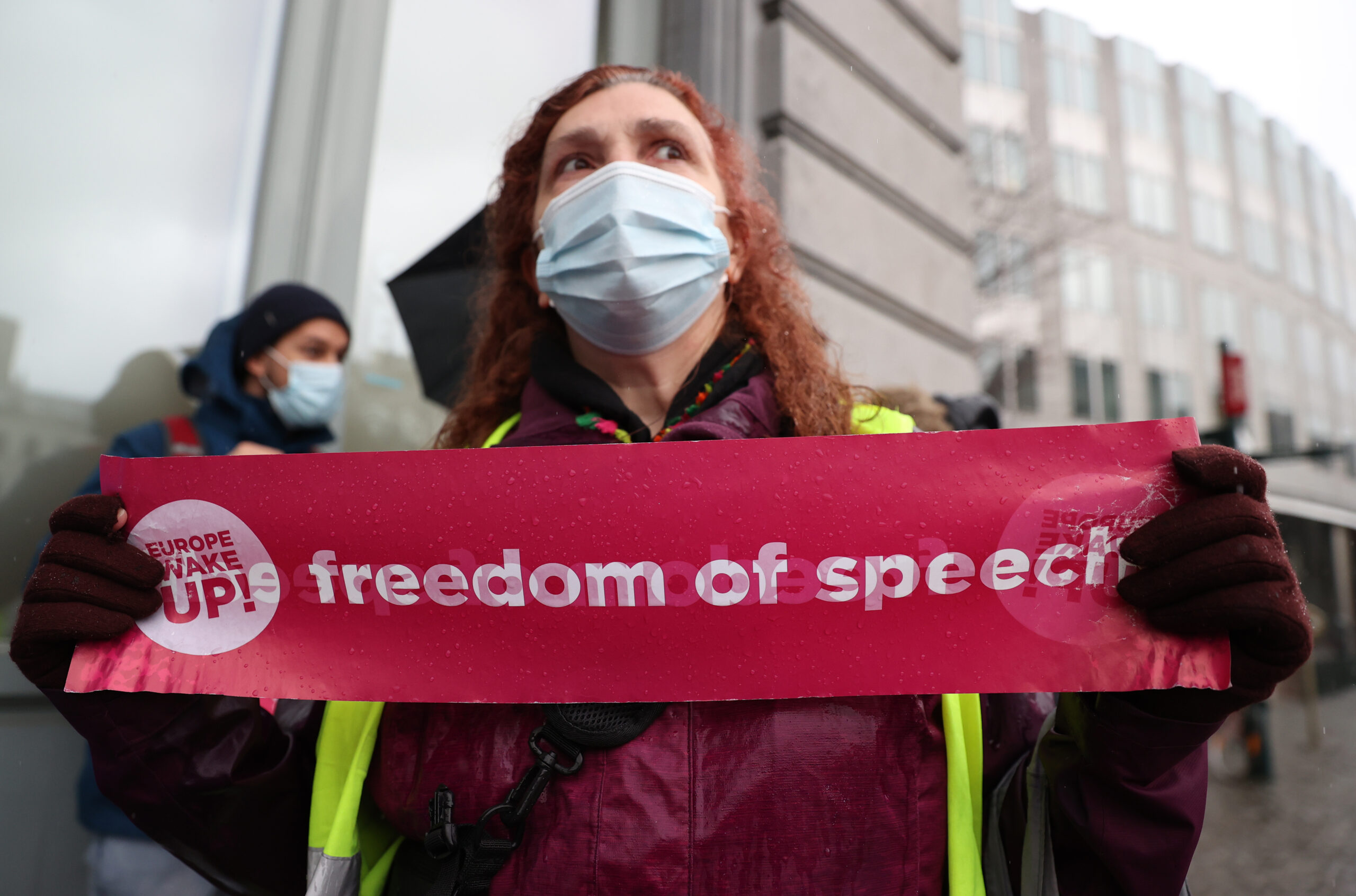
When democracies pass laws against hate speech and extremism, they are giving autocrats the cover they need for their own crackdowns. We shouldn’t let democratic norms become a blueprint for repression.
By Jacob Mchangama and Jeff Kosseff
April 2026
European democracies hold free and fair elections, ensure peaceful transfers of power, and maintain a vibrant media landscape. Their independent judiciaries hold governments accountable if they violate civil liberties, and their jails hold no political prisoners. Yet a steady expansion of European laws against hate speech and extremism has led to crackdowns on individuals and social movements critical of government policies and politicians. The laws are advertised as aimed at the strengthening of democratic values such as equality and tolerance, but the expanding reliance on speech restrictions raises urgent questions about the future of free speech in democracies and in international law. To glimpse a future where the trend toward greater speech restrictions continues unchecked, we do not have to turn to science fiction.
Authoritarian states offer a real-time window into a dystopian world where hate-speech laws are weaponized to crush dissent and entrench unaccountable rule. The rulers of such states often cite precedents from Western democracies and international human-rights law, cloaking harsh crackdowns in the language of equality, tolerance, and social peace. In this way, nominally democratic norms are repackaged into an exportable blueprint for repression.
Understanding how laws putatively aimed at stopping hate speech and extremism are applied in these regimes lets us grasp what could happen if open societies fail to stem the tide and continue to erode free speech in the name of tolerance and democracy. Vladimir Putin’s Russia and the member states of the Organization of Islamic Cooperation are arguably the most prominent among the authoritarian states that are weaponizing Western norms against hate speech to serve the work of suppressing political opponents.
On 19 January 2024, thousands of protestors braved the cold to gather outside a courthouse in Baymak, a city in Bashkortostan, a constituent republic of the Russian Federation. In one of the largest demonstrations that Russia has seen since the invasion of Ukraine, protestors gathered to support Fail Alsynov, a prominent activist for Bashkir autonomy and environmental rights. Alsynov faced a charge of having incited ethnic hatred for allegedly slurring Central Asians while protesting against a proposed goldmine. In the Bashkir language, however, the term he used is frequently translated as “common people.”
As word spread that Alsynov had been hit with a four-year jail term, police with tear gas, batons, and riot shields dispersed the protesters. The now-banned Russian human-rights organization Memorial has since declared Alsynov a political prisoner.
Russia’s war on hate speech is baked into the 1993 Constitution of the Russian Federation. Article 29(1) guarantees everyone freedom of thought and speech. But the very next paragraph states, “Propaganda or agitation, which arouses social, racial, national, or religious hatred and hostility shall be prohibited.”
Russia’s constitutional ambivalence regarding freedom of expression mirrors Article 123 of the 1936 “Stalin” Constitution of the USSR, which held that “any advocacy of racial or national exclusiveness or hatred and contempt, is punishable by law.” Repression of dissent has intensified steadily under Putin’s leadership, rising since the invasion of Ukraine until it now eclipses (in terms of numbers of people convicted of political crimes) the repression that was imposed upon Soviet citizens under Josef Stalin’s successors Nikita Khrushchev and Leonid Brezhnev.
“Fighting Extremism” or Just Crushing Dissent
Laws against hate speech and extremism play a prominent role in Russia’s backward march toward totalitarianism. Article 282 of the Russian Criminal Code prohibits inciting hatred or enmity, as well as degrading the dignity of individuals or groups based on characteristics such as race, religion, gender, nationality, or social affiliation. It was introduced in the early 2000s to combat extremism but quickly became a favored tool for suppressing dissent. Putin symbolically decriminalized parts of the article after his 2018 reelection, but it reappeared in the Code of Administrative Offenses.
A 2024 study by the independent Russian media outlet Proekt, which the Kremlin calls an “undesirable organization” whose journalists are “foreign agents,” revealed a steady increase in prosecutions under Article 282. Between 2018 and 2023, a total of 948 individuals faced criminal charges while 4,995 were fined for administrative offenses. In total, under laws against extremism and hate speech, more than 45,000 people have been hauled before a court for public statements during this period.
Even humor can draw punishment. In 2021, stand-up comedian Idrak Mirzalizade, a Belarusian of Azerbaijani origin, highlighted the discrimination faced by non-Slavic people in Russia. Mirzalizade used his own problems with finding an apartment to rent. Then he turned the joke on its head by recounting how he had thrown out a soiled mattress left by previous tenants. Apparently, he noted, “ethnic Russians smear themselves with shit and go to bed.”
The line’s purpose was not to denigrate Russians, but rather to poke fun at the absurdity of generalizing about entire groups of people based on a single bad experience. Russian nationalists, including television host and Putin propagandist Vladimir Solovyov, circulated an out-of-context clip of the joke while demanding Mirzalizade’s arrest. After receiving thousands of threats and being assaulted, Mirzalizade was jailed for ten days and banned from Russia for life.
Historical topics also feature red lines. In 2014, Russian blogger Vladimir Luzgin posted on the Russian social-media site VKontakte: “The communists and Germany jointly invaded Poland, helping spark World War II. That is, communism and Nazism closely collaborated.” Luzgin’s statement was factually correct: In August 1939, Nazi Germany and the Soviet Union had signed a nonaggression treaty known as the Molotov-Ribbentrop Pact. Per a secret annex to it, Berlin and Moscow had plans to divide Poland. The Germans invaded that country from the west on 1 September 1939, with Soviet forces invading from the east on September 17.
Despite the truthfulness of his statement, Luzgin was convicted under Russia’s law against “Nazi rehabilitation.” Specifically, he was found guilty of spreading “false information” about the USSR’s role in World War II and fined 200,000 rubles. The Kremlin-funded media outlet RT reported that the bill’s sponsors “refuted all criticism and said that many foreign nations, such as Germany, Austria and France already had similar legislation protecting the historical truth.”
The Russian government would use similar arguments again four years later, when it passed an online-censorship law obliging platforms to remove illegal content within twenty-four hours or face fines as high as 50 million rubles. The Russian law was explicitly modeled on Germany’s 2017 “Facebook Act,” which aims at banning several categories of content including hate speech. Reporters Without Borders’ verdict is damning: “The German law on online hate speech is now serving as a model for nondemocratic states to limit internet debate.”
True enough: By 2019, the list of authoritarian states that were copy-pasting the Facebook Act had grown to include Belarus, Honduras, Venezuela, and Vietnam. This is a recurring pattern. Alexander Verkhovsky, who runs Moscow’s independent SOVA Research Center, confirms that the Putin government often justifies its repressive measures by pointing to similar practices in countries such as France or Germany, regardless of the context or differences between Russia and Western Europe.
Exporting Censorship
Russia’s extremism model does not stop at its borders. Over the past decade, laws and enforcement practices developed in Moscow have metastasized across a growing circle of former Soviet states, from Belarus to the five Central Asian republics. Since 2018, all have ramped up their Russian-inspired laws against extremism. A key vehicle of this diffusion has been the Shanghai Cooperation Organization (SCO), which has developed an authoritarian legal ecosystem in the name of efforts to combat “terrorism, separatism, and extremism.”
In 2017, the SCO adopted a “Convention on Combating Extremism” over the signatures of representatives from China, Kazakhstan, Kyrgyzstan, Russia, Tajikistan, and Uzbekistan. This convention—with its sweeping definition of extremism—is a thinly veiled effort to legitimize censorship and suppress dissent, adhering to authoritarian principles that prioritize state security and stability over human rights.
Extremist actions include inciting political, social, racial, national, or religious discord—particularly through the promotion of enmity or hatred between groups. Additionally, the convention condemns ideologies that claim individuals can be superior or inferior to others on the basis of race, politics, social status, nationality, or religion. It also bans any public calls for action grounded in allegations about superiority or inferiority, as well as the mass production, storage, and dissemination of extremist propaganda intended to further these harmful ideologies.
Thus, the SCO’s convention is rooted in authoritarian standards developed by Russia and China, which they export to other illiberal and authoritarian states to normalize and streamline repressive laws and norms. It is no coincidence that the expansion across the post-Soviet space of laws against extremism gained momentum shortly after the adoption of the SCO Convention.
The significance of this regional diffusion is not confined to Central Asia or Eurasia. As authoritarian regimes converge around censorship, they also push to reshape international norms. The goal is not merely to defend their own crackdowns but to change the meaning of “human rights” itself—so that order, security, and national interests become higher values than dissent. This was a problem that the framers of the international bill of human rights were acutely aware of six decades ago.
The International Covenant on Civil and Political Rights (or ICCPR, 1966) protects expression in Article 19, yet also includes an obligation in Article 20(2) to prohibit “advocacy of national, racial or religious hatred that constitutes incitement to discrimination, hostility or violence.” The Soviet bloc and its allies pushed Article 20 through the UN General Assembly against the opposition of Western democracies spearheaded by the United States. When the UN Commission on Human Rights was established in 1946, the first person to chair it was former U.S. First Lady Eleanor Roosevelt. In 1950, she presciently warned that “totalitarian states” would exploit bans, citing the examples of Bulgaria, Hungary, and Romania, where communist governments had used peace treaty obligations intended to safeguard human rights through “suppression of fascism and hostile propaganda” to justify censorship. She also warned of the difficulties of distinguishing “advocacy” from “incitement” and “the various shades of feeling ranging from hatred to ill-feeling and mere dislike” which might encourage states to “punish all criticisms in the name of protection against religious or national hostility.” Shortly before the adoption if the ICCPR, the Norwegian delegate, speaking on behalf of all the Nordic countries, cautioned that the minorities such a broad restriction was “designed to protect might very well find themselves its victim.” History has vindicated those fears.
A fateful example of norm diffusion came in July 2023, when the UN Human Rights Council (which had succeeded the UN Human Rights Commission in 2006) adopted a resolution on “countering religious hatred constituting incitement to discrimination, hostility or violence.” This move followed a wave of Koran burnings in Denmark and Sweden that triggered protests across Muslim-majority countries and credible terrorist threats against both nations.
In response, the 57-member OIC demanded on behalf of the Muslim world that such burnings be not merely condemned but banned. The resolution urged states to “address, prevent and prosecute acts and advocacy of religious hatred,” and the OIC insisted that defamation of religious ideas and symbols itself constitutes incitement to religious hatred—speech which, OIC representatives argued, must be prohibited under Article 20(2) of the ICCPR.
The resolution of this UN body risks legitimizing the suppression of religious dissent and lifting the stigma from regimes (such as those in Burma, Iran, Russia, Saudi Arabia, and Uganda) that harshly punish blasphemy. These regimes can point to the resolution to challenge condemnations from human-rights organizations and the media. Does not the UN Human Rights Council itself, these states can rhetorically ask, accept the idea that attacking religious symbols and ideas constitutes a form of the very “hate speech” that international human-rights law requires governments to ban?
This marked a sharp departure from 2011, when the administration of U.S. president Barack Obama rallied democracies behind a pivotal UN Human Rights Council resolution meant to halt the OIC’s longstanding effort to internationalize anti-blasphemy norms. The 2011 approach emphasized education and answering speech with more speech, while focused narrowly on penalizing “incitement to imminent violence”—protecting individuals from tangible harm rather than shielding abstract religious ideas from criticism.
By 2023, that coalition had frayed. The resolution passed 28–12, with support concentrated among illiberal and authoritarian regimes—including nineteen OIC states—alongside nominally socialist and atheist states such as China, Cuba, and Vietnam. The cynicism was stark: Beijing endorsed global restrictions to protect Muslims from symbolic insult abroad while detaining vast numbers of Uyghur Muslims at home and imprisoning people for religious teaching and possessing Korans. The democracies’ 2023 defeat at the Human Rights Council should prompt a hard question: Is normalizing expansive hate-speech policing at home helping authoritarians to redefine “human rights” abroad?
Hate-speech restrictions in democracies often embolden authoritarian states to persecute dissidents and minorities. With democracy in retreat and authoritarianism on the rise globally, well-intentioned hate-speech bans in open societies and international human-rights law are handing authoritarian regimes a ready pretext for launching crackdowns on dissent. While these tendencies have been by far the most severe in countries such as Putin’s Russia, the Rwanda of longtime president Paul Kagame, and Chavista-run Venezuela, democracies are moving closer to this model rather than the other way around. That is a troubling sign for the future of free speech.
Jacob Mchangama is the Executive Director of The Future of Free Speech, a research professor at Vanderbilt University, and a Senior Fellow at The Foundation for Individual Rights and Expression (FIRE). Jeff Kosseff is a non-resident Senior Fellow at The Future of Free Speech. This essay is adapted from The Future of Free Speech: Reversing the Global Decline of Democracy’s Most Essential Freedom (Johns Hopkins University Press, 2026)
Copyright © 2026 National Endowment for Democracy
Image credit: Dursun Aydemir/Anadolu Agency via Getty Images
|
FURTHER READING |
||
How Zambia’s Cyber Laws Rebrand Repression
|

Why Beijing Thinks Jimmy Lai Is a Dangerous Criminal |
Tracking Tyranny in an Age of Democratic Backsliding
|