
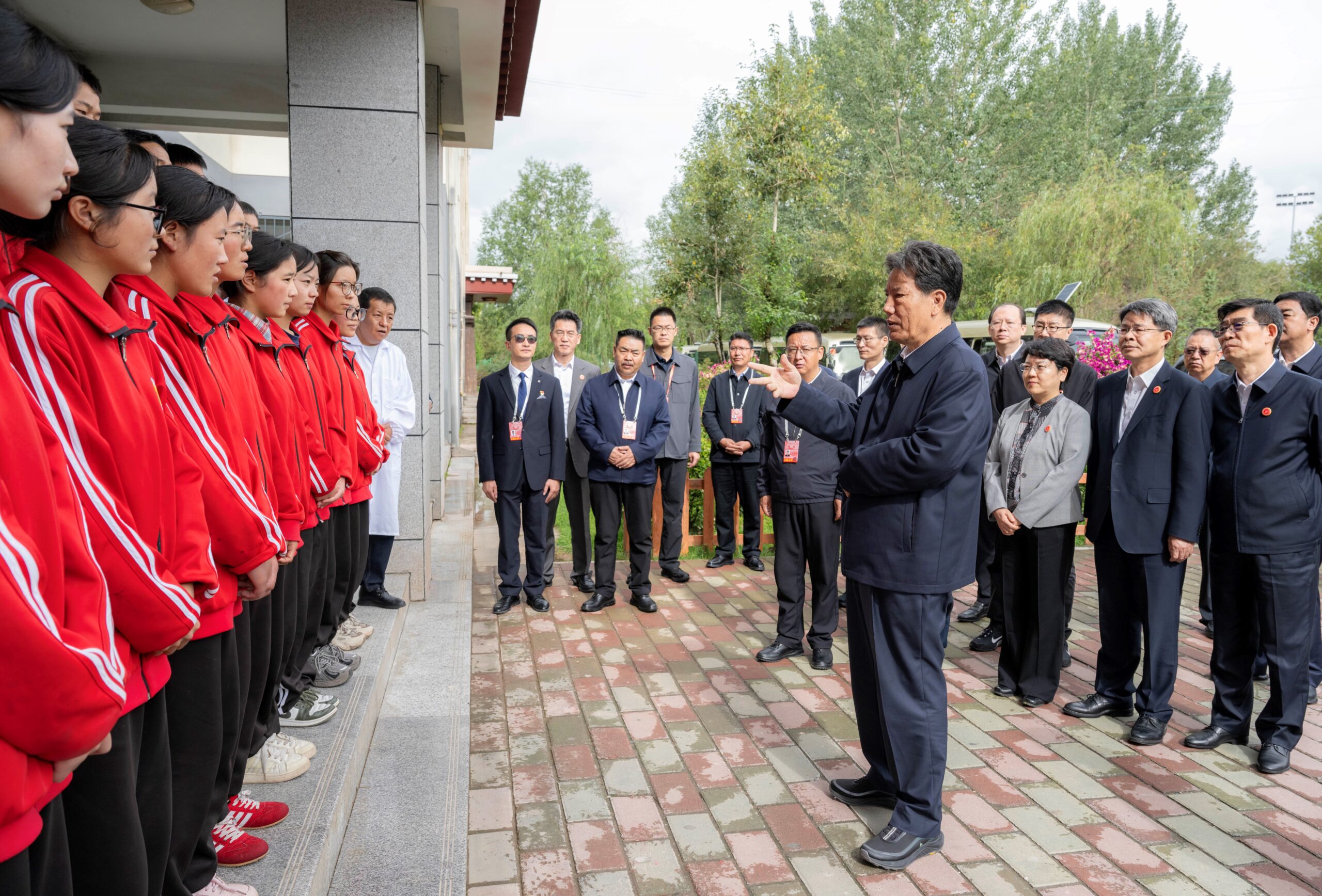
Beijing is engaged in a deliberate and devastating war on Tibetan heritage, culture, and memory. And in this war, the Chinese Communist Party’s chief target is Tibetan children.
March 2026
In Tibet today, the Chinese Communist Party (CCP) is waging a war not only against territory and religion, but against memory itself. The battlefield is the classroom. The weapons are language policies, boarding schools, and ideological indoctrination. And the targets are children — the most vulnerable carriers of culture.
The CCP has placed more than one-million Tibetan children in state-run boarding schools across the plateau. They are separated from their families, stripped of their language, and immersed in Mandarin-only education. They are taught to glorify Mao Zedong, to sing hymns to the People’s Liberation Army, and to view the CCP as the benevolent architect of their future. What is happening is not education — it is subjugation.
This campaign is deliberate, systematic, and devastating. It seeks to sever Tibetans from their heritage, to erase the transmission of Buddhist philosophy and Tibetan identity, and to engineer a generation that thinks, speaks, and dreams in Mandarin, loyal to Beijing rather than to Lhasa.
Factories of Assimilation
The boarding-school system is the centerpiece of Beijing’s strategy. Children as young as four are taken from their homes and placed in institutions where Tibetan language and culture are marginalized. Tibetan is taught, if at all, as a “secondary” subject, while Mandarin dominates instruction.
The separation from family is not incidental — it is essential. By removing children from the daily rhythms of Tibetan life, Beijing weakens the bonds of community and interrupts the transmission of culture. Parents report that their children return home unable to speak fluently in Tibetan, embarrassed by their traditions, and alienated from Buddhist practice.
This mirrors the darkest chapters of colonial history. The residential schools imposed on Indigenous peoples in North America sought to “kill the Indian, save the man.” In Tibet, the CCP seeks to “erase the Tibetan, mold the subject.” The trauma is generational, and the scars will last long after the classrooms are dismantled.
Language is the vessel of culture. To speak Tibetan is to carry centuries of philosophy, poetry, and ritual. To lose Tibetan is to lose the ability to pray in one’s own tongue, to recite ancestral stories, to transmit wisdom across generations.
Beijing understands this. That is why Mandarin is enforced as the sole medium of instruction. Tibetan is relegated to the margins, taught as a “local dialect” rather than a living language. The message is clear: Mandarin is the language of power, progress, and modernity; Tibetan is the language of backwardness, superstition, and irrelevance.
This linguistic displacement is not neutral. It is an act of cultural genocide, as the Dalai Lama himself charged Beijing with committing more than a decade ago. Beijing seeks to erase the very possibility of Tibetan identity by eroding the foundation upon which it rests.
The CCP does not stop at language. It fills the vacuum with ideology. Children are taught to glorify the Party and view Tibet’s incorporation into China as a “liberation.” Textbooks erase Tibetan history, portraying the Dalai Lama as a separatist and Buddhism as a relic.
Military training begins in elementary school. Children march in formation, sing patriotic songs, and participate in “red heritage” campaigns. The goal is not merely obedience — it is loyalty. By normalizing militarization and Party worship, Beijing seeks to engineer a generation that will not resist, because resistance will no longer be imaginable.
Why Beijing Targets Youth
Why this focus on children? Because the CCP understands that adults may resist, but children molded early are more malleable. By shaping the minds of the young, Beijing ensures that the next generation will be less resistant to Chinese rule.
This is a long-term strategy. It is not about pacifying Tibet today — it is about securing Tibet tomorrow. By erasing Tibetan identity in the classroom, Beijing hopes to eliminate the possibility of resistance in the future.
The human cost of this campaign is immense. Children suffer psychological trauma from separation. Reports describe beatings for wearing Buddhist blessing cords, punishment for praying, and humiliation for speaking Tibetan.
Families are fragmented. Communities are weakened. Generations risk growing up without fluency in Tibetan language or connection to Buddhist traditions. The result is not only cultural loss — it is spiritual devastation.
These policies violate international law. The UN Convention on the Rights of the Child guarantees the right to family life, cultural identity, and education in one’s own language. The UN Declaration on the Rights of Indigenous Peoples affirms the right to transmit culture and language across generations. Beijing’s boarding schools violate both.
The world cannot remain silent. To ignore this campaign is to enable cultural annihilation. Tibet is not merely a frontier region — it is a civilization. Its philosophy of compassion, its discipline of joy, its resilience in exile are treasures for humanity. To allow them to be erased is to impoverish us all.
What Can Be Done?
The international community must act. Governments should condemn the boarding-school system as a violation of human rights. They should support Tibetan-language preservation through funding for exile schools and digital archives. They must document abuses and pursue accountability through international law, while amplifying Tibetan voices, ensuring that the world hears from those directly affected.
Likewise, civil society must mobilize against the erasure of Tibetan culture. Universities can host Tibetan scholars. NGOs can support Tibetan families. Journalists can expose the realities of the boarding schools.
The Discipline of Memory
China’s boarding-school system in Tibet is a calculated project of mind control and cultural erasure. By forcing Mandarin, indoctrinating CCP thought, and severing children from their families, Beijing is attempting to engineer a generation of Tibetans who no longer think, speak, or believe as Tibetans.
But Tibetans have endured exile, repression, and loss before. They have transformed sorrow into resilience, and displacement into purpose. The discipline of memory is stronger than the machinery of erasure.
The world must stand with Tibet — not only to defend a people, but to defend the principle that identity cannot be engineered, that culture cannot be erased, and that dignity cannot be subjugated.
Khedroob Thondup is the nephew of the Dalai Lama.
Copyright © 2026 National Endowment for Democracy
Image credit: Zhai Jianlan/Xinhua via Getty Images
|
FURTHER READING |
||
Why China’s Effort to Erase Tibetan Identity Can’t Succeed |
Beijing Wants to Erase Tibet’s Name. Don’t Let Them.
|
Breaking Han Silence
|