
U.S. counterterrorism strategy across West Africa is quietly increasing coup risk—here’s how Washington can both better fight terrorism and prevent coups.
By Calin Trenkov-Wermuth and Alexander Noyes
February 2026
For much of the past decade, Benin stood out as one of the few remaining democratic anchors in West Africa. While coups swept across the Sahel and military juntas displaced elected governments, Benin — despite its democratic deficits — maintained civilian control of the armed forces and preserved constitutional rule. For Washington and its partners, the country appeared to demonstrate that counterterrorism cooperation and democratic governance could coexist.
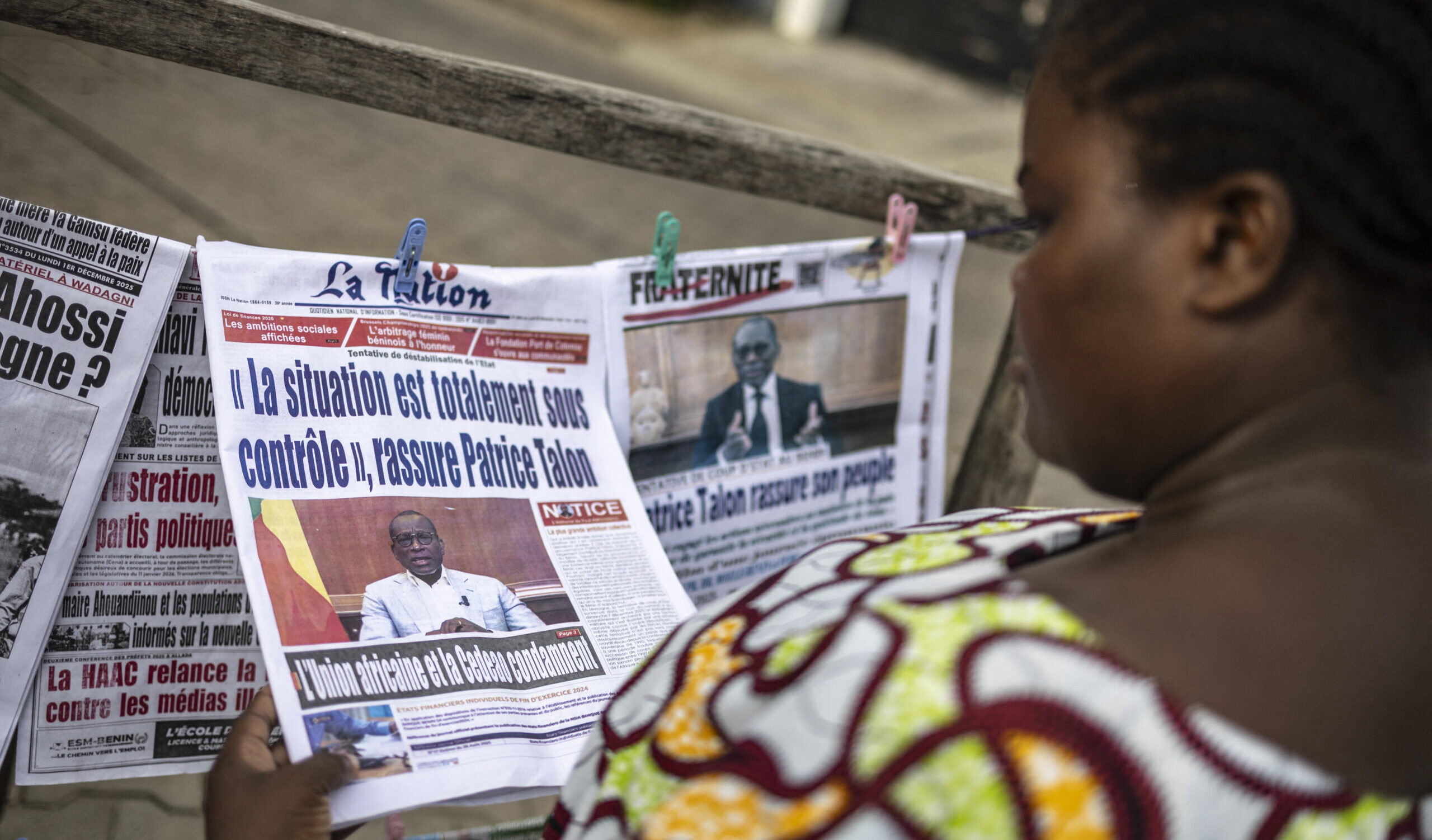
That all changed on 7 December 2025, when elements of Benin’s special forces launched a violent but ultimately failed coup attempt in Cotonou, the capital city. Members of the Special Forces Group (GFS) seized the national television station, attempted to detain President Patrice Talon, and took senior military officials hostage. At least one civilian was killed before loyalist forces — aided by Nigerian airstrikes and a surprisingly rapid ECOWAS intervention — restored civilian control.
Ultimately, the coup attempt collapsed within hours. But its failure should not obscure its significance. Benin’s experience exposes a widespread vulnerability now spreading across coastal West Africa — one tied directly to how states, often with U.S. support, have chosen to fight terrorism by supporting elite units without enough attention also paid to defense reform and the governance of security. At stake is not only security effectiveness, but the survival of civilian rule and democratic accountability in a region where both are already under severe strain.
This is the elite-forces trap. And a shift in Washington’s approach can help to counter terrorism effectively while helping to lower coup risk.
Tactical Success, Strategic Risk
Benin’s security environment has deteriorated rapidly over the last few years. Starting in 2019, with a noticeable increase in activity in 2021, Jihadist groups linked to al Qaeda and the Islamic State began pushing south from Burkina Faso, exploiting porous borders and weak rural governance. Attacks in northern Benin in early 2025 killed civilians and soldiers alike, threatening trade corridors and exposing the limits of the country’s traditional security posture.
The response followed a familiar pattern. Benin invested heavily in elite counterterrorism units designed for speed, mobility, and high-intensity operations. The GFS became the spearhead of this effort, deployed to the north and tasked with the most demanding missions. International partners, including the United States, reinforced this approach, prioritizing training, equipment, and operational advising for units capable of delivering rapid results, while focusing too little on the broader institutional defense capabilities that allow for such units to be both effective and professional.
From a tactical perspective, the strategy worked. Elite units responded faster, hit harder, and reassured both domestic audiences and foreign partners. But counterterrorism built for speed carries a hidden cost.
Over time, elite units absorb not just resources but prestige. They bear the highest operational tempo and casualties, develop strong internal cohesion, and come to see themselves as the state’s primary guarantors of security. This concentration of capability and identity is not inherently destabilizing — but in weak or eroding democracies, it accelerates the breakdown of civilian oversight and lowers the barriers to military intervention in politics.
Elite units do not need to be overtly politicized to become political. Capability itself is power. Benin’s reliance on elite units amid weak defense institutions produced uneven power, informal influence, and a perception among some forces that they could act independently of civilian authority.
When Politics Reaches the Barracks
In Benin, military dynamics collided with rising political tension. In October 2025, the electoral commission disqualified the leading opposition candidate from the 2026 presidential race. A month later, parliament approved a constitutional amendment extending the presidential term from five to seven years. Though term limits formally remained, these moves fueled concerns about clear democratic backsliding and elite entrenchment.
Inside the armed forces, frustration was already mounting. Troops deployed in the north faced repeated jihadist attacks and mounting losses. Officers privately questioned whether political leaders were matching security rhetoric with resources and strategy. Lt. Col. Pascal Tigri, identified as the coup’s ringleader, had long-standing ties to elite units and was known to be openly critical of the administration’s handling of security.
When the coup plotters appeared on national television, their language echoed a now-familiar regional script: accusations of corruption, poor governance, and neglect of soldiers fighting on the front lines. After failing to seize the president, they took senior generals hostage — an apparent attempt to force negotiations by exploiting a temporary absence of top military leadership.
This was not a spontaneous mutiny. It was a calculated coup attempt by an elite unit that thought it had the leverage and capability to overthrow the head of state and strongarm other branches of the military.
An Alarming Regional Pattern
Benin’s experience fits squarely within a broader West African pattern. In Mali, the coups of 2020 and 2021 were led by officers from combat-hardened units trained and supported by foreign partners. In Burkina Faso, junior officers drawn from counterterrorism formations toppled two governments in 2022 amid battlefield frustration and political paralysis.
Guinea followed the same trajectory in 2021, when special-forces officers who had been fast-tracked and publicly celebrated by the government seized power themselves. In Niger, the 2023 coup was likewise spearheaded by the presidential guard — one of the country’s most professional and well-resourced units.
In each case, elite units accumulated operational autonomy, cohesion, and political confidence long before they intervened. The result has been not only repeated coups, but the steady hollowing out of democratic institutions, as militaries becomes arbiters of political outcomes rather than subordinates to elected authority. The trigger was rarely ideology. It was a perceived collapse of civilian legitimacy combined with the belief that elite military actors could act where politicians could not.
Benin’s failed coup shows that coastal states long viewed as more resilient are now entering the same danger zone.
The Problem Is Not Special Forces — It’s Imbalance
The lesson here is not militaries should abandon elite units. Counterterrorism without tactical capability is fantasy. The problem is the types of military assistance and support that Washington and its international partners have chosen to prioritize.
U.S. security assistance to Benin has been limited compared to what some of its neighbors receive. Yet for more than a decade, U.S. security assistance to the region has emphasized access, speed, and elite performance — often through special-forces partnerships, expeditionary tactical advising and equipment, and short-term operational gains. Defense institutions, civilian oversight, and military governance have received far less attention, funding, and political backing.
This imbalance quietly reshapes civil–military relations. As elite formations grow in prominence, conventional forces stagnate. Ministries of defense remain weak. Personnel systems, promotion boards, and disciplinary mechanisms fail to keep pace with operational realities. Power within the armed forces becomes unevenly distributed, informal, and increasingly insulated from civilian control.
Under those conditions, coup risk — especially at the hands of tactically proficient elite units — goes up.
What Washington Should Do Differently
Fixing this problem does not require abandoning counterterrorism partnerships, which remain important to help countries in the region contain threats. But it does require taking a more comprehensive approach to military assistance that prioritizes the strengthening of defense institutions alongside the usual tactical-level train-and-equip support. This approach must be adopted across both the State and Defense Departments, which oversee most of the U.S. government’s military-assistance programming.
Education and training programs should be treated as the strategic tools they are, not as diplomatic courtesies. Instead of prioritizing tactical courses and short-term exchanges, training funding should emphasize professional military education, civil–military relations, defense management, and command accountability. Exposure to U.S. norms matters most when it shapes how officers think about authority, not how they clear rooms.
Equipment and training packages should also be conditioned on investments in personnel systems, promotion transparency, and disciplinary mechanisms that apply across the armed forces — and that do not exempt favored units.
Finally, Washington should adjust how it measures success. Access, partner capacity, and operational tempo are not sufficient indicators. Programs should be evaluated on whether assistance strengthens civilian control, reduces intramilitary inequality, and builds institutions capable of absorbing shock. That requires political engagement, not just military coordination.
Risk Management, Not Idealism
Benin’s coup attempt failed. The democratic warning it carries should not.
As insecurity spreads in the Gulf of Guinea, more governments will feel pressure to rely on elite units as expedient solutions to complex political and security challenges. When those units are empowered without corresponding investments in civilian oversight and defense governance, the result is not stability but the gradual erosion of democratic control over the use of force.
Thus, if Washington continues to privilege speed over structure and access over institutions, it will keep winning tactical battles all while watching partners unravel and fall into the orbit of adversaries like Russia and China.
The most serious threat to democracy in West Africa is not only armed groups operating at the margins of the state. It is the unintended political empowerment of military actors who come to see themselves as guardians of the nation rather than servants of elected authority.
Rebalancing U.S. security assistance toward institution-first counterterrorism is therefore not idealism. It is risk management and a democratic imperative — and one of the few remaining tools available to fight terrorism while preventing the next generation of coups from becoming permanent systems of military rule.
Calin Trenkov-Wermuth is the former principal security governance advisor at the U.S. Institute of Peace and coauthor of The Future of the Security Sector in Ukraine (2024). Alexander Noyes is a fellow at the Brookings Institution and coauthor of War at Arm’s Length: How America Can Build Effective Partners Through Military Assistance (forthcoming).
Copyright © 2026 National Endowment for Democracy
Image credit: OLYMPIA DE MAISMONT / AFP via Getty Images
|
FURTHER READING |
||
The Squeeze on African Media Freedom |
The Truth About Africa’s CoupsPraetorian politics are not making a comeback. Africa’s recent putsches have more to do with democracy’s failure to deliver than any fondness for military rule. |
The Myth of the Coup ContagionMany fear that coups are making a comeback. While this is not true, one thing is alarming: Anti-coup norms are starting to erode. |