

With global democracy threatened by China, Russia, and their fellow autocrats, how can America help secure a democratic future? The world’s liberal democracies must pursue a strategy of “defensive liberalism” to defend the freedoms we value most.
June 2026
During a recent trip to the Polish port of Gdansk on the Baltic coast, I found myself reflecting on what feels like an increasingly disordered, dangerous, and divided international system. With one war raging in Europe (Ukraine), another simmering in the Middle East (Iran), and fears of yet another on the horizon in the Pacific (China–Taiwan), a gloomy resignation about a dismal future of great-power conflict now colors many discussions of the world and America’s place within it. Though conflict between the United States and its great-power adversaries may not be inevitable, competition surely is and is already well underway, prompting the question: What is to be done to secure America’s security and prosperity in the decades to come?
As I pondered this question, I realized that I was but a stone’s throw from the historic city of Königsberg, known today by the Stalinist name of Kaliningrad. The association is apt, for it was in Prussian Königsberg that Immanuel Kant wrote his philosophical treatise Toward Perpetual Peace. And indeed, a version of Kant’s construct, updated for the twenty-first century, offers a compelling answer to the grand strategic question of “what is to be done?”
In that essay, Kant proposed three “definitive articles” that, if realized, would ensure peace and prosperity among nations:
First: “The civil constitution of each state shall be republican.”
Second: “The law of nations shall be founded on a federation of free states.”
Third: “The rights of men, as citizens of the world, shall be limited to the conditions of universal hospitality.”
Those who have studied international relations theory will recognize in Kant’s work the foundations of the modern international-relations tradition known as liberalism.
Modern liberalism is often derided by so‑called realists with the pejorative label of “idealism.” These “realists” insist that nothing has fundamentally changed in international politics since the Athenians told the Melians that “the strong do what they can and the weak suffer what they must.” But liberalism asserts that, despite an anarchic international system, states can — and often do — find ways to advance their mutual interests peacefully through cooperation, resting on essentially the same foundations that Kant identified centuries earlier.
First, we know that democracies are highly unlikely to go to war with one another, and that when political, economic, and even military disputes arise between democracies, they are extraordinarily successful at finding nonviolent solutions. Second, we know that free and open trade — and the economic interdependence it fosters — tends to incentivize peace rather than war. As recent events remind us, interdependence is not an ironclad guarantor of peace, but deeper economic ties raise the cost — and lower the incentive — of rupturing those ties through war. And third, we know that a robust network of interconnected and overlapping international institutions and organizations can help facilitate peaceful dispute settlement, especially when participating states are democratic and market‑oriented.
In a single phrase, Kant’s proposition could be summed up as peace based on freedom: free people living in free countries, with free economies, associating freely as sovereign states with those they choose.
Yet today these freedoms — and the possibility of a durable and just peace — are threatened by an Axis of Upheaval that represents the antithesis of these principles. This axis seeks to remake the world in its own image, where might makes right and the pursuit of raw, violent power is the only value that matters.
For more than four years, Russia has waged a bloody, genocidal war against Ukraine — not because NATO expansion forced its hand, as many realists would claim, but because Ukraine chose freedom. Russia’s war is predicated on denying the Ukrainian people the freedom to choose their own leaders, choose their own allies, choose their own trade partners, and choose their own destiny. When the unyielding tenacity of the Ukrainian people prevented Vladimir Putin from extinguishing these freedoms, he turned to a more terrifying goal: denying Ukrainians the right to live, the right to exist as a nation and a people.
Russia’s brutal campaign to render the Ukrainian state, nation, and identity extinct has been supported by other members of the Axis of Upheaval. China’s financial networks and energy purchases help Russia to pay for its war. Chinese trade networks enable Russia to evade export controls by funneling prohibited and dual‑use technologies into Russia’s defense industry. And, as is becoming increasingly clear, Beijing directly supports Russia’s war with various forms of material backing. Simultaneously, China extends its economic influence across the globe using tactics that are anathema to free‑market economics — pursuing a statist model of international economic dominance based on coercion for Beijing’s benefit rather than the mutual benefit envisioned by economic liberalism.
Meanwhile, less powerful but still dangerous members of the Axis of Upheaval, such as Iran and North Korea, provide artillery shells, rockets, and drones that Russia uses to devastate cities across Ukraine. Belarus continues to provide direct logistical support for Russian missile and drone strikes on Ukrainian civilians. As if this were not enough, Iran and North Korea continue to stoke chaos, upheaval, and violence in their own regions as they seek to dismantle the post–Cold War liberal order that has maintained stability, peace, and prosperity for more than thirty years. The same could be said of regional rogues Syria and Venezuela prior to the ouster of their longtime autocrats.
What is Gdansk today had been the Free City of Danzig from 1920 until Nazi Germany invaded Poland on 1 September 1939. The city’s fate is a reminder of what happens when the free world turns a blind eye to such naked aggression. Gdansk residents know all too well the consequences of allowing power‑hungry tyrants to dismember and destroy free countries to serve their ugly ambitions and ideologies. One cannot help but wonder whether Poland could have withstood the onslaught in 1939 had the Western world stood resolutely against Hitler at Munich the year before, when he promised to seek no territory beyond the Sudetenland.
But just as Danzig holds the warning, so too does Gdansk offer inspiration. It was there that the Solidarity movement was born, reminding us that no tyrant, no ideology, no evil can forever withstand the power of freedom. Just as communism was eventually defeated in Poland, in Eastern Europe, and ultimately in the Soviet Union itself, so too will the specter haunting the free world today be defeated.
But how?
A New Strategy for the Twenty-First Century
I propose a neo‑Kantian grand strategy for the twenty-first century that I call “defensive liberalism.”
We, the liberal democracies of the world, must be clear‑eyed in acknowledging that the project of building a universal “rules‑based liberal international order,” which began in earnest after the collapse of communism, has failed to achieve its most ambitious aims. Though many long‑suffering countries in this region reclaimed their rights as free members of the West, three decades of hoping that international institutions, economic integration, and democracy support would liberalize countries like Russia and China must now give way to reality. Decades of isolation and economic pressure likewise failed to bring positive change to Iran or North Korea. Not even the extraordinary decapitation of the Iranian leadership at the start of the 2026 Israeli-American assault has tempered the extremists who continue to rule from Tehran with an iron fist. The uncomfortable truth is that the countries comprising the Axis of Upheaval remain unreformed — and unreformable — from the outside.
The problem is not just that they refused to join and play by the rules of the liberal order. Today, in their own ways and through a wide range of malign methods, they seek to dismantle that order and replace it with one that Thucydides’ Athenians would have recognized: the strong do what they can, and the weak suffer what they must. By infecting their adversaries with corrosive disinformation, pulling levers of economic coercion, and manipulating the sovereign politics of free nations, these countries pursue a divide‑and‑conquer strategy to weaken and dismantle what remains of the liberal West. They must not be allowed to succeed.
Now is the time to circle the wagons and defend — collectively, with friends, allies, and partners — the freedoms that we have all fought for throughout our diverse histories. Defensive liberalism means investing in and strengthening the pillars of liberalism within the “federation of free states,” while mounting the most robust defense against threats from without.
And while I refer to “the West” as shorthand, thriving market democracies in East Asia — such as Japan, South Korea, and Taiwan — are part of the rules‑based liberal order and full‑fledged allies in our endeavor to protect freedom wherever it has taken root.
We must work tirelessly to improve transparency, reduce corruption, and invigorate the rule of law within our market economies. We must continue to tear down parochial economic barriers that prevent full coordination and integration of our collective economic engine. Together, we constitute the largest and most dynamic economic system the world has ever known — but only if we fully link all its constituent pieces.
This strategy calls for the elimination of tariffs and other barriers to trade in goods, services, and financial flows within the liberal world. At the same time, this approach depends on defending our markets from those outside the wire — most prominently, China — who take advantage of our openness to undermine our economic sovereignty and resilience. Tariffs and other barriers thus have a place in a strategy of defensive liberalism — not as cudgels wielded against our allies, but as instruments applied collectively with allies in defense of strategic sectors against our adversaries and enemies.
Defensive liberalism is not ignorant of the enduring importance of material power in international politics. We must devise dynamic twenty-first-century industrial policies that strengthen and improve the resilience of critical industries in the civilian sectors of our economies. For maximum impact, we must look beyond national borders and seek opportunities to achieve diversification and economies of scale in our defense industries by cooperating with allies across the liberal world. At a moment when output of American Patriot missile interceptors is woefully insufficient to meet the threat of Russian and Iranian missile attacks — let alone future threats from China — the United States must turn to our allies for solutions. This means granting production licenses and investing in co-production facilities for these and other critical weapons in allied nations to address current shortages and mitigate future supply risks.
We must also recognize that the era of the post–Cold War “peace dividend” is over. It is time to reinvest seriously in our defense industrial base if we are to deter — or fight — totalitarian adversaries who treat their own citizens as cannon fodder. The 2025 Hague Plan to increase NATO military and security‑related spending to 5 percent of GDP annually is a step in the right direction, but it may not be enough — nor soon enough — if regional conflicts spiral into global wars.
The second imperative of defensive liberalism is to reinvest in the bonds that have long tied us to one another as freedom‑loving nations. In the coming years, the mutually reinforcing web of international institutions, organizations, forums, treaties, laws, and — yes — military alliances will be a key source of strength for the liberal world. These relationships, and the formal structures that facilitate cooperation among allies, need renegotiation, repairs, renovations, and reinvestment. I have long believed that the power of allies is not just additive. When we work together, communicate openly with trusted partners, and settle disagreements in a spirit of common purpose and reciprocity, our unity is forged and our power is multiplied.
We know that there are often disagreements — even intense ones — within the closest families. But we must be forthright about the difference between legitimate differences of opinion among allies and those obstructionist members who do not hold the same fundamental commitment to liberal principles that form the bedrock of our strength. Divorces are never easy, but they are sometimes the only solution when irreconcilable differences threaten to become fatal weaknesses.
Finally, this brings me to the democratic pillar of defensive liberalism. Of all the fronts we must defend, this is the most important. Without the freedoms and liberties that democracy guarantees, the other pillars are hollow and hardly worth defending.
It is also the most imperiled, the one in most urgent need of reinforcement today. Internally, our societies are increasingly polarized, with politics reduced to a zero‑sum battle that denies the legitimacy of democratic rivals. As citizens disengage and lose faith in the legitimacy of democratic institutions themselves, they fall prey to the alluring but toxic appeal of populist strongmen who demand unwavering loyalty in exchange for a return to an imagined past, often by vilifying minorities, immigrants, and others whose differences are said to dilute the purity of the “true” people.
The Axis of Upheaval understands this and uses the openness of our democratic systems against us, with devastating effect. Our citizens are subjected daily to a relentless barrage of disinformation, manufactured by our adversaries and introduced like a virus into our information ecosystem with a skill and sophistication that make Cold War information operations seem quaint by comparison. By finding the cracks in our societies, seeping in, and wrenching us apart, foreign enemies play a corrosive role in setting the agenda and toxic tenor of our domestic political discourse — a daily violation of our sovereignty and democracy.
It is not just Russia, of course. China, North Korea, and Iran increasingly conduct sophisticated information operations against us because they have seen how effective such methods can be. If they can set us against one another, exploiting existing fractures within and between allies, they can severely undermine our ability to act resolutely in collective defense of our values and interests. And the risk of a dystopian world where “nothing is true and everything is possible” will only grow as technology and artificial intelligence make it ever easier to engineer convincingly deceptive alternative realities for those who accept everything they see and hear at face value.
So we must recommit, with renewed energy, to democratization and political liberalization within our own countries. When our own democracies are strong, so too is the global alliance of democracies.
The challenges before us are great as we urgently reinforce our defenses against the forces of global upheaval. Defensive liberalism — a collective, cooperative, collaborative effort of the free world to defend what we value most — is not an easy strategy. But it is the only strategy that can defeat the autocrats seeking upheaval.
And none of us can succeed on our own. I am reminded of a famous saying by one of America’s founding fathers, Benjamin Franklin, who, while signing the Declaration of Independence in 1776, mused: “We must all hang together, or assuredly we shall all hang separately.” Those words — and Kant’s solution — ring as true today as ever. Only by defending, with our allies, our most precious freedoms can we hope to prosper in peace in such extraordinary times.
Robert Person is a nonresident Senior Fellow at the Foreign Policy Research Institute (FPRI). The views expressed here are his own.
Copyright © 2026 JoD Productions
Image credit: Hyperfinch via Flickr
|
FURTHER READING |
||
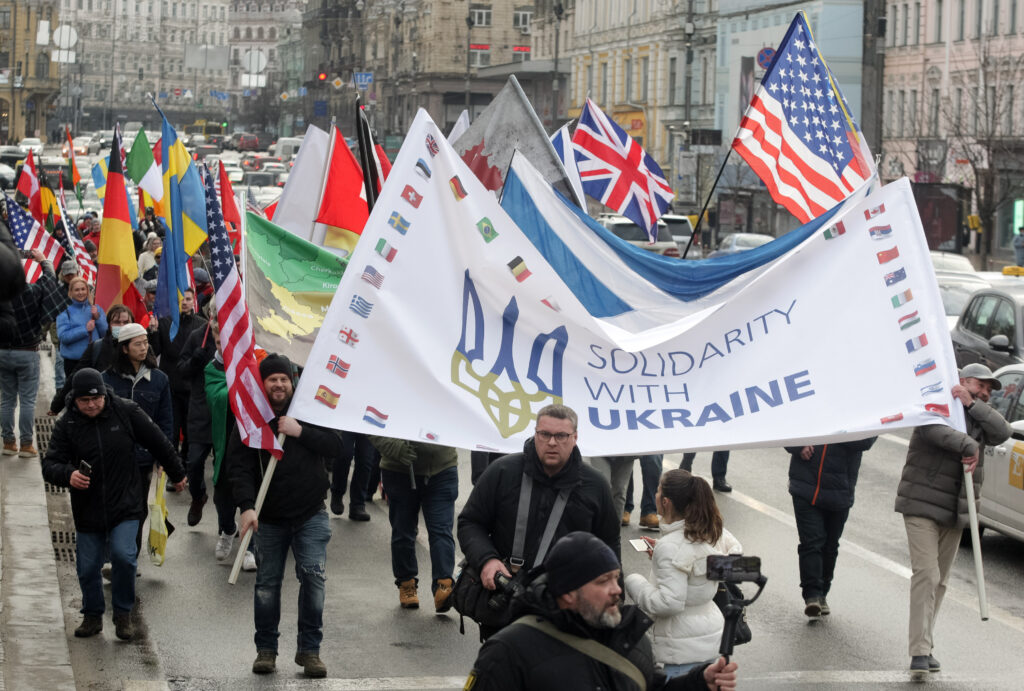
What Putin Fears MostRobert Person and Michael McFaul Forget his excuses. Russia’s autocrat doesn’t worry about NATO. What terrifies him is the prospect of a flourishing Ukrainian democracy. |
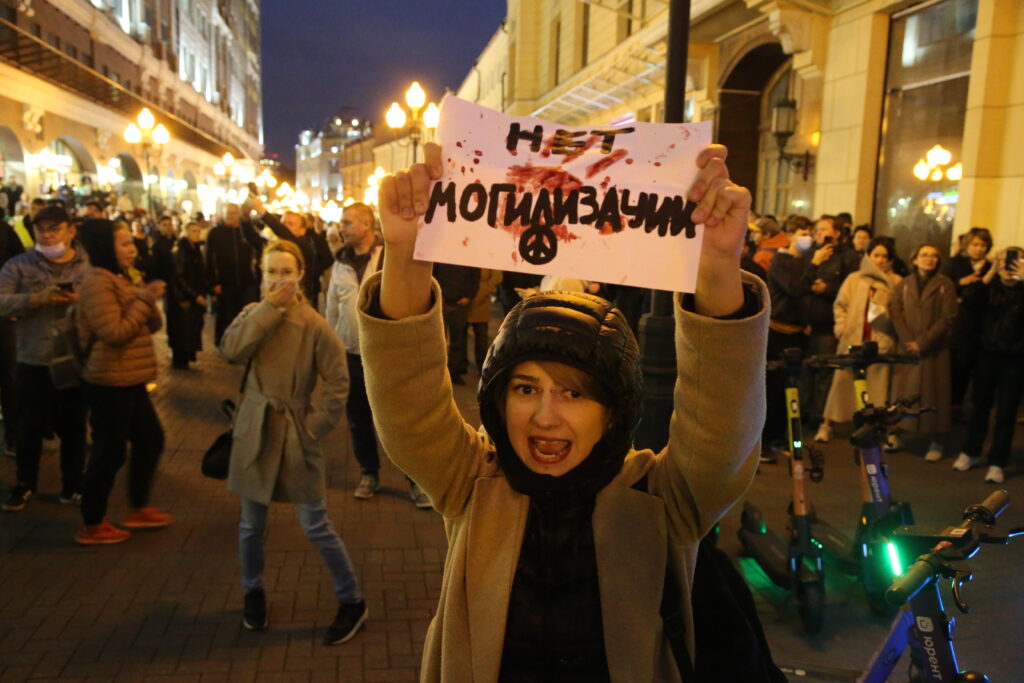
Putin’s Big GambleThe Kremlin’s order to call up Russians to fight in Ukraine risks massive protests. It’s the riskiest decision of Putin’s rule, and it could lead to his undoing. |
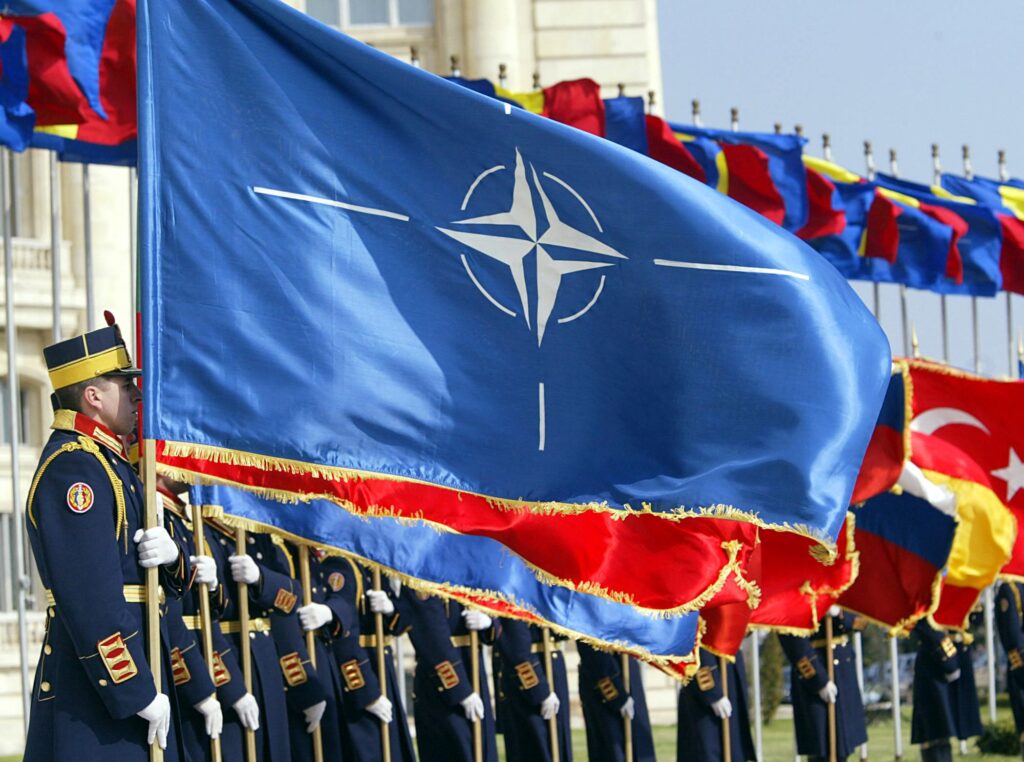
Why NATO Is More Than Democracy’s Best DefenseRobert Person and Michael McFaul |