

Why Gen-Z Is Rising
Young people from Peru to Madagascar to Nepal—furious with political elites reaping the spoils of privilege and corruption—are rising up to demand change. But what happens when their movements succeed?
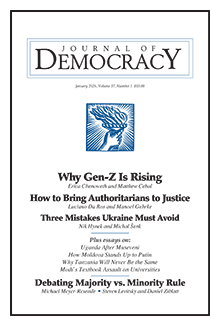
Volume 37, Issue 1
Young people from Peru to Madagascar to Nepal—furious with political elites reaping the spoils of privilege and corruption—are rising up to demand change. But what happens when their movements succeed?
Brazil did something that few democracies achieve: It convicted a former president of attempting a coup. How did the country’s courts hold would-be autocrat Jair Bolsonaro accountable when so many other coup plotters go unpunished?
A revolution in political participation is underway: Political players and advocacy groups are using AI to draft ballot initiatives, gather signatures, and persuade voters—undermining democratic legitimacy in the process.
Elected leaders across the globe are intentionally undermining their governments’ ability to govern. How and why do these leaders seek to dismantle the states they lead?
Ukraine must win its war against Russian aggression. But it is also true that the decisions it makes now will determine what kind of state it will be when the war is over.
Narendra Modi and his ruling BJP have developed the textbook attack on India’s universities and centers of free thought. It offers a vital warning for other countries where higher education is in danger.
The reelection of Uganda’s octogenarian president Yoweri Museveni may be a foregone conclusion, but the country is wracked with unease. His highly personalized regime is passing, and there is no clear view of what will follow.
As Tanzania’s October 2025 sham election got underway, protests broke out across the country, sparking a brutal regime crackdown. That brief reign of terror marks a turning point for both the ruling party and the Tanzanian people. There is no going back.
Moldova is poor, strategically located, and under intense pressure from Russia. But one of Europe’s smallest players has come up with a surprisingly effective recipe for holding Russian dominance at bay.
Ecuador was already besieged by crime and violence. Now it faces a populist president whose “strong hand” policies show little success. They may do even more damage to the country’s democracy.
Two decades ago, there was a wave of optimism about the rise of “Muslim democracy,” but these hopes have not been realized. What are the real barriers to progress?
Ukraine, Israel, and Taiwan are embattled democracies shaped by historic traumas and facing dire threats from powers that deny their right to exist. Can democracy endure in such conditions?
Whether preying on people’s anxieties or playing the part of the progressive liberal, autocrats and would-be authoritarians see “gender” as a tool that can be adapted to whatever use best serves their interests.
Authoritarians often abuse electoral systems and institutional power to thwart majority will. But the basic principles of democracy—political participation, fundamental rights, and the rule of law—can take shape in more than one way.
While attending to the risk of majoritarian abuse, we must also guard against institutions that empower—and even entrench—authoritarian minorities.
Maria Sandu on Russian interference; Ekrem İmamoğlu in solidarity with Europe’s democratic cities; opposition leader Tundu Lissu on inhumane prison conditions; a Malagasy student’s speech to gendarmes; a Nepalese student’s class speech against corruption; and the Hong Kong Alliance’s demand to release two political prisoners.