
The essay analyzes the global surge of Gen-Z–led mobilization, arguing that youth protests are propelled by economic precarity, exclusion from power, and especially corruption. It finds that movements with extensive youth participation can be potent yet face severe repression and rarely resolve structural grievances quickly. Organizing is often decentralized and leaderless, aiding diffusion but complicating bargaining and transitions. Cases examined include Tunisia’s 2010 uprising; anticorruption mobilizations in Nepal, Indonesia, Serbia, Peru, and the Philippines; and diffusion from Sri Lanka (2022) and Bangladesh (2024), with transition dynamics unfolding in Bangladesh, Nepal, Madagascar, and Peru. Durable gains hinge on disciplined mobilization during volatile transitions and converting protest energy into electoral and institutional influence.
A common finding from survey data is that Gen Z — comprising young people between the ages of 13 and 28 — is disconnected from politics and disillusioned with democracy.1 Yet youth mobilization has been a primary feature of recent efforts to bring change and accountability to ineffective governments around the world. Just this year, a wave of “Gen-Z protests” has swept the globe from Indonesia to Kenya and Madagascar to Peru. The results have been mixed: Youth-led uprisings have toppled governments, compelled reforms, and provoked violent clashes and crackdowns. Some youth-led struggles, as in Serbia, are ongoing.
Today’s Gen-Z protest movements follow a longer-term trend: Protest movements are often powered by young people. One study finds that, between 1990 and 2020, 80 percent of nonviolent campaigns to topple incumbent national leaders or achieve self-determination featured substantial youth participation, with people under thirty estimated to comprise at least a quarter of frontline participants.2 The second People Power Movement in the Philippines that ousted Joseph Estrada from power in 2001, the Cedar Revolution that expelled Syrian forces from Lebanon in 2005, and the Sudanese uprising that led to Omar al-Bashir’s fall from power in 2019 are but a few examples of movements powered in large part by young peoples’ active frontline participation. While youth disillusionment with established modes of governing may be real, the potential power of youth mobilization to challenge entrenched power is equally evident.
Now, Gen Z is rising. What are the drivers of Gen-Z protests, and how do these movements compare to past protest campaigns? Will young activists defy the authoritarian current and bring forth a renewed wave of democratic change, or will they be stymied? And are they even about democracy at all? What does rising youth mobilization herald for the years to come? Putting the current Gen-Z protests in comparative perspective, this essay offers some brief observations about the promise and perils of youth-led mass mobilization. If history is any guide, efforts to reverse the global democratic recession will likely align with the fates of youth-led movements around the world.
Greed Is a Global Grievance
A multitude of factors motivate young people to protest. Youth are especially vulnerable to economic precarity; stagnant economies mire young people in chronic unemployment and dash dreams of upward mobility, even among educated graduates. This was the case in Tunisia in 2010, for instance, where the combination of economic malaise, thuggish repression, and impunity for government abuses led frustrated youth to rally in outrage around street vendor Mohamed Bouazizi’s self-immolation, launching the Arab Spring.3 Moreover, young people are notoriously underrepresented in formal institutional politics, as gerontocratic political systems exclude younger generations from the halls of power that hold sway over their lives.4
The Gen-Z protests exemplify these trends. Many of the countries to experience Gen-Z protests feature persistently weak economies, high youth unemployment, and swelling youth populations governed by an aged cohort of political elites who are far older than the average citizen. For instance, youth unemployment stands at roughly 20 percent in Nepal and an astronomical 35 percent in Morocco, and both countries’ economies reeled under covid-19 pandemic shocks.5
But the Gen-Z protests’ true rallying cry seems to be corruption: Young people are furious with political elites, who shamelessly reap the spoils of opulent privilege while their countries suffer. In Nepal, viral images of “nepo kids” flaunting luxury gifts provoked mass outrage. In Indonesia, protests were incited by the revelation that parliamentarians were receiving a monthly housing allowance many times greater than the minimum wage. Young Serbians mobilized following the 2024 collapse of the Novi Sad railway station that killed more than a dozen people, a tragedy protesters blamed on government corruption and negligence. Peruvian protesters have demanded justice for endemic criminal extortion and violence, enabled by blatant government complicity with organized crime. Protests coalesced in the Philippines after a July government report disclosed that more than US$2 billion intended for flood-relief projects had been lost to corruption. In all these cases and more, Gen Z is rebelling against rapacious elites who put their own privileges over the public good.
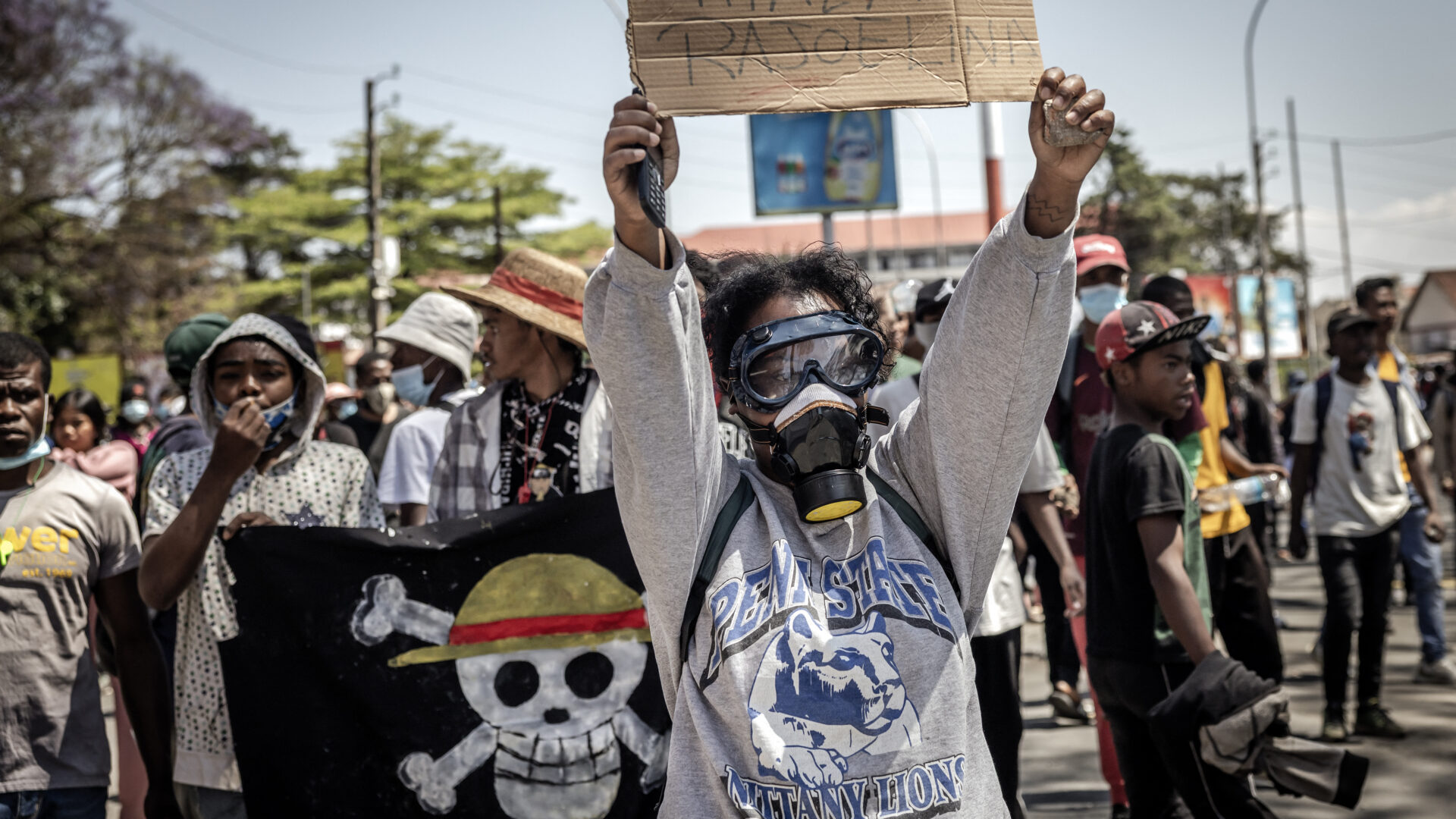
This anticorruption crusade of 2025 first diffused in Asia, as protests in Indonesia, the Philippines, and Nepal drew inspiration from earlier uprisings in Sri Lanka (2022) and Bangladesh (2024).6 Yet anticorruption campaigns have caught fire globally. Iconography from the hit Japanese manga “One Piece” can be found all over the world, as Gen-Z protesters from Madagascar to Peru display creative variations of the Straw Hat pirates’ flag as a symbol of the liberation of common people from corrupt leaders. Anticorruption is a universal theme that resonates widely. Deepening global interconnectivity via the internet and social media has likely helped to further ease protest diffusion across regional boundaries.
Youth Movements Often Win — But at a Cost
Prior research has found a powerful association between youth participation in political protest and the success of maximalist nonviolent campaigns — that is, “those that seek to remove the incumbent national leadership from power or create territorial independence.”7 Indeed, most cases that feature extensive youth participation succeed, while most that do not fail (see Table). Results from a recent study suggest that the average nonviolent campaign is more than twice as likely to succeed if it has extensive youth participation, where more than 50 percent of the observed frontline participants are young people, compared with limited youth participation, where fewer than 10 percent are.8
We also observe positive associations between youth participation and measures of egalitarian and liberal democracy in the years after the campaign ends. Sirianne Dahlum and Adam Bonica highlight the crucial role that student protests have played in democracy movements over the past seventy years, from South Korea to Taiwan to East Germany to Brazil.9
Why do movements with high youth participation win? Scholars have argued that young people are highly committed activists, deploy novel and creative protest tactics, and are better positioned to build broad coalitions across rigid sociocultural divides.10 Examples of these dynamics are plentiful, from Ukrainian students occupying Kyiv’s Independence Square in the frigid winter during the 2013–14 Euromaidan protests, to Lebanese youth mobilizing across entrenched sectarian lines during the 2019 October Revolution, to ingenious Hong Kong youth innovating new techniques to evade Chinese surveillance during 2019 protests.
However, young people also face important obstacles. Most crucially, youthful campaigns tend to be positively associated with more intense repression, even though they are no more likely to use violence themselves.11 These findings parallel those from Ragnhild Nordås and Christian Davenport and Ayal Feinberg and Idean Salehyan, who argue that autocratic regimes and their security forces find youth especially threatening, and therefore tend to violently repress them.12
Unfortunately, that pattern is well exemplified by the Gen-Z protests, many of which have suffered lethal crackdowns. In Bangladesh, the government’s July 2024 massacre killed hundreds — though the repression soon backfired, as mounting popular outrage forced Prime Minister Sheikh Hasina to flee the country in August. In Kenya, dozens were killed during protests against the 2024 Finance Bill, dozens more have died in 2025, and many young activists have been abducted by security forces in a failed effort to suppress dissent. Moroccan security forces aggressively repressed the Gen-Z 212 movement, arresting thousands and imposing harsh prison sentences. And most recently, a brutal postelection crackdown on youth protests in Tanzania left more than a thousand dead in late 2025.13
Moreover, even when youth-led protests successfully topple dictatorships, young people still may not see improvements to their material well-being. One study, for instance, reveals no association between youth protest participation and improvements in youth unemployment in the following years.14 Even though youth protests are positively associated with liberalization, changing the head of state is often far easier than resolving the root socioeconomic grievances fueling protests in the first place. Today’s Gen-Z protests may be on a collision course with this reality — and if new governments do fail to deliver, they may wind up facing recurrent mobilization in the years to come.
Gen-Z for Democracy?
Recent studies argue that a mobilized civil society is an essential antidote to the ongoing trend of global democratic backsliding.15 Along these lines, informed readers might infer that the Gen-Z protests are a positive indicator of mass resistance to authoritarianism, a rising bulwark against the global illiberal tide.
There are reasons for both optimism and caution when making predictions about the democratizing effects of Gen-Z protests. Strengthened democracy is certainly one possible outcome of mass Gen-Z mobilization. That said, at least four aspects of the Gen-Z protests should temper overly idealistic expectations for democratization.
Nonviolent discipline. First, it is not clear that recent Gen-Z protests have been able to fully embrace or enforce nonviolent discipline. A large body of research extols the democracy-promoting benefits of nonviolent resistance compared to violence. Audiences tend to perceive nonviolence as morally appealing and appropriate, which increases participation. Nonviolent coalition building also embodies core democratic values of pluralism and tolerance, allows for the broadening of prodemocracy networks across different crucial constituencies, and is associated with durable democratization.16 In contrast, violent resistance tends to decrease popular identification with movements, repel potential participants, and increase support for repression against movements and dissent more generally.17
To be clear, many Gen-Z activists initially mobilized around explicit calls for peaceful protests. For instance, Morocco Youth Voice, a group that helped to organize initial protests alongside Gen-Z 212, published a code of conduct endorsing nonviolence and disavowing violence and vandalism.18 In Madagascar, protests were also initially peaceful, with demonstrations becoming more chaotic after police began to use more heavy-handed crowd-control tactics such as tear gas and rubber bullets.
However, protests that begin nonviolently do not always stay that way, regardless of movement organizers’ best intentions. In Nepal, a mass nonviolent march was quickly overtaken by violent rioters. The following day, dozens died as a crowd burned down the parliament building along with prominent politicians’ homes. Similar scenes played out in Morocco, Kenya, and Indonesia, where protesters clashed with security forces while arsonists torched government and police buildings. Many instances of protester violence were clearly provoked by violent state repression. Yet whatever the inciting factor may be, once movement-aligned actors begin to use violence toward their opponents, the situation can quickly spiral beyond organizers’ control, sidelining peaceful activists while their movements are either “hijacked” by more radical elements or marginalized by either antirevolutionary forces or political moderates, who may support change but not at the cost of violent disorder.19
In the short term, violent protests may still compel change, as was seen in Nepal and Madagascar. But, in the long run, such methods are not typically conducive to durable, stable democracy.20
Decentralized movements. Another feature of the Gen-Z movements is their leaderless organizational structures. Modern social movements often tout decentralization as a core virtue, as young activists tend to eschew rigid leadership hierarchies in favor of diffuse horizontal ties spread through digital organizing.21 This makes modern protest movements quicker to mobilize, more immediately responsive to organic grassroots sentiment, and more difficult to fully repress. Some recent movements have explicitly adopted such approaches, as did activists associated with Hong Kong’s June 5 Revolution in 2019.
Yet “leader-full” movements are not totally immune to repression, as many of the key organizers of Hong Kong’s uprising experienced directly. And what such movements gain in adaptability, they may sacrifice in coalitional cohesion and bargaining power. Without a centralized authority, movements may struggle to establish and enforce clear standards of behavior, contain violent flare-ups before they spiral beyond control, or make credible commitments at the negotiating table. Because negotiated transitions to democracy often prove to be the most durable, civil society groups with clearer organizational representation in such negotiations are more likely to shape the country’s future.22
“Democracy” movements? Third, Gen-Z protests are not necessarily about democracy qua democracy. Certainly, some Gen-Z movements have rallied around explicit calls for democratic reform. Bangladesh is undertaking major constitutional revisions in the wake of its 2024 uprising. In Peru, prominent activists castigate their government as “a dictatorship disguised as a democracy,” treating corruption and democracy as inextricably linked.23 And in Nepal, Gen-Z activists have used the protests as an opportunity to push for political-party reforms that would retire old elites and improve youth representation in parliament.
That said, the Gen-Z protests are primarily motivated by socioeconomic inequality, corruption, and nepotism — grievances that are related to good governance, but not centered around democracy itself. For instance, in Morocco, Gen-Z protesters are demanding state investment in improving dilapidated health and education services, not to abolish the monarchy. And in Madagascar, it remains unclear whether protesters will resist the military coup that capped off Gen-Z protests against President Andry Rajoelina, if the new military-led government can resolve water and power outages.24
In short, while some Gen-Z protests may invoke democratic themes, democracy itself may not be their primary raison d’^etre. While popular narratives may use “democracy movements” as a catchall term for protest movements against corrupt governments, observers should be careful not to project ideological commitments onto Gen-Z movements beyond protesters’ stated grievances.25
Navigating transitions. Finally, regime transition periods are fraught with uncertainty. Transitions involve power struggles and complex political interactions that are difficult to predict in the best of circumstances. All too often, reactionary forces interrupt democratic reforms and roll back progress.
Although some Gen-Z protests have deposed offending heads of state, their countries’ futures remain up for grabs. Bangladesh entered a constitutional crisis when Prime Minister Hasina fled to India, though the provisional government now appears on track to hold elections and a national referendum on constitutional revisions next year. In Nepal, the interim government (chosen by Gen-Z activists coordinating over Discord) is under pressure to restore order in time to hold secure, free, and fair elections in March 2026.26 In Madagascar, the new military government could consolidate power, but may yet face renewed popular protests. And in Peru, deposed president Dina Boluarte’s successor José Jerí promised a crackdown on crime, but Gen-Z protesters see the entire Peruvian political class as corrupt and untrustworthy, and have demanded Jerí’s resignation.
Civil-resistance scholarship reveals that continued nonviolent mobilization during transition periods is key to successful democratization.27 If democracy movements demobilize too soon, they open the door for entrenched elites to sabotage transition agendas and sideline youth activists. Along these lines, Gen-Z activists can draw inspiration from their Serbian peers, who have mobilized consistent protests for over a year in a defiant signal that they will not be silenced until their demands for accountability are fully met.
Relatedly, democratic transitions can also hinge on the internal make-up of democracy movements. Sirianne Dahlum, for instance, shows that socially diverse nonviolent movements that unite people across various social strata are positively associated not just with democratic breakthroughs, but also with sustained democratization over time.28 Thus, Gen Z’s efforts to successfully navigate regime transition periods will likely depend on whether it manages to build meaningful and durable connections between different social groups, including youth, women, and minority groups.29
Gen-Z Rising
The central throughline of existing scholarship is that, as the saying goes, nonviolent campaigns are movements, not moments. Success requires strategic planning, disciplined organization, and persistence over the long haul. It is abundantly clear that a significant proportion of Gen Z is tired of sitting on the sidelines while their political systems fail them. And it is noteworthy that many Gen-Z movements are yielding major shake-ups during a period of global democratic backsliding, when governments have otherwise tended to maintain an advantage over mass movements.30 Still, whether these young protesters can manifest and sustain the core qualities of successful nonviolent movements remains to be seen.
Looking ahead, a key question will be whether Gen Z can channel momentum from protests into formal institutional politics. At least in democratic systems, electoral politics is the crucial link through which democracy movements convert the short-term leverage gained through disruptive activism into political reforms that endure over time. Yet many activists are deeply skeptical of political parties and politics writ large. This is understandable — young people across the globe have been disillusioned by established parties and other political institutions that appear irredeemably corrupt and that willfully exclude them from power.
In this respect, politicians and political parties have an important role to play in harnessing Gen Z’s energies for good. Governments or political leaders that earnestly engage youth and win Gen Z’s support stand to reap enormous gains. This latent reservoir of youth political power is clearly illustrated by democratic socialist Zohran Mamdani’s 2025 campaign for New York City mayor. Initially a little-known candidate, Mamdani spoke directly to young people, providing an aspirational vision for “a city we can afford,” condemning his primary opponent as deeply corrupt, and connecting with voters through a digitally savvy campaign that distinguished him from out-of-touch older candidates. On election day, Mamdani’s youth outreach paid off in spades when energized young people helped to carry him to victory.
Ultimately, Gen Z may be experiencing a global political awakening. Today, young people constitute a large and growing demographic — there are an estimated 2.8 billion people between the ages of 10 and 29, or roughly a third of the global population. If young people continue to build on their momentum and commit to sustained political activism — and sclerotic governments work to bring young people into the fold — 2025 may prove to have marked the beginning of a profound generational transformation in world affairs. For global democracy’s sake, greater youth engagement cannot come soon enough.
NOTES
-
- Roberto Stefan Foa et al., “Youth and Satisfaction with Democracy: Reversing the Democratic Disconnect?,” Cambridge: Centre for the Future of Democracy, October 2020; Gerardo Berthin, “Why Are Youth Dissatisfied with Democracy?” Freedom House, 14 September 2023,
https://freedomhouse.org/article/why-are-youth-dissatisfied-democracy
-
- .
2. These claims rest on a recent cross-national study on youth frontline participation in 209 maximalist nonviolent campaigns from 1990–2020. Data available here. For an extended analysis, see Chenoweth et al., Youth and LGBTQ+ Participation in Nonviolent Action (Washington, D.C.: U.S. Agency for International Development, 2023), https://www.hks.harvard.edu/publications/youth-and-lgbtq-participation-nonviolent-action.
3. Mark R. Beissinger, Amaney A. Jamal, and Kevin Mazur, “Explaining Divergent Revolutionary Coalitions,” Comparative Politics (2015).
4. Brit Anlar et al., “The Global Youth Participation Index Report 2025,” Brussels: European Partnership for Democracy 2025.
5. Rudabeh Shahid, Nischal Dhungel, and Shakthi De Silva, “The Economic Roots of Nepal’s Uprising — And What It Means for the Region,” Atlantic Council, 19 September 2025, https://www.atlanticcouncil.org/blogs/new-atlanticist/the-economic-roots-of-nepals-uprising-and-what-it-means-for-the-region/
6. Paul Staniland, “Why South Asia’s Regimes Keep Falling,” Journal of Democracy, September 2025, https://www.journalofdemocracy.org/online-exclusive/why-south-asias-regimes-keep-falling/.
7. Erica Chenoweth, “The Future of Nonviolent Resistance,” Journal of Democracy 31 (July 2020): 70.
8. Erica Chenoweth et al., Youth and LGBTQ+ Participation in Nonviolent Action.
9. Sirianne Dahlum, “Students in the Streets: Education and Nonviolent Protest,” Comparative Political Studies 52, no. 2 (2019): 277–309; Adam Bonica, “The Power of Student Protests in the Fight for Democracy: Why Trump and Authoritarians Worldwide Fear Campus Activism,” On Data and Democracy,Substack newsletter, 7 March 2025.
10. Jonathan Pinckney and Miranda Rivers, Precarity and Power: Reflections on Women and Youth in Nonviolent Action (Washington, D.C.: U.S. Institute of Peace, 2021), https://www.usip.org/publications/2021/09/precarity-and-power-reflections-women-and-youth-nonviolent-action; Cihan Erdal and Jacqueline Kennelly, eds., De Gruyter Handbook of Youth Activism (Berlin: Walter de Gruyter, 2026).
11. Chenoweth et al., Youth and LGBTQ+ Participation in Nonviolent Action; Dahlum, “Students in the Streets.”
12. Ragnhild Nordås and Christian Davenport, “Fight the Youth: Youth Bulges and State Repression,” American Journal of Political Science 57, no. 4 (2013): 926–40; Ayal Feinberg and Idean Salehyan, “Student Protest, Violent Interactions, and State Repression,” Journal of Peace Research 62, no. 1 (2025): 85–101.
13. Nicholas Bariyo, “The Power of Gen Z Protesters Meets Lethal Force in Tanzania,” Wall Street Journal, 9 November 2025, https://www.wsj.com/world/africa/the-power-of-gen-z-protesters-meets-lethal-force-in-tanzania-f298adfb.
14. Chenoweth et al., Youth and LGBTQ+ Participation in Nonviolent Action.
15. Stephan Haggard, Backsliding: Democratic Regress in the Contemporary World(Cambridge: Cambridge University Press, 2021); Matthew Cebul, Nonviolent Action Against Democratic Erosion: The United States in Comparative Perspective (Cambridge: Harvard University, Ash Center for Democratic Governance and Innovation, 2025), https://ash.harvard.edu/resources/nonviolent-action-against-democratic-erosion-the-united-states-in-comparative-perspective/.
16. Markus Bayer, Felix S. Bethke, and Daniel Lambach, “The Democratic Dividend of Nonviolent Resistance,” Journal of Peace Research 53, no. 6 (2016): 758–71; Daniel Lambach et al., Nonviolent Resistance and Democratic Consolidation(New York: Palgrave Macmillan, 2020); Luke Abbs, The Impact of Nonviolent Resistance on the Peaceful Transformation of Civil War (Washington, D.C.: International Center on Nonviolent Conflict, 2021).
17. Erica Chenoweth and Maria J. Stephan, Why Civil Resistance Works: The Strategic Logic of Nonviolent Conflict (New York: Columbia University Press, 2011); Yonatan Lupu and Geoffrey P. R. Wallace, “Violence, Nonviolence, and the Effects of International Human Rights Law,” American Journal of Political Science 63, no. 2 (2019): 411–26. Pearce Edwards and Daniel Arnon, “Violence on Many Sides: Framing Effects on Protest and Support for Repression,” British Journal of Political Science 51, no. 2 (2021): 488–506; Sirianne Dahlum, Jonathan Pinckney, and Tore Wig, “Moral Logics of Support for Nonviolent Resistance: Evidence from a Cross-National Survey Experiment,” Comparative Political Studies 56, no. 3 (2023): 326–62.
18. Firdaous Naim, “Morocco’s Youth Say Enough to Broken System, Plan Nationwide Protest September 27,” Morocco World News, https://www.moroccoworldnews.com/2025/09/259678/moroccos-youth-say-enough-to-broken-system-plan-nationwide-protest-september-27/.
19. Hannah Beech, “How a Gen Z Revolution Spiraled Out of Control,” 8 October 2025, New York Times, https://www.nytimes.com/2025/10/08/world/asia/nepal-gen-z-revolution.html.
20. Chenoweth et al., Youth and LGBTQ+ Participation in Nonviolent Action.
21. Zeynep Tufekci, Twitter and Tear Gas: The Power and Fragility of Networked Protest (New Haven and London: Yale University Press, 2017); Edmund W. Cheng and Samson Yuen, The Making of Leaderful Mobilization(Cambridge University Press, 2025). Sooyeon Kang, The Politics of Leaderless Movements, unpubl. ms., Loyola University Chicago, 2025).
22. Kang, The Politics of Leaderless Movements.
23. Dan Collyns, “‘We’ll March as Many Times as Necessary’: Peru’s Youth Protesters Defy State of Emergency,” Guardian, 25 October 2025, https://www.theguardian.com/world/2025/oct/25/peru-youth-protesters-state-of-emergency-gen-z.
24. For 2024 polling data on support for military rule in Madagascar, see Afrobarometer (2025).
25. Mark R. Beissinger, “The Semblance of Democratic Revolution: Coalitions in Ukraine’s Orange Revolution,” American Political Science Review 107, no. 3 (2013): 574–92.
26. Tulsi Rauniyar, “The Inside Story of How Gen Z Toppled Nepal’s Leader and Chose a New One on Discord,” Wired, 4 November 2025,https://www.wired.com/story/nepal-discord-gen-z-protests-vote-prime-minister-election/.
27. Jonathan Pinckney, From Dissent to Democracy: The Promise and Peril of Civil Resistance Transitions (Oxford University Press, 2020).
28. Sirianne Dahlum, “Joining Forces: Social Coalitions and Democratic Revolutions,” Journal of Peace Research 60 (January 2023): 42–57.
29. Pinckney, From Dissent to Democracy; Dahlum, “Joining Forces.”
30. Chenoweth, “The Future of Nonviolent Resistance.”
Copyright © 2026 National Endowment for Democracy and Johns Hopkins University Press
Image credit: LUIS TATO/AFP via Getty Images