
This essay challenges the assumption that political polarization leads naturally to political violence. Surveying cases from ancient Alexandria and the Russian pogroms to lynching in the American South, Hindu-Muslim riots in India, and the 2017 “Unite the Right” rally in Charlottesville, the essay argues that polarization turns deadly only when several forces converge: when affective hostility fuses with fears of demographic change and political displacement, when groups come to see control of the polity as a matter of collective survival, and when the state retreats from enforcing equal protection. Mass democracy heightens the danger by translating demographic difference into political power. Yet fatalism is unwarranted—most polarized societies remain peaceful, and Charlottesville did not become a pogrom because institutions held. The United States, the essay concludes, is not on an inevitable path to violence so long as its civic order and sense of common membership endure.
It stands to reason that political polarization and political violence should be closely connected. Yet the relationship between democratic conflict and collective bloodshed turns out to be far more contingent and elusive than is often assumed. In a society marked by mutual trust, affection, and broad agreement, political violence would be hard to imagine. The reverse, however, does not necessarily hold. Even societies marked by deep disagreement and mutual hostility do not inevitably descend into violence.
But in recent years, debates about polarization in the United States have become increasingly blended with fears of political violence.1 Ordinary homicide rates have declined, but threats and acts of political violence have risen sharply. Beyond an attempt to prevent the peaceful transfer of power, assassinations, threats against judges, governors, members of Congress, election officials, and local public servants have risen dramatically, while harassment, doxxing, swatting, and intimidation have become increasingly common features of democratic life. Public officials now routinely describe fears not only for themselves but for their families. One state legislator, reflecting after the assassination of Minnesota lawmakers, described the experience of contemporary politics as “a fishbowl where people can stand over us with not signs, but guns.”2
Much of this violence remains individualized and carried out by socially marginalized lone wolves. But we have also seen a return to older forms of organized social aggression, what Donald Horowitz has called “the deadly ethnic riot” and others more colloquially describe as a “pogrom.”3 These are socially organized forms of political violence directed not at individuals, but at entire communities cast as alien, dangerous, or illegitimate. Such riots were once common in the United States, but by the time Horowitz wrote his synthesis the bulk of his examples came from the Global South.
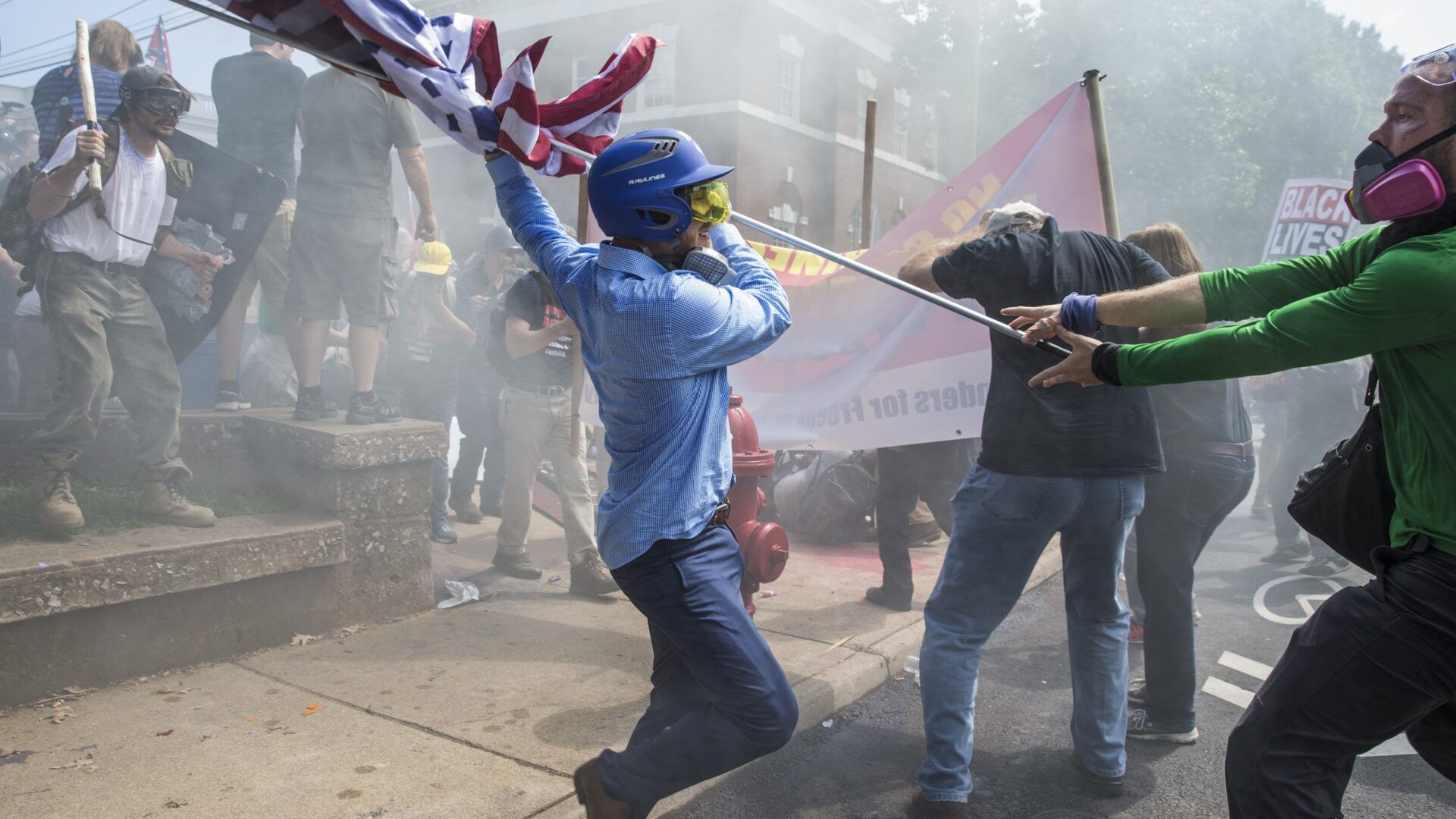
The events in Charlottesville, Virginia, in August 2017 reminded us that pogrom politics are back. Hundreds of torch-bearing demonstrators marched through the campus of the University of Virginia chanting “Blood and Soil” and “Jews will not replace us.” The slogans fused white nationalism, antisemitism, and demographic panic into a single political message. The rally ultimately ended in deadly violence when a white supremacist drove his car into a crowd of counterprotesters.
As James Loeffler’s incisive forthcoming study demonstrates, the rally was more than a bout of political extremism.4 It reignited deep tensions within American democracy concerning racism, antisemitism, free speech, political intimidation, and equal citizenship. Charlottesville revealed how, under the right circumstances, polarized democratic conflict can move toward violence. The “Unite the Right” march was partly expressive politics. Andrew Anglin, editor of the Daily Stormer, put it succinctly in a blog post ahead of the march: “August 12, 2017 is going to be a shot heard around the world. . . . Next stop Charlottesville, VA. Final stop: Auschwitz.”5 Protesters moved in formation carrying torches evocative not only of fascist spectacle but also of the long American history of racial intimidation. The chants expressed disagreement. They also asserted that Jews and African Americans above all did not belong and were fundamentally alien to the nation itself.
Charlottesville did not become a pogrom. State institutions ultimately held, however imperfectly. But it does invite one to pose a question central to democratic politics. Under what conditions does polarization become violent? Much public discussion assumes a relatively straightforward relationship between polarization and democratic breakdown. Democracies, however, have always contained conflict, disagreement, and deep ideological divisions. Polarization in the sense of deep and fundamental ideological disagreement does not produce collective violence. It is at most a necessary, but clearly not sufficient, condition.
So, when does polarized politics lead to deadly riots? It is most likely to do so, I maintain, when polarization between groups moves from being ideological to emotional in character, when the stakes of conflict involve “ownership” of the polity, and, finally, when the state weakens or fragments. In short, a lot has to transpire to get from here to there. In what follows, I first briefly revisit the scholarship on polarization and the claims it makes for its relationship to political violence. I then derive some provisional generalizations from a range of historical examples of pogroms, ethnic riots, and lynching within democracies and democratizing contexts in order to highlight some of the common conditions that facilitate the move from polarization to violence. Finally, I turn to the various attempts to regulate the pernicious impact of polarization through the law.
Polarization and the Emotional Structure of Democratic Conflict
Democracies are designed to institutionalize disagreement and channel conflict into peaceful contestation. Some measure of ideological differentiation and partisan competition is therefore not only unavoidable but democratically healthy.6 Sharp disagreements over economic inequality, religion, race, immigration, or foreign policy reflect the existence of palpable differences within society. Democratic politics without meaningful (and therefore strong) disagreement is unrealistic and ultimately a bit silly.
I mention this because it is all too easy when thinking about polarization to slip into nostalgia for a supposedly less polarized era. Much of this framing amounts to pretty thin gruel, a weak form of both-sidesism that romanticizes periods of bipartisan consensus without adequately taking into account what that consensus actually entailed. The United States was “less polarized” during much of the twentieth century partly because neither major political party consistently challenged racial segregation and exclusion. Bipartisan cooperation was often made possible because fundamental questions involving racial equality and minority inclusion were suppressed or excluded from meaningful political contestation altogether. “Consensus” may therefore reflect political containment rather than democratic outcomes.7
In fact, democratic inclusion itself often intensifies conflict. As previously excluded groups begin making claims for equal citizenship, representation, and political power, disagreements over who properly belongs within the polity sometimes become sharper and more politically consequential. Modern democratic politics is not merely a matter of aggregating preferences. It also raises fundamental questions about collective identity, membership, and power.
In a widely read article, Shanto Iyengar and his collaborators define “affective” polarization as the tendency of political partisans to dislike and distrust one another as social groups rather than merely to disagree over policy.8 These authors and others have spawned a huge research program on this topic. Under conditions of affective polarization, political identity increasingly functions less as a set of policy preferences and more as an emotionally charged social identity. Affective polarization is not the same as ethnic conflict, but it shares some similarities—affectively polarized groups behave as if they were ethnic communities of mutual disdain. Indeed, it is no accident that democratic polarization becomes especially dangerous when partisan identities become socially fused with racial, religious, or ethnonational divisions, and opponents increasingly appear as hostile communal enemies rather than ordinary political rivals.
This distinction between ideological and affective polarization is critical because pogroms, lynchings, and communal riots rarely emerge from ordinary policy disagreement alone. They emerge when political conflict becomes emotional, moralized, and existential. The affective polarization literature is valuable because it shifts attention away from ideological distance and toward the emotional foundations of democratic conflict.
Recent work by Nicolas Campos and Christopher Federico makes this point even more explicit by emphasizing processes of “othering,” “aversion,” and “moralization.” Political opponents increasingly appear not only different but alien and illegitimate, and compromise itself may appear corrupt or dangerous. Politics, under these conditions, ceases to involve competition among fellow citizens and instead becomes a struggle among hostile moral communities.9
The chant “Jews will not replace us” in Charlottesville illustrated this transformation with unusual clarity. The slogan fused racism, antisemitism, demographic panic, and conspiratorial thinking into a single narrative of existential displacement. Beyond the depiction of Jews as a disliked minority, they were cast as hidden villains orchestrating the destruction and replacement of the nation itself. Under these conditions, political conflict was no longer about disagreement over policy and instead became a struggle over collective survival.
Yet even affective polarization does not automatically produce violence. Nathan Kalmoe and Lilliana Mason demonstrate that attitudinal support for political violence remains highly conditional and context-dependent rather than stable or uniform.10 Moreover, almost all research on the relationship between affective polarization and political violence measures “approval” or “support” for violence—that is attitudes toward violence—rather than actual violence itself. Most polarized societies do not descend into communal bloodshed. The problem, the evidence shows, is not polarization alone but the conditions under which polarization becomes fused with institutional weakness, demographic anxiety, and fears about the ownership of the polity itself.
It is true that recent evidence also suggests that even lower levels of political violence can reshape democratic participation long before societies approach open communal conflict. Threats and intimidation are contributing to the withdrawal of public servants from political life, particularly women, minorities, and younger officials. Surveys of local officeholders report declining willingness to run for office, appear in public, or address controversial issues because of harassment and threats. In this sense, political violence matters not only because of physical harm but because it gradually narrows the public sphere itself, and democracy cannot but begin to deteriorate when fear alters who is willing to participate openly in political life.11
Yet while contemporary American politics has not approached the levels of communal violence seen in some historical societies, these developments nonetheless point toward a broader and older problem within democratic politics itself: the conditions under which political conflict becomes organized around fears of collective displacement, exclusion, and domination. Pogroms represent one of the more extreme outcomes of this process. They reveal how polarization can become politically explosive when emotionally charged group conflict converges with institutional weakness, demographic anxiety, and struggles over who properly “owns” the polity.
Pogroms, Democracy, and Political Threat
Pogroms are not simply riots. They are asymmetrical forms of collective violence that target vulnerable minorities where they live under conditions in which the state fails to provide equal protection. Historically, they tend to emerge where three conditions converge: intense group hostility, weakened or fragmented state authority, and fears that minorities threaten the political dominance of the majority community. In virtually all such cases, polarization was present long before violence erupted. But polarization became dangerous when political and social divisions hardened into affective forms of hostility in which communities increasingly viewed one another as alien, threatening, and morally illegitimate.
Some of these conditions occurred well before the advent of modern democracy. Anti-Jewish violence in Alexandria in 38 CE (dubbed by one scholar of the antiquity “the first pogrom”) occurred after a weakened Roman governor, Flaccus, lost his patron in Rome with the ascent of Gaius (Caligula) to the throne. In many ways, Alexandria was the “New York City” of the ancient world, with a weighty Jewish minority population. Scholarly estimates put it between 100,000 and 200,000 people in a total population of between 500,000 and 1,000,000. Alexandrian Greeks and Jews had lived together for centuries before the pogrom, but the sources of animosity and suspicion toward the Jews had been well documented: distrust of the Jews’ all-powerful yet invisible god coupled with their refusal to worship the emperor or his likeness (as the somewhat anachronistic adage goes, they prayed “for” but not “to” rulers); their refusal to dine with others (due to strict dietary rules), which sparked charges of misanthropy; the practice of circumcision; and their supposed clannishness.
Local Greek Alexandrians, when given the opportunity, drove Jews from their neighborhoods and subjected them to humiliating public rituals and acts of violence, including murder and torture. The riots revolved around themes that would later become central to modern pogrom politics: demographic balance, residential segregation, contested civic belonging, struggles over who properly “owned” the polity (Jews had long lobbied for citizenship status, something only the Greeks possessed), and the weakening of public authority. Caligula’s successor, Claudius, in an attempt to prevent a repeat of the pogrom, summarized the issues in a letter of 41CE to both the Alexandrian Greeks and the Jews, highlighting the matter of “ownership.” He admonished the Greeks “to behave gently and kindly toward the Jews.” He advised the Jews “not to aim at more than they have previously had . . . since they enjoy what is their own, and in a city which is not their own they possess all good things.”12
Yet modern democracy transformed the older factors in fundamental ways. The modern era of pogroms emerged alongside the spread of mass politics in nineteenth-century Europe.13 Before democratization, ethnic and religious differences certainly produced violence, but demographic weight did not necessarily translate directly into political power. Relations between affectively polarized communities were handled through other channels. The expansion of suffrage, representative institutions, and nationalist mobilization altered this relationship profoundly.
Under democratic conditions, numbers could increasingly be converted into votes, representation, and claims upon the state. Minorities therefore became politically consequential in new ways. They now had parties and ran in elections. Violence emerged not simply from hatred, but from fears that demographic rivals might reshape the polity itself. Democratic politics intensified these fears because electoral competition encouraged communities to view one another not merely as neighbors or religious rivals, but as competing political blocs. Polarization became increasingly affective as political identities fused with ethnic and religious identities. And for this reason, opponents were not just “wrong,” they now seemed threatening, illegitimate, and potentially dangerous.
The anti-Jewish riots that swept the German states after the Napoleonic Wars and the three major waves of pogroms in the Russian Empire between 1881 and 1921 reflected these anxieties. Emancipation changed everything. It created masses of new “citizens” and potential voters. Jews were increasingly perceived not only as religious outsiders but as potent political rivals, threatening actors associated with modernization, revolution, liberalism, or socialism. Political polarization increasingly took affective form as Jews came to symbolize broader fears about social transformation, economic dislocation, and political disorder. Pogrom violence reflected hostility toward Jews as individuals, but it was also the product of emotionally saturated demographic fears about the destruction of an existing social and political order. Pogroms became a means not simply of expressing hostility but of excluding perceived rivals from emerging systems of mass politics.14
The same underlying factors tying polarization to deadly ethnic conflict appears in other democratic settings. Studies of Hindu-Muslim violence in India (which some scholars also label “pogroms”) by Steven Wilkinson and Ashutosh Varshney show that communal violence is strongly tied to democratic competition and state behavior. Wilkinson argues that riots become more likely when political elites see electoral incentives to tolerate or encourage antiminority violence, particularly where minorities are locally weak and politically expendable. By design, the state fails to intervene to prevent violence. Varshney, by contrast, emphasizes the importance of intercommunal civic networks in restraining violence even amid high levels of polarization. Yet both approaches point to the same broader conclusion. Communal violence becomes especially dangerous when religious identity becomes fused with electoral competition and struggles over political control. Under such conditions, polarization becomes simultaneously political and affective. Hindus and Muslims increasingly appear not simply as competing electoral constituencies but as morally antagonistic communities whose political success threatens the security and status of the other, and ultimate ownership of the polity.15
A similar logic shaped lynching in the postbellum American South. Scholars have long debated the degree to which lynching intensified in regions where emancipation, Reconstruction, and black political mobilization threatened white political dominance, but there is little doubt that it did.16 Where local black communities could ally with tolerant whites, the results were explosive. Lynchings were not simply expressions of racial hatred or spontaneous mob violence. They were mechanisms of political control designed to reverse the consequences of black enfranchisement and the temporary empowerment of African Americans after the Civil War. Violence communicated who truly possessed power within the polity and who could claim the protection of law. For all their differences, lynching, like pogroms, was largely about putting future rivals for ownership of the state back in place and the abdication of state authority when it was most needed to forestall deadly “festivals of violence.”
Even the pogroms of summer 1941 on the Eastern Front, on the eve of the Holocaust, reveal many of the same underlying factors. It is tempting to disconnect these pogroms from the preceding decades of ethnically polarized democratic politics in interwar Poland, but that temptation reflects our knowledge of the catastrophe that followed. Contemporaries, of course, did not know what was coming. Pogrom violence, involving non-Jews attacking their Jewish neighbors and looting or destroying their property, often before the Nazis arrived or after they had moved on, closely tracked earlier patterns of affectively polarized democratic political competition.
Under conditions of state collapse, pogroms occurred disproportionately in places where Jews had been politically mobilized into assertive nationalist politics and were demographically significant enough to be perceived as rivals within local political life. Violence therefore reflected not random hatred alone, but fears about political power and an attempted reckoning with perceived competitors for control over the state. Participation in anti-Jewish violence became both political ritual and public spectacle—undertaken by a “carnival crowd”—a demonstration of exclusive belonging within the imagined national community itself. Pogroms occurred where democratic conflict hardened into existential struggles over who truly belongs within the nation and who properly “owns” the state, even when the state had all but vanished.17
Charlottesville and the Democratic Dilemma
Charlottesville was not a pogrom, but it exposed several commonalities with pogrom politics. Most obviously, the rally fused asymmetric polarization, white racial nationalism, and conspiratorial antisemitism. The “Great Replacement” narrative depicted demographic change not as ordinary social change but as a deliberate plot to destroy the nation and displace its “real” inhabitants.18 Political opponents and minorities appeared not simply as misguided or wrong but as existentially threatening.
Yet Charlottesville also invites a more unsettling counterfactual. What if the rally had occurred not in a liberal university town but in a racially and politically polarized locality in the Deep South? What if local authorities had not merely appeared hesitant or overwhelmed, but had effectively disappeared altogether? As Loeffler notes, law enforcement had not vanished but only temporarily “abdicated.”19 What if the targeted minority community had been smaller, more isolated, and more vulnerable? Under such conditions, events could have unfolded very differently; locals could have joined and turned it into a modern “festival of violence.” Charlottesville did not become a pogrom in part because important institutional and social constraints on escalation still existed. State authority remained present, however imperfectly. Countermobilization was substantial. The broader political environment, though polarized, still contained powerful institutional commitments against overt communal violence. Things could have been much worse.
The march also underlined a further core democratic dilemma. How should liberal societies balance protections for political expression against the obligation to preserve equal citizenship and public order? In the American case, this dilemma is rooted directly in constitutional structure itself. The tension is exemplified by the relationship between the First and Fourteenth Amendments. The First Amendment protects even deeply offensive political speech and assembly, and reflects a longstanding suspicion of state censorship. The Fourteenth Amendment, by contrast, obligates the state to provide equal protection of the laws to all citizens.20 Ordinarily the inherent tensions between the amendments remain largely theoretical. But moments such as Charlottesville reveal how they can collide. Torch-bearing marches, heavily armed demonstrations, and organized intimidation—the scary parts of affectively polarized racial politics—may be defended as protected political expression under one constitutional principle while simultaneously threatening the equal standing and security of vulnerable minorities under another.
Different democracies resolve this tension differently. Germany’s postwar constitutional order emerged from the conviction that democracies can destroy themselves by tolerating openly antidemocratic movements. Germany therefore prohibits certain extremist symbols and organizations deemed hostile to the democratic constitutional order. Britain relies more heavily on public-order policing and aggressive containment of extremist mobilization.21 The United States historically chose a more absolutist approach to political expression.
None of these approaches entirely solves the underlying dilemma. On the one hand, excessive repression risks undermining democratic legitimacy. On the other, excessive permissiveness may gradually erode the conditions necessary for equal citizenship itself. The challenge for democracies is not eliminating polarization but preventing political conflict from hardening into existential warfare.
The challenge is in fact even more complicated because contemporary polarization is not necessarily symmetrical. Calls for national “healing” or greater civility often take for granted that polarization reflects equivalent forms of extremism on opposing sides. But this is not the case. Some forms of polarization emerge from struggles over democratic inclusion and equal citizenship, while others emerge from efforts to resist or reverse those transformations. The preservation of democratic equality is not morally or politically equivalent to one organized around ethnic exclusion or authoritarian intimidation.
For this reason, the solution to violent polarization cannot simply consist of urging citizens to “talk to each other” more. Who would be against that? The deeper problem concerns the conditions under which political opponents cease to recognize one another as legitimate members of a shared political community. Violence becomes possible when institutions weaken, when conspiratorial narratives flourish, and when groups increasingly view political competition as a zero-sum struggle for collective survival.
Polarized and Peaceful
The relationship between polarization and violence is complex. Democracies are supposed to generate conflict. Sharp disagreement over religion, race, immigration, inequality, or national identity is not a bug but an ordinary feature of democratic life. Indeed, some degree of polarization may even reflect democratic vitality rather than democratic decay. The potential for tragedy comes about when political conflict ceases to involve competition among legitimate rivals and instead hardens into a struggle among communities that increasingly regard one another as alien, threatening, and morally illegitimate.
But even that may not be enough to tip a polarized community into violence. The cases discussed here—from Alexandria to the Russian pogroms, from lynching in the American South to Hindu-Muslim riots in India, from the Polish borderlands in 1941 to Charlottesville in 2017—show that violence results not from polarization alone but from the comingling of several forces. Affective polarization must become fused with fears about demographic change, political displacement, and the future ownership of the polity itself. And even then, public authority has to retreat from the scene. Social violence becomes possible when groups no longer trust that the state will enforce a common political order or provide equal protection across communal lines.
Modern democracy introduces a “new” danger because it transforms demographic difference into political power. Under conditions of mass politics, population size can be translated into votes, representation, and claims upon the state. Democratic inclusion therefore often intensifies rather than resolves conflict, especially when previously subordinate groups begin making demands for equal citizenship and political participation. Many of the violent episodes discussed here were, at their core, struggles over who properly belonged within the polity and who could legitimately claim the protection and power of the state. In some ways, this is where the United States (still) finds itself.
At the same time, we should avoid fatalistic accounts of polarization. Many deeply polarized societies remain peaceful most of the time. Even Charlottesville did not become a pogrom. State institutions held. Most contemporary political violence remains fragmented, episodic, and socially isolated rather than organized into brutal and targeting forms of communal mobilization. Why then have there not been more Charlottesvilles in the United States since 2017? The answer, at least to some extent, may lie in the continued capacity of the state and in the residual strength of a shared civic order. However polarized Americans may be, most citizens and political actors still operate within institutions that retain substantial legitimacy and coercive authority. Equally important, most Americans still continue, however uneasily, to regard political opponents as members of the same national community rather than wholly alien enemies beyond the bounds of democratic life.
NOTES
1.Nathan P. Kalmoe and Lilliana Mason, Radical American Partisanship: Mapping Violent Hostility, Its Causes, and the Consequences for Democracy (Chicago: University of Chicago Press, 2022).
2. Minnesota state senator Erin Maye Quade in “The Exit Interview: Why Decent People Are Struggling to Serve in Public Office,” Future Caucus, 2026, https://futurecaucus.org/the-exit-interview/.
3. Donald Horowitz, The DeadlyEthnicRiot (Berkeley: University of California Press, 2003).
4. James Loeffler, Exceptional Hatred: Antisemitism and the Fight over Free Speech in Modern America(New York: Metropolitan Books, 2026).
5. See Southern Poverty Law Center, “Andrew Anglin,” https://www.splcenter.org/resources/extremist-files/andrew-anglin/.
6. Jennifer McCoy and Murat Somer, “Mainstream Parties in Crisis: Overcoming Polarization,” Journal of Democracy32 (January 2021): 6–21.
7. Carol Anderson, White Rage: The Unspoken Truth of Our Racial Divide(London: Bloomsbury, 2017); Robert Mickey, Paths Out of Dixie: The Democratization of Authoritarian Enclaves in America’s Deep South, 1944–1972(Princeton: Princeton University Press, 2015).
8. Shanto Iyengar et al., “The Origins and Consequences of Affective Polarization in the United States,” Annual Review of Political Science22 (2019): 129–46.
9. Nicolas Campos and Christopher Federico, “A New Measure of Affective Polarization,” American Political Science Review120 (February 2026): 160–78.
10. Nathan Kalmoe and Lilliana Mason, “How to Measure Public Support for Political Violence,” Public Opinion Quarterly90 (Spring 2026): 118–51.
11. For an excellent overview of the research summarized in this section, see Rachel Kleinfeld, “Polarization, Democracy, and Political Violence in the United States: What the Research Says,” Carnegie Endowment for International Peace, 2023, https://carnegieendowment.org/russia-eurasia/research/2023/09/polarization-democracy-and-political-violence-in-the-united-states-what-the-research-says.
12. Pieter W. van der Horst, Philo’s Flaccus, Philo of Alexandria Commentary Series (Atlanta: Society of Biblical Literature, 2003), emphasis added; the “first pogrom” has generated a large secondary research even though it is based almost completely on this source. For an interpretation in exactly these terms, see Werner Bergmann and Christhard Hoffman, “Kalkül oder Massenwahn: Eine soziologische Interpretation der antijüdischen Unruhen in Alexandria 38n.Chr.,” in Antisemitismus und Jüdische Geschichte, ed. Rainer Erb and Michael Schmidt (Berlin: Wissenschaftlicher Autorenverlag, 1987).
13. The term pogrom derives from the Russian verb gromit’meaning to smash or wreck violently.
14. Christhard Hoffmann, Werner Bergmann, and Helmut Walser Smith, Exclusionary Violence: Antisemitic Riots in Modern German History(Ann Arbor: University of Michigan Press, 2002); John Klier and Shlomo Lambroza, eds., Pogroms: Anti-Jewish Violence in Modern Russian History(Cambridge: Cambridge University Press, 1992)
15. Steven I. Wilkinson, Votes and Violence: Electoral Competition and Ethnic Riots in India(Cambridge: Cambridge University Press, 2004); Ashutosh Varshney, Ethnic Conflict and Civic Life: Hindus and Muslims in India(New Haven: Yale University Press, 2002).
16. For a critical summary of the debates, see Stewart E. Tolnay and E.M. Beck, A Festival of Violence: An Analysis of Southern Lynchings, 1882–1930(Urbana: University of Illinois Press, 1995). A third of all counties in the postbellum South never experienced a lynching.
17. Jeffrey S. Kopstein and Jason Wittenberg, Intimate Violence: Anti-Jewish Pogroms on the Eve of the Holocaust, (Ithaca: Cornell University Press, 2018); John Paul Himka, “The Lviv Pogrom of 1941: The Germans, Ukrainian Nationalists, and the Carnival Crowd,” Canadian Slavonic Papers53, nos. 2–4 (2011): 209–43.
18. “Great Replacement theory” would also infuse the massacres at the Tree of Life Synagogue in Pittsburgh, Pennsylvania, in 2018 and at a Buffalo, New York, supermarket in 2022.
19. Loeffler, Exceptional Hatred, 226.
20. This is extensively discussed in Loeffler, Exceptional Hatred.
21. For a contrasting example, see Michael D. Shear and Megan Specia, “Rival Protests Take Place in London, with a Major Security Effort,” New York Times, 16 May 2026, https://www.nytimes.com/2026/05/16/world/europe/london-rival-protests.html?smid=nytcore-android-share.
Copyright © 2026 JoD Productions and Johns Hopkins University Press
Image Credit: Samuel Corum/Anadolu Agency/Getty Images