
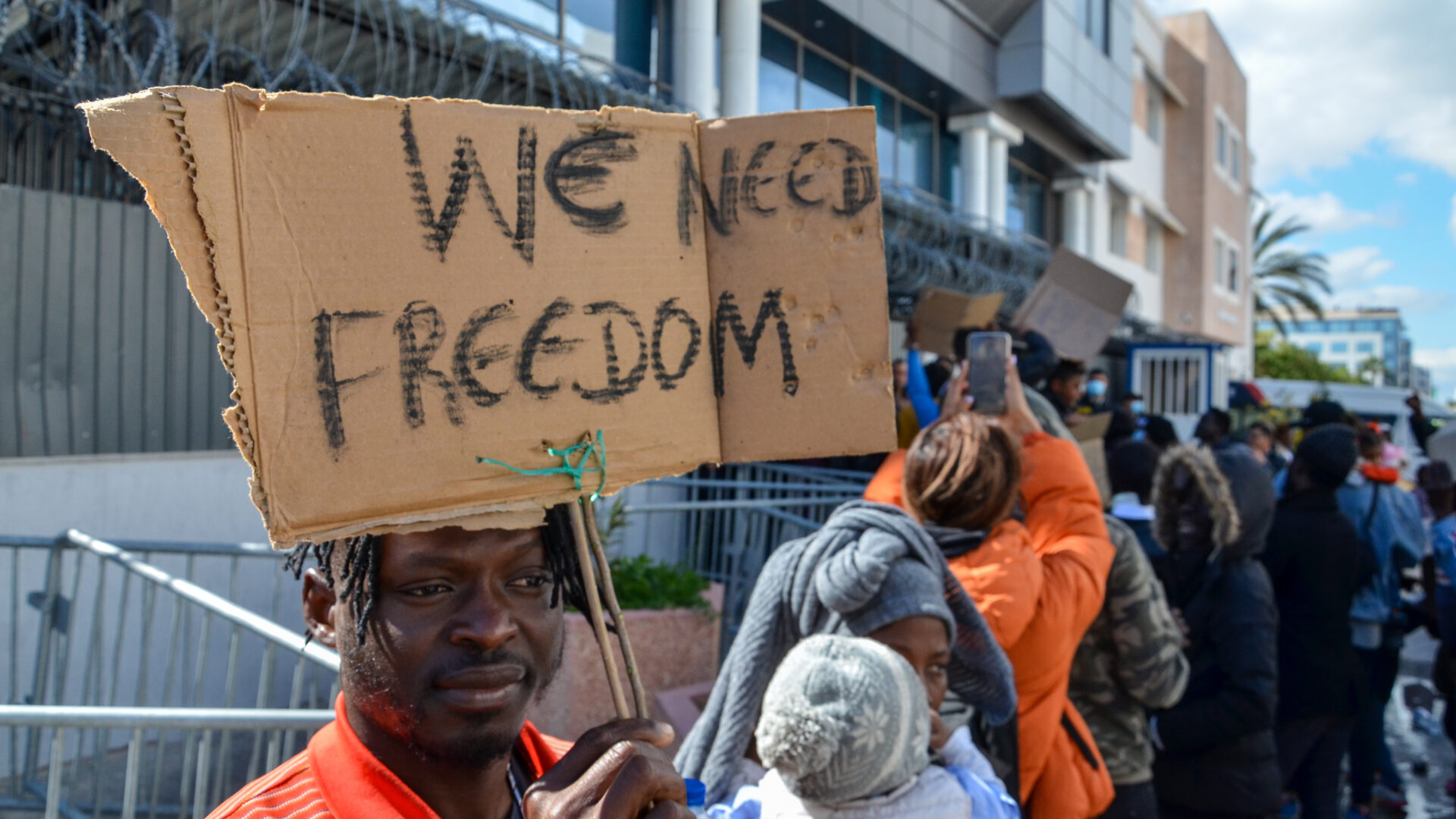
This essay argues that philanthropy has made a fundamental error: It funds programs—education, health, climate—while neglecting the freedom that makes those gains durable. Of roughly US$900 billion in annual global giving, the authors note, less than one percent flows to freedom, democracy, and civil liberties; education alone receives more than twenty-five times as much, and even animal welfare attracts more than civil liberties do. The essay reframes this not as a moral shortfall but as a market failure—freedom has been mispriced, treated as a moral preference rather than the productive infrastructure on which every other cause depends. The essay proposes treating freedom as an asset class, with tools to target risk, measure returns (“Freedom Alpha”), and allocate capital across regime types. Raising freedom funding to ten percent of giving over the next decade, the authors conclude, is not idealism but an overdue market correction—and it is up to funders to act.
Philanthropy today is adept at funding programming for specific outcomes, such as improving education or lowering carbon emissions, but it has underinvested in the systems that make those outcomes last. This limited focus reads well in an impact report, but it trains funders to optimize for what is accessible while overlooking the systemic, high-leverage investments that make every other outcome possible. This is philanthropy’s central failure.
Freedom functions as the infrastructure for everything else that philanthropy tries to accomplish. A foundation that funds education in a country where journalists face imprisonment is funding education on borrowed time, because a state that jails reporters for what they publish will not long tolerate classrooms that teach students to think for themselves. A climate initiative in a nation that debanks civil society organizations operates without the institutional foundation that makes contracts enforceable and progress durable. Philanthropies have developed sophisticated pipelines for distributing mosquito nets and measuring carbon offsets while neglecting to foster systems that allow these programs to function. At the core of any such system is liberty itself.
In the past two decades, the philanthropy sector developed tools and frameworks for measuring impacts in health, education, and climate. Mosquito nets were distributed. Children were vaccinated. Carbon emissions were reduced. These metrics created trust, attracted capital, and professionalized entire fields. Foundations competed to demonstrate measurable returns. Intermediary organizations emerged to aggregate funds and deploy them efficiently. The sector matured, staffed, and scaled, ready to absorb billions.
What these metrics did not do was improve or protect the underlying conditions that make such progress possible. Legal certainty and predictability, equality before the law, constraints on government power, protection of fundamental rights, access to justice, independent courts, free and fair elections, freedom of expression, civic associations, and financial autonomy form the infrastructure of open societies—yet they remained outside of measurement frameworks and therefore of capital flows. The result is a large blind spot for most philanthropists.
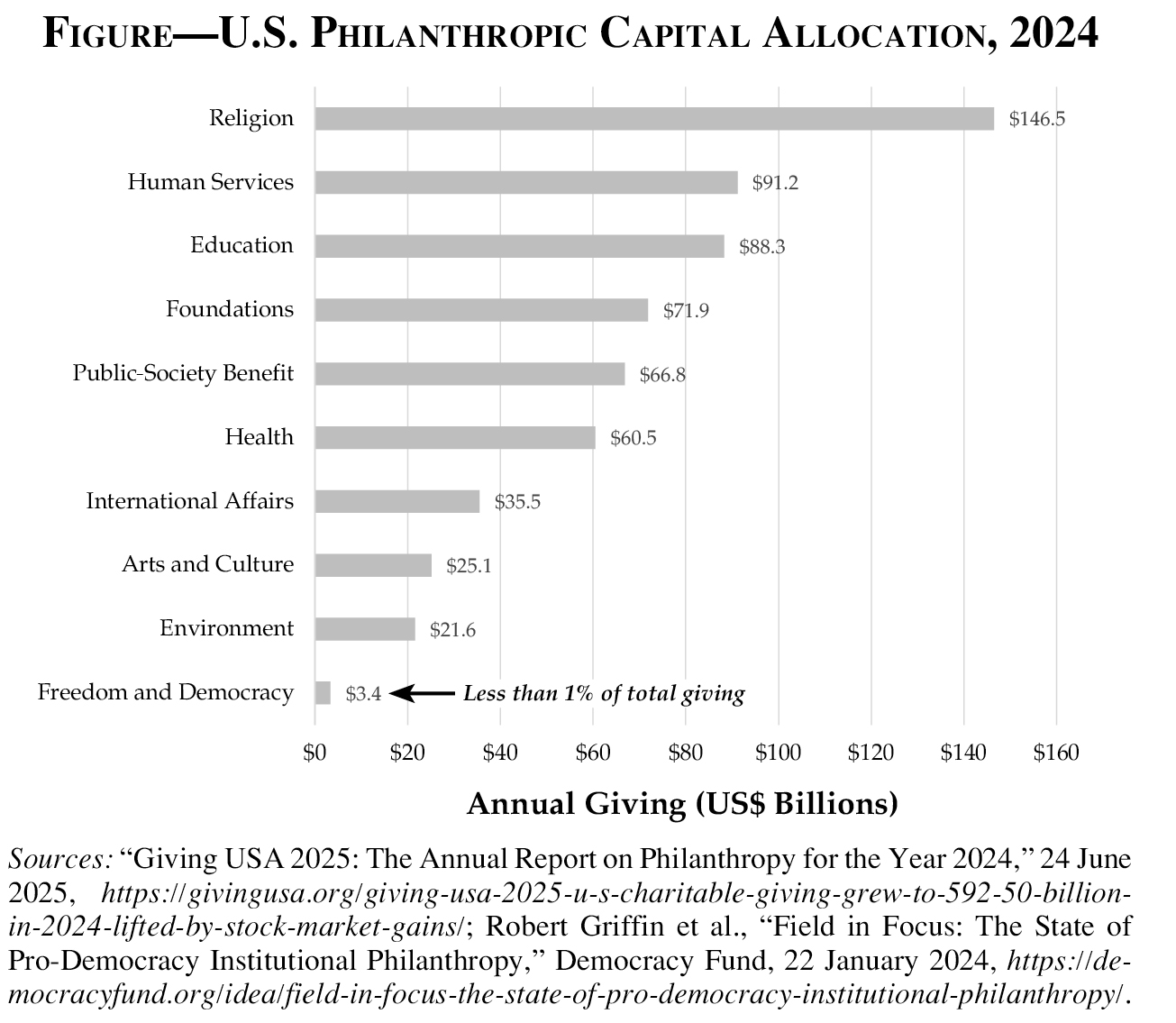
Consider the numbers. Global philanthropy deploys roughly US$900 billion annually. In 2024 in the United States alone, charitable giving exceeded $590 billion, with foundation grants accounting for $110 billion of that total.1 Of this sum, less than one percent flowed toward freedom, democracy, and civil liberties combined.2 Less than one penny of every charitable dollar defends the conditions that make all other charitable work possible. This is not a problem of funding. It is a problem of mispriced risk. Freedom has been treated as a moral preference rather than a productive asset. The result is a market failure.
Lord Acton’s formulation remains the clearest expression of the underlying error: “Liberty is not a means to a higher political end. It is itself the highest political end.” When philanthropy treats freedom as one cause among many rather than as the condition that makes all other causes viable, it has mispriced the most fundamental asset in its portfolio. To grasp the scale, consider how philanthropic capital distributes across causes. Education receives approximately $88 billion annually, more than 25 times what freedom and democracy programs receive; health initiatives receive $61 billion; and environmental causes receive up to $22 billion, dwarfing what freedom and democracy receives at roughly $3.4 billion. Even animal welfare attracts more philanthropic dollars than civil liberties.3
Each of these causes is important. But under tyranny, none can be sustainably solved. An autocrat does not care about animal welfare, access to education, or public health. Funders who care about any of these causes should also care about the political environment that either enables or undermines them all. The rise of autocracy undermines every other philanthropic investment: It is the upstream threat that makes downstream outcomes fragile.
The need for efficient capital allocation in the freedom and democracy space has never been greater. The number of autocratic states now exceeds the number of democracies, 91 versus 88, for the first time in two decades. By population, the situation is starker: 75 percent of humanity, approximately 6.1 billion people, currently live under authoritarian rule.4 Democratic backsliding affects every region. And authoritarian regimes have grown sophisticated in their methods, weaponizing financial systems to isolate, surveil, and silence domestic opposition.
The traditional response to this crisis has been government action. The United States historically provided roughly $3 billion annually in democracy assistance, accounting for a significant majority of all funding in the field. Since 2025, however, U.S. democracy programming has been frozen or eliminated, and the pipeline that sustained civil society organizations in dozens of countries is running dry. No other government has filled the gap. The United States and the EU were long the two largest funders of this aid, and since the cuts, major European countries have reduced their own aid budgets rather than expanding them.5
This creates both a crisis and an opportunity. The crisis is immediate: Organizations that depend on government grants cannot pivot overnight to private funding, networks built over decades are verging on collapse, and local partners in authoritarian countries are facing cash shortages with no clear alternatives. The opportunity is structural: Private philanthropy is not constrained by the political cycles that govern foreign-assistance budgets. It can take risks that government agencies cannot, transfer funds in jurisdictions where foreign-government support could prove counterproductive, and operate over longer periods unbound by fiscal years. Yet private philanthropy has not stepped in to fill this gap because it lacks the infrastructure to do so.
Climate philanthropy provides a striking contrast. Twenty years ago, environmental giving was fragmented, underfunded, and largely invisible in the philanthropic landscape. Today it commands nearly $5 billion annually, having nearly tripled since 2019, supported by sophisticated intermediaries, collaborative funding pools, research networks, and outcome-measurement systems that allow funders to compare interventions across portfolios.6 The climate-philanthropy sector built that infrastructure deliberately over time, and has achieved tangible outcomes. The freedom and democracy sector has no comparable ecosystem, no consensus framework for measuring impact, few vehicles for pooling philanthropic capital, and almost no intermediaries capable of deploying significant sums strategically. Critically, there is also no common language for treating freedom as an investment category rather than a sentiment.
We introduce “Freedom Philanthropy”: the intentional allocation of philanthropic capital, networks, and strategic resources toward the preservation and expansion of free societies. As a field, Freedom Philanthropy encompasses funders, those who defend and expand freedom, and the connective architecture between them. The investment model that connects them is the Freedom Accelerator. The goal is to make freedom investible,7 so that capital can flow to where it is most needed and will have the greatest impact.
Financial Repression and the Freedom Disadvantage
Modern authoritarianism is more than a common ideology; it is a strategy that serves the sole purpose of maintaining power, regardless of the economic, social, or environmental consequences. Over the last twenty years, closed regimes have developed tools for maintaining power that are cheaper, faster, and more scalable than the methods available to open societies. Freedom and democracy require long-term investment in institutions, civic education, and trust building. Authoritarians, however, can deploy financial repression whenever they choose.
Some counter-infrastructure has emerged. The Reynolds Foundation has been studying how open-source freedom technologies function both as an asset class and as operational tools for front-line activists in autocracies where banking systems have been weaponized. Bitcoin and related protocols offer a partial hedge against financial exclusion when banks become instruments of control. Organizations in Belarus, Nigeria, and Russia have used Bitcoin to receive donations after being cut off from conventional banking. Complementary tools such as Nostr, the censorship-resistant, open-protocol messaging platform, provide communication infrastructure resistant to deplat-forming.8 It should be noted, however, that the same infrastructure that enables censorship-resistant transactions can also be exploited for sanctions evasion or illicit finance.
As Friedrich Hayek asserted in The Road to Serfdom (1944), economic control is control of the means for all ends. A state that directs what is produced, who can transact, and the channels through which value flows cannot tolerate the independent civic organizations, free press, and judicial institutions that would challenge those decisions. The planning apparatus and the repression apparatus are not separate instruments; they are the same instrument deployed in sequence.9 This asymmetry favors the autocrat.
Today’s authoritarian regimes now have at their disposal a financial toolkit that enables them to deter, incapacitate, and impoverish their opponents without visible violence. With a single administrative order, they can debank dissidents and cut them off from the formal economy, restrict cross-border movements, and tighten capital controls to keep wealth inside national borders and compel compliance. Such regimes drain the opposition’s organizational capacity through asset freezes and seizures; trade in increasingly automated surveillance technologies with other autocratic regimes; and weaponize sanctions-compliance systems to turn the international financial system against civil society, pressuring banks to shut down legitimate accounts and block lawful transactions.10
Building the institutions that sustain freedom and democracy takes decades. Destroying them takes mere days. From China to Egypt to India, Nicaragua, and beyond, authoritarian governments have been hammering human-rights defenders, civil society organizations, churches, and universities—anyone deemed a threat—by freezing bank accounts and seizing assets, essentially making it impossible for them to operate. Financial repression is cheaper than violence and harder to see. That is precisely what makes it dangerous. Worse, these regimes learn from one another. What works in Moscow is studied in Cairo; what succeeds in Beijing is adapted in Managua. The speed of diffusion exceeds the capacity of democratic institutions to respond.
The cooperation among autocracies follows no ideological logic. Russian nationalists support Venezuelan socialists. Iranian theocrats partner with Chinese communists. Turkey, a NATO member, conducts sanctions-busting purchases of Venezuelan gold. The binding agent is not shared belief but an “interest-based union that seeks to foster impunity for mutual benefit.”11 China has extended $62 billion in loans to Venezuela (nearly half of all Chinese lending in Latin America) with no transparency requirements attached. Iran has pioneered false-documentation techniques to help Venezuela evade oil sanctions. And when Belarus’s stolen 2020 election triggered Western sanctions, Russia provided $1.5 billion in immediate financial support to the Lukashenka regime and stationed reserve police on standby for deployment.12
The practical architecture of this cooperation spans at least seven domains: military assistance and weapons transfers; surveillance and censorship-technology sharing; sanctions-evasion mechanisms; kleptocratic financial networks that shelter stolen assets; transnational repression; diplomatic mutual protection in international forums; and coordinated disinformation campaigns.13 Critically, this assistance flows rapidly to wherever it is most needed. Democratic coordination, by contrast, requires consensus-building, legislative approval, and public justification—processes measured in months or years rather than days.
The capital efficiency of authoritarianism is stark. Financial repression requires no standing army, no mass imprisonment, no visible repression, only control of payments infrastructure. A regime that masters this can suppress dissent at minimal cost while maintaining a facade of legitimacy for international investors—though what autocrats save with cheap financial repression, their economies pay in the accumulated friction of institutional uncertainty.
Open societies operate under opposite conditions. Building the institutions that sustain freedom and democracy—independent courts, a free press, civil society organizations, financial systems that serve rather than surveil citizens—requires decades of investment. These institutions generate diffuse benefits that are difficult to measure and impossible to attribute to any single funder. They require maintenance even when they appear to be working, because their erosion is invisible until collapse becomes imminent. This asymmetry creates a structural advantage for autocracy. The authoritarian playbook scales horizontally, from one regime to another, and vertically, from targeting leaders to ordinary citizens. The democratic response does not scale easily. It depends on institutions that must be built locally and that require patient capital with tolerance for ambiguous outcomes.
Authoritarian coordination is observable, the mechanisms documented, the results measurable. Whether democratic institutions will adapt their own coordination mechanisms in response remains the open question. Philanthropy has largely failed to recognize this asymmetry. The hardest cases, where dissidents are being systematically debanked, where journalists are being starved of resources, where civil society is being strangled financially, receive a fraction of available funds. Funders are not indifferent, but they lack the awareness and tools to engage. That can change.
The Freedom Accelerator Model
If authoritarianism operates as an efficient machine for consolidating control, defending freedom requires an equally deliberate architecture for building capacity. Traditional grantmaking, which is reactive, siloed, and episodic, cannot meet this challenge. We need a model that encompasses both what must be strengthened and how to do it.
What must be strengthened is a “freedom infrastructure” that comprises three interdependent layers that sustain open societies: civic institutions, which provide what Tocqueville called “the art of association”—the organizational capacity through which citizens hold power accountable, resist centralization, and coordinate independent of the state; financial autonomy, which provides the material foundation for civic activity—that is, the ability to receive funds, store value, and transact outside state-controlled systems; and independent information, which sustains the flows of knowledge that allow citizens to make informed decisions—independent journalism, encrypted communications, and the technical infrastructure that enables information to move freely. Each layer reinforces the others, and weakness in any one creates cascading vulnerabilities across the system.
How we strengthen this freedom infrastructure is through the Freedom Accelerator investment model, which, in the words of the Reynolds Foundation’s founder Tim Reynolds, supports “leaders who build projects, and projects that grow into organizations.” The Reynolds Foundation’s Freedom Accelerator is a deployment map: a curated, integrated portfolio of leaders, projects, and institutions working across all three layers, so that new funders and philanthropists know where to invest and how to move the needle of freedom.
Traditional democracy assistance has focused heavily on civic institutions. These are structurally important, and yet civic capacity alone is insufficient. Organizations that depend on bank accounts can be debanked; leaders who require salaries can be impoverished; movements that communicate through surveillance-accessible channels can be preempted. Civic capacity without financial autonomy is civic capacity on borrowed time.
Yet traditional philanthropy has largely neglected financial autonomy. Most funders assume that money will flow to legitimate recipients through normal channels. Yet when regimes weaponize banking, activists need alternative payment rails, some means of censorship-resistant payment transfers, and remittance networks outside state banking systems if they are to continue operating.
Independent information, meanwhile, is under global assault. State propaganda, automated social-media accounts, and the hacking of journalists’ accounts all distort public debate. Without independent information, accountability fails. Moreover, information asymmetry imposes costs that extend well beyond politics. When citizens cannot distinguish propaganda from reporting, when investors cannot verify claims about governance, when trading partners cannot assess counterparty risk, the result is a tax on every transaction—paid in the form of additional verification, hedging, and insurance against uncertainty. Reducing that asymmetry generates returns that flow through civic, financial, and commercial channels simultaneously.
These three layers form a system in which each element enables and protects the others. Historical evidence supports an integrated approach. Serbia’s Otpor movement, for example, combined civic mobilization with a sophisticated communications strategy and financial support from multiple international sources to oust the country’s dictator, Slobodan Milošević, in 2000. Otpor later exported its model to Georgia and Ukraine. But a grant to a civic organization that lacks financial autonomy is a grant on borrowed time; a payment-rail innovation that civic organizations cannot use remains a technical curiosity; and media funding without distribution infrastructure produces journalism that no one can read. Effective freedom and democracy philanthropy must integrate all three layers.
Consider, for example, an organization in Venezuela that runs a coordinated, multilayered operation: strategic coaching for leaders in exile, backed by a knowledge network spanning leading research universities; digital-information campaigns that reach inside Venezuela through channels the regime cannot freeze; and direct support to families of political prisoners, keeping civic infrastructure alive at the ground level. A networked portfolio of resistance applies the same logic in reverse: connecting leaders, data, technology, and strategy so that what works in one country accelerates freedom in the next. No single layer is sufficient; each enables the others.
To date, traditional philanthropy has been largely reactive, funding existing organizations, responding to crises as they emerge, and evaluating success through short-term outputs. The accelerator approach is preventive and inverts this logic: identifying gaps in infrastructure, building resilience before crises occur, evaluating systemic capacity rather than short-term outputs. This requires funders willing to take coordinated positions across all three layers, hold investments over longer time horizons, and accept that many interventions will produce no measurable short-term return. But preventive investment is always cheaper than reconstruction.
The strategic implication for philanthropic capital is direct. If AI, for example, structurally favors state power over civil society, as the evidence suggests, then every year of philanthropic underfunding compounds the asymmetry. Authoritarian regimes incorporate AI into their repression toolkit yet civil society organizations lack the resources to deploy comparable capabilities defensively. The philosophical and operational architecture of these technologies, their design, financing, and relationship to the classical liberal tradition of individual liberty and voluntary exchange, warrants dedicated examination. This framework is in formation. What the evidence already supports is simpler: Every year that civil society lacks the tools its adversaries possess, it is at an even greater disadvantage. That gap can be closed. But doing so requires sustained philanthropic attention and patient capital.
Efforts are underway to build the technical infrastructure for civil society operating in hostile environments, including open financial rails, censorship-resistant communications, and permissionless AI (that is, open-source and decentralized).14 For example, the Human Rights Foundation has pioneered financial-autonomy interventions that connect dissidents with censorship-resistant payment tools and training; the Oslo Freedom Forum brings together global activists, journalists, and potential partners; and the Reynolds and Demo Lab Foundations host annual gatherings that bring together activists, academics, and technologists with the principals of family offices (private organizations that manage the financial and philanthropic affairs of high-net-worth families) to raise capital for freedom and democracy projects.15 These examples remain exceptions rather than the norm. Changing that will require not only more capital, but capital deployed with greater intentionality: knowing where the gaps are and which interventions are most likely to hold. The Freedom Accelerator is that map. Funders enter through the door that fits their mandate, their risk appetite, and their values—and because the map is shared across the ecosystem, the coverage will compound.
Freedom Alpha
In finance, investors use a simple concept to evaluate performance: alpha—that is, the value a portfolio generates beyond what the underlying market provides. A positive alpha means that an investment outperformed its benchmark. The philanthropic analog is return on grants, or what I call “Freedom Alpha”—the societal returns generated by strategic investments in freedom, democracy, civil liberties, and human rights that coordinated philanthropic efforts generate beyond what passive conditions would produce.
In the simplest formulation, Freedom Alpha equals the observed democratic outcome after a philanthropic intervention minus the expected counterfactual trajectory. The counterfactual is the likeliest path for freedom and democracy absent that intervention, adjusted for regional trends, regime type, and systemic shocks. Outcomes are measured through the observable condition of freedom as it manifests through institutional, civic, and individual dimensions (such as judicial independence, electoral competitiveness, and civil society operating space), while taking into account other key factors and contexts. For example, a country experiencing democratic backsliding might show declining freedom scores, but a philanthropic intervention that slowed that decline would still have generated positive Freedom Alpha.
The concept is deliberately borrowed from finance because the vocabulary of investment (returns, risk, diversification, allocation) provides discipline that philanthropy, in this space, has lacked. When funders think about mosquito nets or carbon offsets, they have metrics that allow comparison. Freedom and democracy have no equivalent framework—hence, Freedom Alpha.
Understanding philanthropic impact in freedom and democracy work requires grappling with counterfactuals. Interventions may transform conditions, accelerate positive trajectories, stabilize against decline, or slow deterioration.16 The essential point is that most freedom and democracy investments prevent decline rather than produce visible improvement. A civil-liberties organization in a country that has maintained the same democracy score for a decade in a backsliding region has helped to hold ground that may otherwise have been lost. Standard impact metrics systematically undervalue this work.
For family offices and funders familiar with portfolio management, the counterfactual challenge resembles benchmark selection—comparing actual returns not against zero, but against what a passive approach would have delivered given the same conditions. In Freedom Philanthropy, we ask whether conditions improved relative to regional dynamics and peer-country trajectories. We can measure judicial independence by executive interference in court rulings; electoral competitiveness by margin of victory and opposition-participation rates; civil society operating space by legal environment, registration requirements, and funding restrictions; financial repression by account seizures, debanking incidents, and currency controls; and forced exile by the number of journalists, activists, and political figures compelled to flee.
The various democracy indexes—in particular, those of the V-Dem Institute, Freedom House, and the Economist Intelligence Unit—along with expert-assessment tools such as the Human Rights Foundation’s Tyranny Tracker offer funders quantitative and qualitative evaluations of political freedom across countries, helping to identify where freedom is most at risk.
This empirical foundation for Freedom Alpha helps to identify its most important constraints: institutions and ideas. In 2024, Daron Acemoglu, Simon Johnson, and James Robinson won the Nobel Prize in Economics for demonstrating the causal role of institutions in long-term economic performance.17 The mechanism operates through trust. Institutions that function predictably allow parties to transact with less verification, less hedging, and fewer intermediaries extracting fees for bearing uncertainty. In high-trust environments, contracts grow simpler, litigation rates decline, and capital flows more readily to productive uses. When institutions erode, the costs cascade through every layer of economic activity; each additional basis point of risk premium that investors demand in institutionally weak environments represents accumulated friction that compounds over time.
Strong institutions must be accompanied by two additional elements rooted in classical liberal thinking—namely, individual liberty and voluntary exchange (where all parties engaging in market transactions are willing participants standing to benefit). And finally, as the work of Fried-rich Hayek and, more recently, William Easterly emphasize, to have the best chance of producing intended outcomes, institutional reform should be driven by local demands and preferences rather than external organizations’ predetermined institutional designs. Institutions matter, ideas about liberty shape whether institutional reform succeeds, and the process by which reform occurs, through indigenous demand rather than external prescription, determines durability: Together, these three pillars define the intellectual architecture of Freedom Alpha. A measurement framework that ignores any one of the three pillars risks systematically mismeasuring what makes freedom investments generate lasting returns.18
There are also three key challenges that Freedom Alpha must address. The first concerns time horizon. Freedom investments mature on radically different timescales. A university economics program may take a decade or two to produce graduates who reshape policy, while a targeted campaign against an unjust law may succeed within months. Any common metric that fails to account for this asynchrony risks systematically disadvantaging long-horizon investments, which are precisely the infrastructure investments that generate the most durable freedom. Freedom Alpha must tolerate, and indeed reward, the patience such investments require, using contribution analysis rather than short-term outcomes as its evidentiary standard.
The second is attribution. Some interventions succeed not because of program design but because of an exceptional social entrepreneur: a civil society leader whose networks, credibility, and judgment constitute the real asset. Mistaking the leader for the model produces the wrong lesson, and building replicable programs around exceptional individuals overstates scalability. This poses a genuine structural constraint that Freedom Alpha must acknowledge rather than paper over. People, not programs, are often the binding constraint on outcomes.
The third is capital-allocation geography. A portfolio focused exclusively on contexts under acute authoritarian pressure risks neglecting equally important work: preventing backsliding in fragile democracies and consolidating gains in emerging ones. Freedom Philanthropy is not emergency relief. This portfolio logic implies a full spectrum: Do not lose ground where freedom exists; enable bold experiments in fragile or transitional contexts where the trajectory is not yet determined; and normalize freedom as the background expectation in societies that have achieved stable democratic institutions.
These three challenges imply different philanthropic instruments, different time horizons, and different tolerance for risk. Preservation operates defensively, experimentation accepts higher failure rates in exchange for disproportionate potential returns, and normalization works through institutional maintenance and civic culture rather than emergency response.
The Reynolds Foundation, for example, proposes a portfolio approach with differentiated risk and return profiles across these three tiers: front-line autocracies (China or Russia, for example), transitional states (such as Georgia or Colombia), and durable infrastructure (independent research institutions, think tanks, leadership-development networks, and the like). When interventions succeed in fully authoritarian contexts, they shift national trajectories; returns are disproportionate because the counterfactual is severe decline. Preventive investment, however, is always cheaper than reconstruction. Thus interventions that stabilize eroding democracies generate returns that compound against backsliding trajectories. Finally, investments in durable infrastructure compound quietly over decades, producing the ideas and leaders who sustain freedom across political cycles.
A portfolio weighted entirely toward front-line autocracies optimizes for impact but accepts high failure rates; one anchored in durable infrastructure generates structural returns but leaves the acute frontier underfunded. Effective Freedom Philanthropy holds all three tiers simultaneously. Thus the value of Freedom Alpha lies not in measurement alone but in allocation. Once funders can estimate expected returns from different interventions, they can make informed decisions about where to deploy capital—diversifying across intervention types, geographies, and time horizons; balancing high-risk, high-return investments against more reliable but incremental improvements; and learning systematically from both successes and failures.
Why Family Offices Matter Now
The largest transfer of wealth in human history is underway. Over the next two decades, an estimated $124 trillion will pass from one generation to the next.19 A significant portion of this wealth is concentrated in family offices (private organizations that manage the financial and philanthropic affairs of high-net-worth families). These entities represent the most underdeveloped source of capital for freedom and democracy work.
Globally, between eight- and ten-thousand single-family offices manage more than $3.1 trillion in combined assets (projected to reach $5.4 trillion by 2030).20 While 75 percent of North American family offices engage in philanthropy, with average donations of $10 million, almost none direct significant capital toward supporting freedom, democracy, civil liberties, or human rights. Family offices are characterized by operational informality: Only 56 percent have an investment committee, and only 44 percent have a documented investment process.21 This creates opportunity rather than weakness. Decisionmaking is concentrated, and a principal can conclude a funding decision after a single meeting (compared to the months or years required by institutional foundations).
Family offices operate under different constraints than do institutional foundations or government agencies, and these differences create structural advantages for the long-horizon, high-uncertainty investments that freedom work requires. Family offices possess genuine patience that institutional funders lack. Unlike foundations bound by 5 percent payout rules or government agencies constrained by annual appropriations, family offices can allocate capital over generational time horizons. Freedom investments compound slowly; institutional improvements take decades to manifest. Family offices can wait. Accountable only to the family, they also tolerate risk that institutional funders cannot absorb. And they can operate quietly, reaching grantees in contexts where government assistance would endanger recipients. The asset class matches the capital structure: Freedom requires patient money, and family offices have patience to spare.
Importantly, the generational transfer of wealth now underway is not merely a transfer of assets but also a transfer of decisionmaking to heirs with different priorities. Next-generation donors are twice as likely to support climate and social-justice: 70 percent say that impact reporting motivates increased giving, and 76 percent want to carve their own path in philanthropy.22 Freedom and democracy align naturally with these preferences. The logic that made environmental and governance factors investible was not moral persuasion but risk identification, and the same logic applies to freedom. A solar installation in a country where contracts prove unenforceable faces political risk that no amount of technical due diligence can mitigate. A social enterprise operating where the government debanks civil society organizations functions on borrowed time regardless of its business merits. Every investment decision already contains an implicit answer to the question of whether the underlying institutional environment will support the expected returns. Making that question explicit (assessing whether an allocation depends upon institutional quality) does not introduce a new constraint. It surfaces a risk that was always present, one that traditional frameworks systematically underweight.
Several obstacles prevent family offices from entering freedom and democracy philanthropy. Legal restrictions on political activity create uncertainty about permissible engagement. Reputational concerns deter families from visible association with politically sensitive causes. And measurement challenges leave potential funders unable to evaluate interventions or compare outcomes across organizations.
Each barrier has corresponding solutions, however. For example, hybrid business structures such as limited liability companies (LLCs) allow flexibility that pure nonprofit status cannot offer. A philanthropic organization that is set up as an LLC rather than a private foundation can make political donations, fund ballot initiatives, invest in for-profit companies pursuing social objectives, and engage in advocacy without the legal restrictions that govern nonprofits. For family offices already operating LLCs for investment purposes, this model offers a natural template: Preserve the philanthropic mission while recovering the operational flexibility that nonprofit law restricts. Another barrier could be potential controversy. Pooled funds, however, offer a solution by aggregating capital across multiple funders, thereby providing donors both anonymity and validation through peer participation.
Family offices are structurally suited to fund freedom work, but the field lacks the connective infrastructure to absorb their capital at scale. Seventy-four pooled funds for democracy-related work now exist nationally, half launched since 2016. The ecosystem remains fragmented, however, and minimal in scale.23
Patient capital does not mean indefinite capital. Even long-horizon investments require milestones that define progress and, eventually, exit conditions. As countries approach critical thresholds, the nature and intensity of required investment shift. Context-specific indicators provide practical benchmarks: free and fair elections contested by a genuine opposition; judicial independence demonstrated under political pressure; freedom of expression normalized and journalism operating without systematic threat; civil society registering and operating without prohibitive legal barriers; financial systems processing civil society transactions without politically motivated interference. As these conditions are met over time, the portfolio will move from funding defensive preservation toward consolidating the durable infrastructure that makes freedom self-sustaining without external capital. This is the exit condition family offices deserve to understand before they invest—not the elimination of all threats to freedom, but the creation of self-sustaining institutional resilience.
A Call to Reprice the Market
Freedom is mispriced. The philanthropic sector has developed sophisticated mechanisms for valuing interventions in health, education, and climate: mechanisms that direct hundreds of billions of dollars toward causes whose impact can be measured and compared. Freedom, democracy, civil liberties, and human rights have no equivalent mechanisms. As a result, capital flows elsewhere.
The case for investing in freedom rests on a recognition of interdependence that extends beyond any single jurisdiction or asset class. As Tim Reynolds frames it, “Without liberty, no markets. Without markets, no wealth creation. Without wealth creation, no liberty.” Without functioning institutions that protect voluntary exchange, markets devolve into patronage networks and extraction schemes. Without markets that generate surplus and reward productive activity, wealth creation stalls and economies become zero-sum competitions for existing resources. Without the material foundation that wealth creation provides, liberty remains an abstraction that citizens cannot afford to defend. The cycle runs in both directions: Expand institutional quality and the conditions for prosperity improve; allow institutions to erode and the prosperity that depended on them erodes as well.24
This is why freedom work differs from conventional philanthropy. The organizations that defend civil liberties, the journalists who investigate corruption, the lawyers who litigate for due process are not charity cases. They are infrastructure. Investment in their work produces returns that compound across generations and flow through channels that no single funder can claim credit for or measure directly.
The Freedom Alpha framework is the conceptual scaffolding. Converting it into operational infrastructure requires investment across two fronts. The first is research and intermediation. Systematic research must develop measurement approaches tailored to philanthropic decisionmaking that build on existing knowledge infrastructure and frameworks. Family offices need intermediary partners who can perform due diligence, deploy capital, and aggregate learning across portfolios. The second is collaboration and narrative development. Collaborative infrastructure (funder networks, pooled investment vehicles, shared evaluation frameworks) would multiply existing capital while attracting new entrants. Freedom work suffers from a vocabulary problem. As Churchill demonstrated through a career spent persuading free peoples to act in their own defense: Language mobilizes. Language wins wars. And language can move capital. Developing a shared vocabulary that treats returns, risk, and diversification as operational concepts is prerequisite to mobilizing capital at scale.
The philanthropic interest in freedom work exists, but the connective tissue—mechanisms for rigorous impact measurement, collaborative networks bridging institutional and individual funders, and access to professional talent capable of managing complex, multiyear portfolios—needs to be stronger. Thus we need to build a coherent Freedom Philanthropy infrastructure that includes: 1) data and diagnostic tools for tracking regime trajectories and identifying where freedom is most at risk; 2) a global research network that generates the independent data and counter-factual analysis that strategic allocation demands; 3) trusted intermediaries, that is, organizations with the field credibility, legal standing, and operational networks to deploy capital on the front lines; 4) AI and freedom technology that will detect authoritarian risk early, price it accurately, and coordinate capital faster than regimes can consolidate control, as well as open-source tools that activists can use without corporate or state intermediaries; 5) a diversified front-line portfolio comprising organizations operating in the most restricted countries and combining civic, financial, and informational interventions; and, finally, 6) next-generation leaders who are movement builders and freedom advocates who will steward this capital over the generational time horizon that freedom work requires.
Building this infrastructure would cost roughly $5 billion in additional annual funding.25 Climate philanthropy reached nearly $5 billion through deliberate field building. Of the $124 trillion that is or will soon be passed to a new generation of principals, some $12 trillion is expected to flow into philanthropy. Capturing even a small fraction of that for freedom work would transform the field.
The global decline of freedom and democracy is a generational problem that will not be reversed by emergency interventions. The appropriate frame is infrastructure investment—building capacity to sustain freedom work over decades, through political cycles and across regime types. The portfolio logic holds here: Preserve what exists, experiment where trajectories are open, and normalize freedom as the background expectation in stable democracies. Each level requires different instruments, different time horizons, and different levels of tolerance for failure. From this, we can derive four keys to freedom investment: data on where freedom is most at risk (from assessments such as V-Dem and the Tyranny Tracker); a way to measure how well grants are working (Freedom Alpha); a framework for deploying capital across the different risk tiers (the Freedom Accelerator model); and cutting-edge technology that activists can use to carry out their work and to evade authoritarian attacks. No single pillar is sufficient, but together they constitute an investment thesis for freedom as an asset class.
An Invitation
For funders already engaged, the Freedom-Alpha framework offers a vocabulary for describing returns the sector has lacked the language to articulate. For funders considering entry, it offers a structure for allocation. For researchers, it identifies questions about counterfactuals and attribution that scholarship could help to answer. And for practitioners—the civil society organizations, journalists, and human-rights defenders doing the work—it offers a reframing. They are not supplicants requesting charitable support. They are the backbone of open societies, and investing in their capacity generates returns that compound over generations. This framework invites refinement. The field needs more capital, better intermediaries, and systematic learning from both successes and failures.
The window is now. Proof of concept exists, and an emerging network of freedom-first family offices suggests that momentum is building. The massive wealth transfer that is transpiring will reshape philanthropic priorities. Next-generation principals are looking for impact and causes that align with their values. Freedom and democracy work, as institutional infrastructure rather than partisan advocacy, meet these criteria.
Freedom has long been mispriced, but the correction has begun. Today less than one percent of global philanthropy reaches freedom and democracy. Raising that figure to 10 percent over the next decade is not idealism—it is a market correction. What happens next, and how quickly, is up to the funders to decide. 
NOTES
1. “Giving USA 2025: The Annual Report on Philanthropy for the Year 2024,” 24 June 2025, https://givingusa.org/giving-usa-2025-u-s-charitable-giving-grew-to-592-50-billion-in-2024-lifted-by-stock-market-gains/.
2. Robert Griffin et al., “Field in Focus: The State of Pro-Democracy Institutional Philanthropy,” Democracy Fund, 22 January 2024, https://democracyfund.org/idea/field-in-focus-the-state-of-pro-democracy-institutional-philanthropy/.
3. On education, health, and environmental funding, see “Giving USA 2025.” On animal-welfare funding, see Griffin et al., “Field in Focus.”
4. Marina Nord et al., “Democracy Report 2024: Winning and Losing at the Ballot,” V-Dem Institute, University of Gothenburg (March 2024), 6.
5. Congressional Research Service, “State, Foreign Operations, and Related Programs: FY2024 Appropriations,” 2024; Thomas Carothers, “Does U.S. Democracy Aid Have a Future?” Carnegie Endowment for International Peace, 3 March 2025, https://carnegieendowment.org/research/2025/03/does-us-democracy-aid-have-a-future; OECD, “Official Development Assistance by Regime Context (2010–19),” OECD Development Policy Papers, No. 44 (2022), 52. On the post-2025 European reductions, see Elena Viudes Egea et al., “European Democracy Support Annual Review 2025,” ed. Richard Youngs, Carnegie Europe Paper, 17 February 2026; and OECD 2025 ODA data.
6. ClimateWorks Foundation, “Climate Giving Surges 20% in 2023, Outpaces Growth in Global Philanthropy,” press release, 10 December 2024. See also Narine Esmaeili et al., “Funding Trends 2024: Climate Change Mitigation Philanthropy,” ClimateWorks Foundation, https://www.climateworks.org/report/funding-trends-2024/.
7. The concept of “making freedom investible” was developed at the 2025 BLISS Summit by Álvaro Salas Castro, Tim Reynolds, and Damon Wilson to describe the project of treating freedom as an asset class: a domain of philanthropic investment with measurable returns, comparable interventions, and portfolio logic, analogous to how climate became investible through the development of carbon markets and ESG frameworks. By “investible” we mean structured, measurable, comparable, and portfolio-managed, not financially remunerative. Freedom Philanthropy seeks civic and institutional returns, not monetary ones.
8. Alex Gladstein, Check Your Financial Privilege: Inside the Global Bitcoin Revolution (Nashville, Tenn.: Bitcoin Magazine Books, 2022).
9. See Friedrich A. Hayek, The Road to Serfdom (Chicago: University of Chicago Press, 1944), part 2; Hayek, “The Use of Knowledge in Society,” American Economic Review 35 (September 1945): 519–30; and Hayek, The Constitution of Liberty (Chicago: University of Chicago Press, 1960).
10. Alex Gladstein, “How to Dictator-Proof Your Money,” Journal of Democracy, April 2024, www.journalofdemocracy.org/online-exclusive/how-to-dictator-proof-your-money/.
11. See Leopoldo López, “Challenging Autocracy from the Front Lines” (Washington, D.C.: Woodrow Wilson International Center for Scholars, July 2023), https://www.wilsoncenter.org/publication/challenging-autocracy-front-lines.
12. Anne Applebaum, Autocracy, Inc.: The Dictators Who Want to Run the World (New York: Doubleday, 2024), 187.
13. Applebaum, Autocracy, Inc., 187.
14. Alex Gladstein, “Why Bitcoin Is Freedom Money,” Journal of Democracy 36 (October 2025): 34.
15. Together, the four BLISS Summits from 2023 to 2026, attended by more than a hundred participants per gathering, have mobilized approximately $100 million; see www.demolabcr.org/blisssummit.
16. Liz Ruedy, “Six Models for Understanding Impact,” Democracy Fund, 2018, https://democracyfund.org/idea/six-models-for-understanding-impact/; the framework identifies six distinct models: transformative, proactive, opportunistic, stabilizing, preventative, and palliative. See also John Mayne, “Contribution Analysis: An Approach to Exploring Cause and Effect,” ILAC Brief 16 May 2008, https://doi.org/10.22004/ag.econ.52525.
17. Nobel Prize Institute, “They Have Helped Us Understand Differences in Prosperity Between Nations,” press release, 14 October 2024, www.nobelprize.org/prizes/economic-sciences/2024/press-release; see also Daron Acemoglu et al., “Democracy Does Cause Growth,” Journal of Political Economy 127 (February 2019): 47–100.
18. Daron Acemoglu and James Robinson, Why Nations Fail: The Origins of Power, Prosperity, and Poverty (New York: Currency, 2012); Deirdre McCloskey, Bourgeois Equality: How Ideas, Not Capital or Institutions, Enriched the World (Chicago: University of Chicago Press, 2016); and William Easterly, The Tyranny of Experts: Economists, Dictators, and the Forgotten Rights of the Poor (New York: Basic Books, 2014).
19. Cerulli Associates, “Cerulli Anticipates $124 Trillion in Wealth Will Transfer Through 2048,” 5 December 2024, www.cerulli.com/press-releases/cerulli-anticipates-124-trillion-in-wealth-will-transfer-through-2048/.
20. Deloitte Private, “Defining the Family Office Landscape, 2024,” The Family Office Insights Series—Global Edition, www.deloitte.com/nl/en/services/deloitte-private/about/defining-the-family-office-landscape.html.
21. UBS Global, “Global Family Office Report 2024,” www.ubs.com/global/en/family-office-uhnw/reports/global-family-office-report-2024.html.
22. Robert Frank, “Wealthy Millennials and Gen Z Are Redefining Philanthropy,” CNBC, 10 October 2024, https://www.cnbc.com/2024/10/10/wealthy-millennials-gen-z-are-redefining-philanthropy-.html; Blackbaud Institute, “Gen Z at the Table: A Special Edition of the Next Generation of Giving,” May 2024, https://investor.blackbaud.com/news-releases/news-release-details/new-report-illuminates-gen-z-philanthropic-giving-behavior; “2022 Bank of America Private Bank Study of Wealthy Americans: The Impact of Shifting Generational Attitudes amid an Historic Wealth Transfer,” 15, available at https://www.scribd.com/document/795685100/2022-BofaA-Private-Bank-Study-of-Wealthy-Americans/.
23. Griffin et al., “Field in Focus.”
24. Hayek, Road to Serfdom, introduction.
25. This estimate derives from the author’s conversations, research, and interviews with leaders in the freedom and democracy space.